

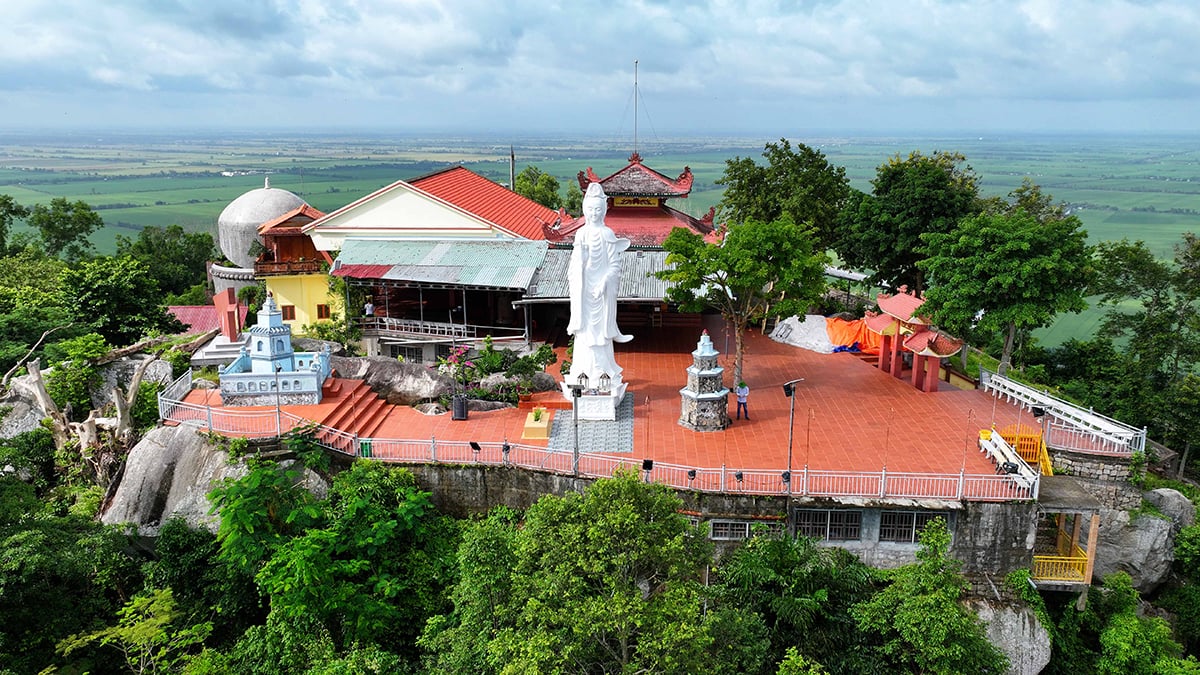
Son Tien Pagoda stands majestically atop Ba The Mountain.
Hidden within mysterious legends
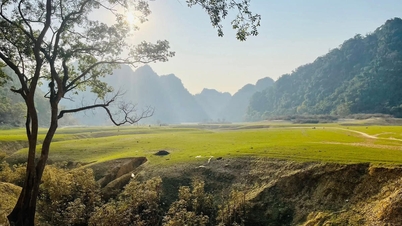
One weekend, we had the opportunity to explore the "ancient land" of Oc Eo. From the foot of the mountain, we followed the concrete road all the way to the summit of Ba The. Having left early in the morning, the mountaintop was sparsely populated, with only occasional glimpses of tourists' vehicles descending the slope. After a few dozen minutes, our motorbike finally reached the summit. Stepping into Son Tien Temple, we found the atmosphere incredibly peaceful and serene. The temple stood majestically amidst the sky, bathed in cool mist. Sitting on a stone bench, breathing in the fresh air, we felt a sense of peace. In front of the temple stood a statue of Avalokiteshvara Bodhisattva, its benevolent face reminding all beings to embrace compassion and benevolence. From the mountaintop, we looked down at the lush green rice fields under the golden sun, resembling a picturesque and prosperous countryside scene.
In the distance are the sea of Ha Tien and Ba Hon ( Kien Giang province). According to archaeologists, the Ba The area was once a sea. Due to the passage of time and the changes of nature, the sea has "receded," giving way to the land and mountains that exist today. To the southwest lies the majestic That Son mountain range. A volunteer at Son Tien Temple said that this temple is presided over by Venerable Thich Bao Sieu. Previously, Son Tien Temple (San Tien, Chan Tien) was founded by Venerable Thich Hue Sanh for his secluded practice. In those days, it was just a thatched hut built with great effort by Venerable Hue Sanh. Later, a road was built all the way to the summit, and the temple transported water and purchased building materials to renovate and beautify the temple.
Walking around Son Tien Pagoda, we also saw several four-sided towers, a unique architectural style remaining from the Oc Eo culture. Next to Son Tien Pagoda is a large rock, seemingly placed there by the hand of a divine being. Beside the rock is a staircase for visitors to easily climb up and admire the view. Strangely, on the surface of the rock is a deep indentation, shaped over centuries, resembling a left foot, which locals call the "Footprint of the Immortals." Many visitors to Son Tien Pagoda climb the rock to try and fit their left foot into it. When asked about the legend of this footprint, most locals say that perhaps, in the beginning of time, immortals came here to play and left their footprints on the rock, preserving them for eternity.
The mountain is often struck by lightning during rain.
Ba Thê Mountain remains quite wild and melancholic, harboring many old stories and legends. Continuing our tour around the mountain, we arrived at Chơn Thiện Cave and met a lay Buddhist practitioner at this spiritual site, chatting with tourists. Looking up, we saw a massive rock weighing hundreds of tons resting on another large rock, forming a large cave. The lay Buddhist recounted that a nun from another province had lived in seclusion in the cave for over 10 years before passing away. Afterward, he took over, offering incense and practicing asceticism there until now. On major full moon days, holidays, and festivals throughout the year, the cave attracts a considerable number of visitors.
When asked about the legend of Ba Thê Mountain, many people say that long ago, a man went up the mountain to practice asceticism. Because he hadn't yet shed his worldly attachments, every evening he would go to the top of the mountain, gaze into the distance, and remember his three wives. After his death, he turned into stone, forming the "Wife-Viewing Rock," which the locals later named Ba Thê Mountain. Further along, you'll encounter a large rock lying near the path up the mountain, which locals call "Ông Địa's Belly." Climbing further down the path towards Ông Tà peak, the first thing you'll see is a giant stone sword, built by the locals with a canopy to protect it from rain and sun. The locals have given it a name exactly like in martial arts films: "The Great Stone Sword."
Locals recount that during heavy rain and thunderstorms, thunder and lightning frequently rumbled on the mountaintop. Some believe that in ancient times, Ba Thê Mountain contained a lot of iron mixed in its rocks, so when it rained, the mountaintop was often struck by lightning in many places. Therefore, few people dared to go up the mountain during rain and thunderstorms. Later, people discovered a rock split into a piece resembling a sword. Seeing this, the locals erected it to worship. However, after another rainstorm, the sword was struck by lightning and fell, and the locals, frightened, used levers to push it down into the ravine. Later, when nature became less harsh, the locals used pulleys to retrieve the large stone sword and erected it on the mountaintop, building a shrine to worship it…
Today, Ba The Mountain looks like a landscape painting, evoking a nostalgic feeling of a bygone era, reminiscent of the time when the mountains were first settled. Standing on the mountaintop and gazing into the distance, visitors forget the worries and anxieties of life, their souls becoming more serene...
Ba Thê Mountain, also known as Vọng Thê Mountain or Hoa Thê Sơn, is one of five mountains in the Ba Thê mountain range in Thoại Sơn district: Ba Thê, Nhỏ Mountain, Tượng Mountain, Trọi Mountain, and Chóc Mountain. Ba Thê Mountain is 221 meters high and has a circumference of approximately 4,220 meters. 2 It stands isolated in the middle of the Long Xuyen Quadrangle plain, in Oc Eo town, about 40km from the center of Long Xuyen city along Provincial Road 943. |
LUU MY
Source: https://baoangiang.com.vn/kham-pha-nui-ba-the-a423040.html















































































Comment (0)