

This is a proud recognition for Ta Hai after the "moments" he has dedicated himself to searching, waiting, and contributing to.
"Someone once said: The unfortunate thing for a photographer is to take pride in a result that is never real. A reporter who deliberately creates a situation is worth less than a passport photo, because at least it serves as proof, instead of those staged or contrived images. Is this statement a bit harsh when talking about photojournalism, sir?"
“It’s no exaggeration to say that for photojournalists like us, the moment is decisive. That moment occurs when visual elements and emotional expressions in real life simultaneously happen unexpectedly and swiftly, creating a perfect synergy to convey the essence and soul of a situation. It’s a moment that cannot be recaptured once it’s gone. Photojournalists must be present at the scene, searching and using their skills and experience to ‘capture’ those moments.”
And that's how our story began…

Author Ta Hai received the Gold Award in the Social Life category at the 2022 "Journalistic Moment" Awards Ceremony.
6 days and 5 nights on the massive construction site.
Nearly 50 years after national reunification, for the first time, a highway running the length of the country is under construction. The aspiration to have 5,000km of highways by 2030, set by the 13th National Congress of the Communist Party of Vietnam, is being realized day and night by workers and engineers in the transportation sector, and the shape of the highway is gradually taking form.
Packing their bags and setting off in mid-May 2022 under the sweltering heat, with the directive from the Editorial Board of Giao Thong Newspaper: "If you can't find a new perspective, a compelling story about real people and real events, don't come back," Ta Hai and his colleagues understood that this was a mission, but also an opportunity to immerse themselves in the lives of the "road workers" - those hardworking laborers who toil alongside heavy machinery and equipment - who might be forgotten amidst the rapid development of high technology .
Ta Hai recounted that, from the center of the capital, after more than two hours of travel by bus to Doc Xay ( Thanh Hoa ), and then another 10 minutes following a shortcut leading into the construction area of the Mai Son - National Highway 45 component project, a straight road appeared before their eyes, already taking shape, no longer the desolate fields and dense forests as it was two years earlier.
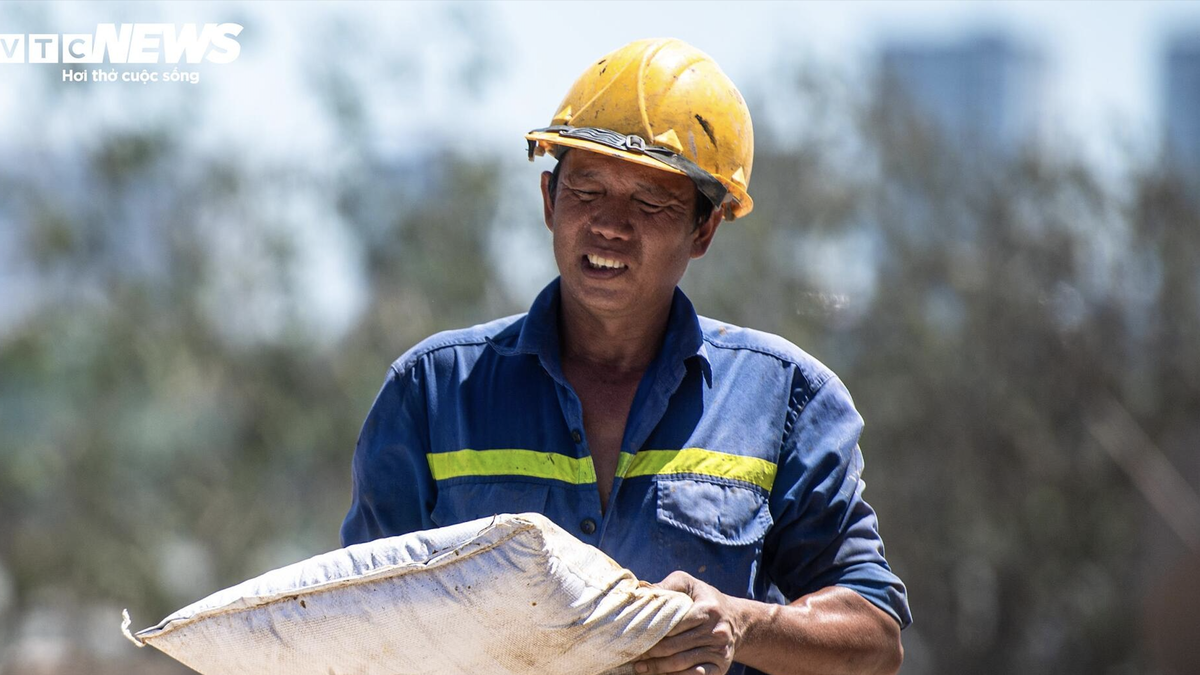
“Before us stretched a long line of road rollers, compacting the top layer of crushed stone aggregate. Each roller operated as if pre-programmed, moving forward and backward like a beehive. A driver with dark skin and ears stuffed with cotton stepped out of the vehicle; the image left a strong impression on me,” said Ta Hai.
Talking to the road roller operators, Ta Hai learned that the men who had been operating road rollers for many years and sitting at the wheel for hours on this construction site almost always suffered from hearing loss and other ailments, ranging from mild neck and shoulder pain to more serious conditions like kidney disease and spinal degeneration. These are all diseases endemic to the road roller operator profession, or, more elegantly, the "earth-compacting machine" operators. And indeed, the ever-increasing length of straight roads is a testament to the years of hard work of these "earth-compacting machine" operators.
For six days and five nights, photojournalist Ta Hai shared everything – eating, sleeping, and working – with the road workers on massive construction sites from North to South, amidst the constant noise of machinery day and night.
“Every kilometer of road built is not only the result of sweat and tears, but also the dedication of young people, the hidden happiness of thousands of officials, engineers, workers, and laborers in the transportation sector… I feel that very clearly and want to express that emotion through each photograph,” Ta Hai expressed.
““Hello, are you safe?”, “Safe…”, “3…2…1…explosion…boom,” the sound of exploding mines ripped through the night, as if trying to burst the chests of those nearby. That’s the daily atmosphere at Thung Thi Tunnel – the largest tunnel and one of the most important sections of the North-South Expressway from Mai Son to National Highway 45” – these are also precious moments captured by Ta Hai in his photographs submitted to the “Journalistic Moments” photo contest of the Newspaper & Public Opinion…
When "moment" comes to "moment"
Even now, when recounting the story to me, photojournalist Ta Hai still shudders several times, his emotions as intense as when he was working that night. To ensure safety, the construction unit required Ta Hai to work 500 meters away from the blasting site. It was the first time he had witnessed the preparations for blasting the mountain to clear the road. "The feeling at that moment was indescribable. I carefully observed and adjusted the position of my tripod. And then I started waiting for the 'moment' to come and press the shutter," Ta Hai shared.
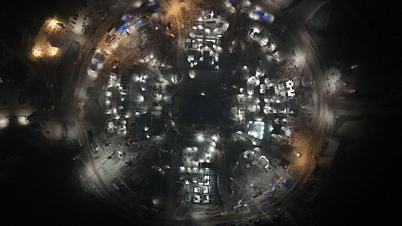
The massive North-South Expressway construction site, with its numerous tunnels through mountains, is not only optimizing the expressway's route but also making this vital national highway even more magnificent. To increase construction output daily, work on the Truong Vinh Tunnel and other tunnels through mountains is often carried out through the night.
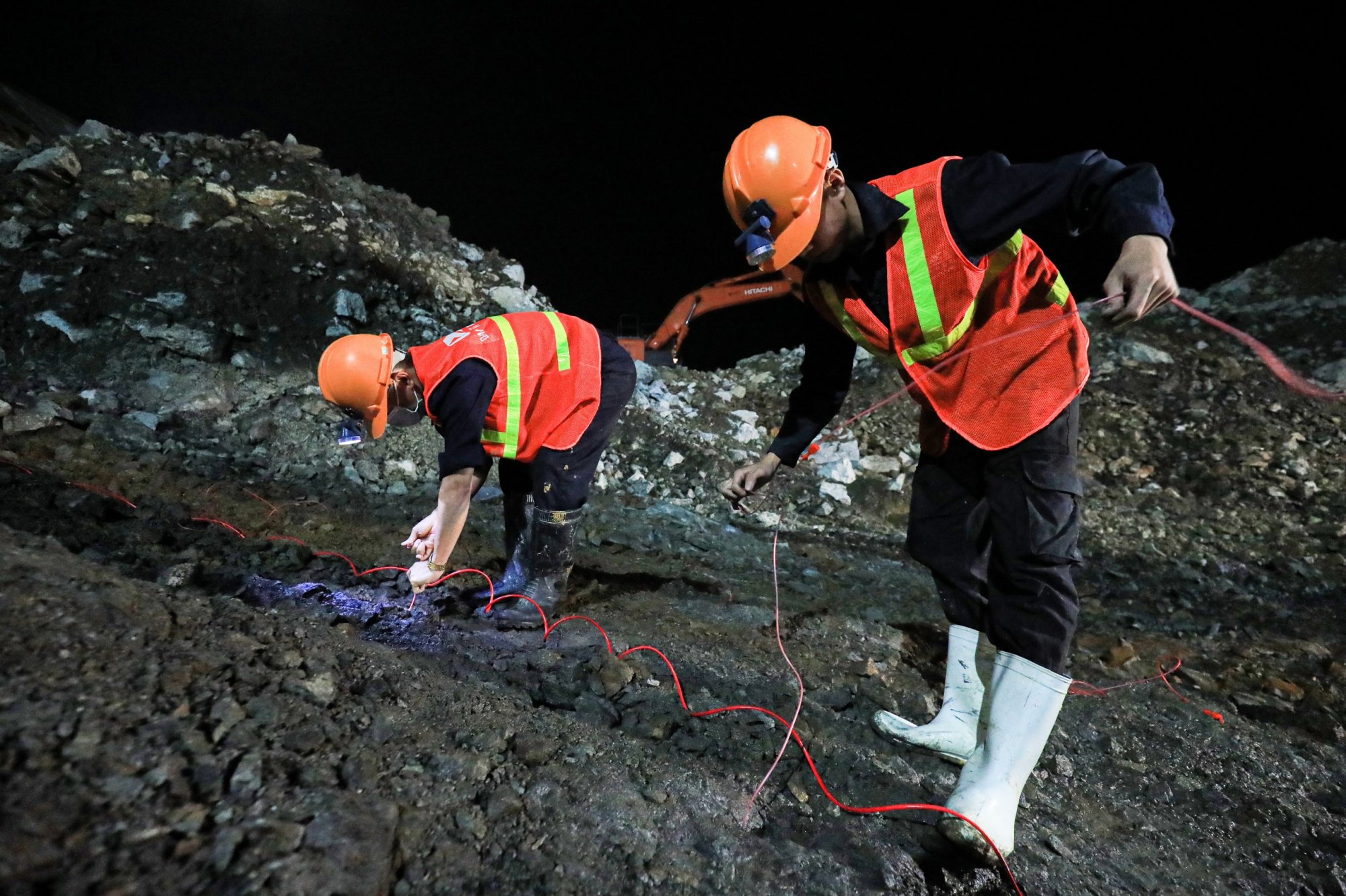
The nighttime blasting operation was carried out meticulously, ensuring absolute safety - a photograph from the winning photo series.
Many people believe that capturing the perfect moment in a story or event is easier if the camera has a high "fps" (frames per second)... However, for photojournalists like Ta Hai, who go to the scene with the spirit of bringing the most authentic images possible, but which must also convey the most authentic emotions, "fps" is just a tool.
A rapid-fire series of shots can sometimes be helpful and increase the chances of capturing what's called a "perfect moment," but the excitement a photographer gets from observing a moment, calculating its rhythm, relying on their instincts, holding their breath, waiting, deciding when to press the shutter… and then bursting with joy upon seeing the finished product is priceless. "It's truly priceless because it's an experience any true photojournalist would want to have in their life. And the happiness is multiplied many times over when the works, the moments I've sought, waited for, and longed for, are honored at a photo award – a rare platform for photojournalists nationwide – the 'Journalistic Moment' award," said Ta Hai.
The days working under the scorching sun on the construction site, mixed with the smell of asphalt, the nights sleeping on makeshift beds in temporary shelters with termites covering the mosquito nets, and the hurried meals with road workers on the route from Ninh Binh to the end of Nghe An have become unforgettable memories for Ta Hai.
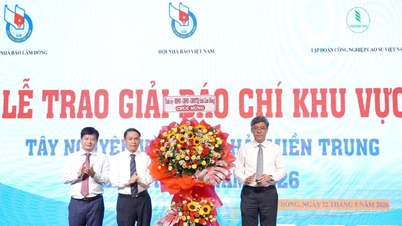
Don McCullin, a renowned British photojournalist, once said: "Photography is not about seeing, but about feeling. If you cannot feel what you are seeing, then you cannot make the viewer feel anything when they look at your photograph." After days and nights of seeing and feeling the images and stories at the North-South construction site, Ta Hai now stands on the podium receiving the Gold Award. When the "moment" he dedicated himself to bringing to readers is recognized and awarded by the "Journalistic Moment " award – that is a glorious, proud, and well-deserved "moment" for photojournalists like Ta Hai, with their dedication and desire to overcome difficulties, to go to the most dangerous places to capture the most valuable moments.
Hoa Giang
Source
![[Image] Hanoi's urban life under the challenge of a "scorching hot" environment](https://vphoto.vietnam.vn/thumb/1200x675/vietnam/resource/IMAGE/2026/05/25/1779706979265_nang-nong-t5-2026-minh-duy-7-4636-jpg.webp)

![[Image] Close-up view of the interchange connecting the two expressways and Long Thanh Airport.](https://vphoto.vietnam.vn/thumb/1200x675/vietnam/resource/IMAGE/2026/05/25/1779703378210_ndo_br_z7863716673926-224453a31600126cce10622af6290afd-4549-jpg.webp)













































































Comment (0)