

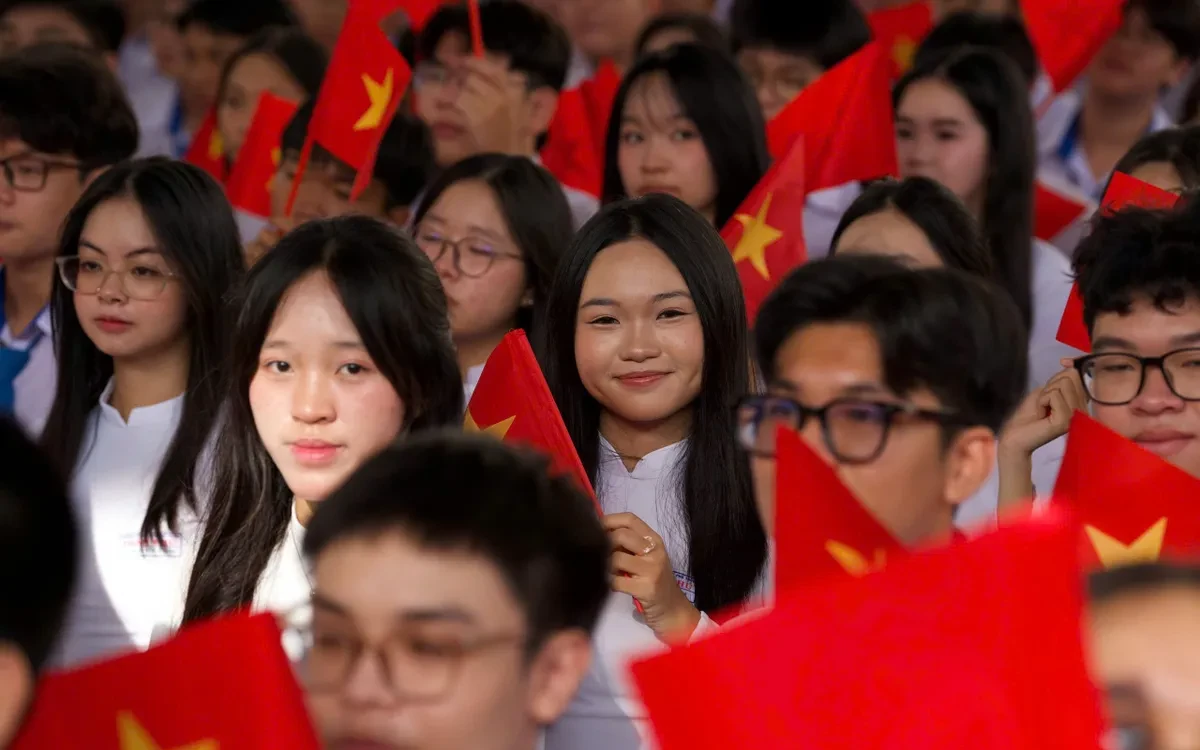
In the context of artificial intelligence (AI) increasingly impacting all aspects of life, the Ministry of Education and Training has issued Decision No. 3439/QD-BGDĐT on the framework for piloting artificial intelligence education for high school students. This is considered an important step in preparing a generation of students with the ability to adapt to and master technology in the digital society.
The AI education content framework is built upon the 2018 General Education Program, while also referencing the UNESCO AI Competency Framework for Secondary School Students. The overarching goal is to help students "know how to use AI" but also "know how to control AI," ensuring that the technology serves humanity safely, responsibly, and humanely.
Human-centered AI education
According to the Ministry of Education and Training , the AI education content framework for high school students is developed based on four core knowledge strands, corresponding to four competency domains, which are interconnected and mutually supportive.
Firstly, the mindset is human-centered, emphasizing the role of AI as a tool to serve human needs. Students are guided to identify problems, practical needs, and evaluate the effectiveness of AI solutions.
Secondly, there is AI ethics, which helps students identify issues related to privacy, personal data, algorithmic bias, legal responsibility, and the social impact of AI.
Thirdly, the course covers AI techniques and applications, providing foundational knowledge about how AI works, while also developing skills in using AI tools in learning and daily life.
Fourthly, it involves designing AI systems, developing capabilities from using AI to gradually creating simple AI systems, thereby honing problem-solving and creative thinking.
Clearly differentiated across different educational levels.
The AI education content framework is designed to be comprehensive yet differentiated into two educational stages, tailored to the psychological and physiological characteristics of each age group.
At the primary school level, students are primarily introduced to AI through visual applications such as image and voice recognition; they understand that AI is created by humans and begin to develop an awareness of protecting personal data.
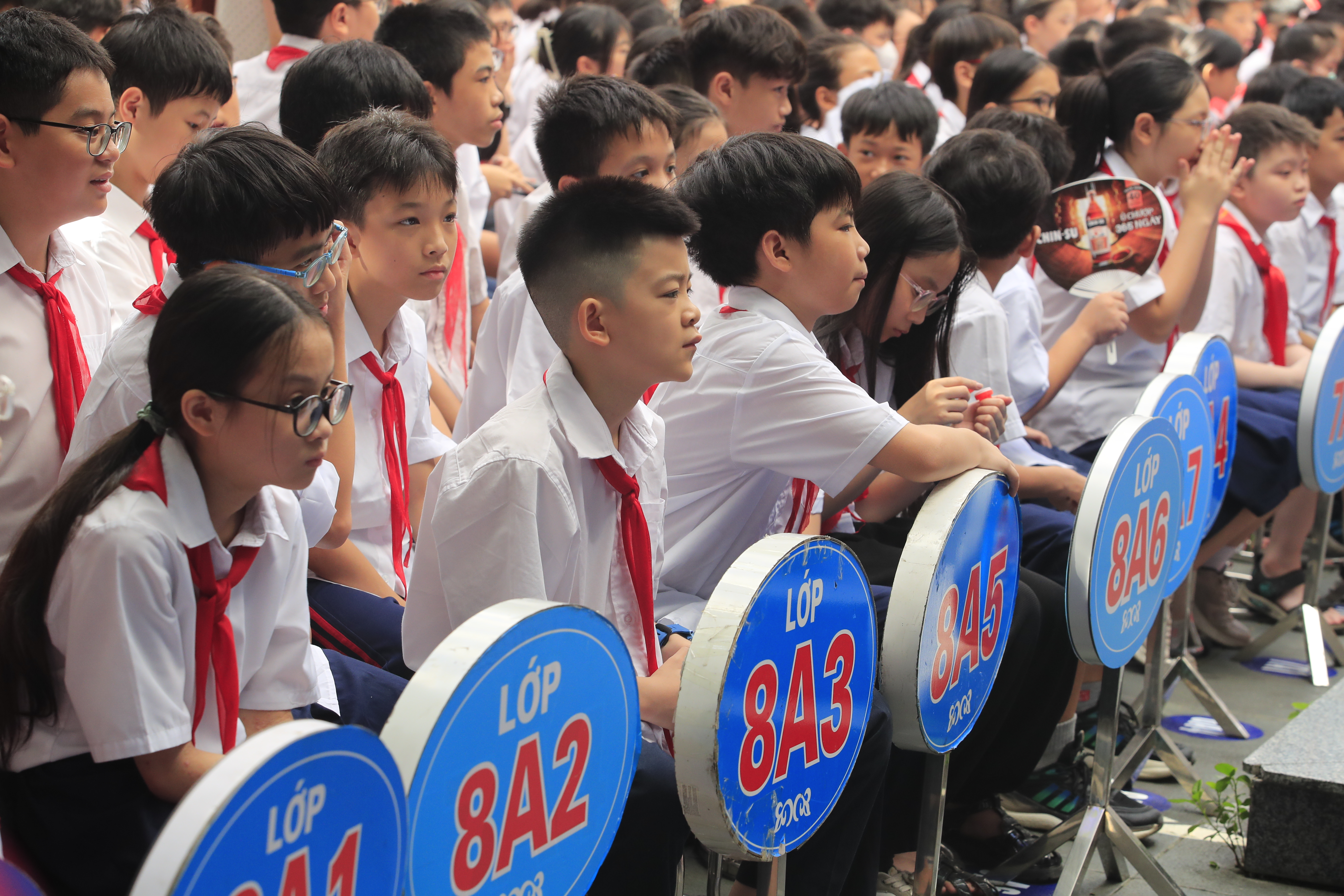
At the middle school level, students are introduced to the basic principles of AI operation, practice using AI tools to solve academic problems, and identify the risks and biases of AI.
At the high school level, students are encouraged to explore, design, and improve simple AI systems through learning projects and scientific research, linked to future career paths.
Flexible deployment, avoiding overload.
The Ministry of Education and Training emphasizes that the pilot implementation of AI education must ensure that it does not change the structure or overload the current general education curriculum. AI education content will be flexibly integrated into subjects, educational activities, specialized topics, clubs, or project-based learning, in accordance with the conditions of each locality and educational institution.
The content framework is designed in an "open" spirit, not dependent on a specific platform or software; it encourages the use of diverse learning materials, especially open-source tools. Student assessment focuses on application skills, creativity, logical thinking, and risk identification when working with AI, rather than just evaluating theoretical knowledge.
Alongside educating students, the Ministry of Education and Training is also piloting the application of AI in education management, supporting teachers in lesson planning and innovating testing and evaluation methods.
According to the plan, the pilot program will be implemented from the end of 2025 to mid-2026 in a number of educational institutions, before being summarized, evaluated, and refined to propose its widespread application in subsequent school years.
According to VTV
Source: https://baothanhhoa.vn/khung-giao-duc-ai-thi-diem-hoc-sinh-se-duoc-lam-quen-lam-chu-tri-tue-nhan-tao-272126.htm

![[Photo] Prime Minister Pham Minh Chinh receives Lao Minister of Education and Sports Thongsalith Mangnormek](/_next/image?url=https%3A%2F%2Fvphoto.vietnam.vn%2Fthumb%2F1200x675%2Fvietnam%2Fresource%2FIMAGE%2F2025%2F12%2F16%2F1765876834721_dsc-7519-jpg.webp&w=3840&q=75)
![[Image] Leaked images ahead of the 2025 Community Action Awards gala.](/_next/image?url=https%3A%2F%2Fvphoto.vietnam.vn%2Fthumb%2F1200x675%2Fvietnam%2Fresource%2FIMAGE%2F2025%2F12%2F16%2F1765882828720_ndo_br_thiet-ke-chua-co-ten-45-png.webp&w=3840&q=75)

![[Live] 2025 Community Action Awards Gala](/_next/image?url=https%3A%2F%2Fvphoto.vietnam.vn%2Fthumb%2F1200x675%2Fvietnam%2Fresource%2FIMAGE%2F2025%2F12%2F16%2F1765899631650_ndo_tr_z7334013144784-9f9fe10a6d63584c85aff40f2957c250-jpg.webp&w=3840&q=75)
![[Photo] Prime Minister Pham Minh Chinh receives the Governor of Tochigi Province (Japan)](/_next/image?url=https%3A%2F%2Fvphoto.vietnam.vn%2Fthumb%2F1200x675%2Fvietnam%2Fresource%2FIMAGE%2F2025%2F12%2F16%2F1765892133176_dsc-8082-6425-jpg.webp&w=3840&q=75)






































![[Live] Closing Ceremony and Award Presentation for the "Impressive Vietnam Tourism" Video/Clip Creation Contest 2025](https://vphoto.vietnam.vn/thumb/402x226/vietnam/resource/IMAGE/2025/12/17/1765974650260_z7273498850699-00d2fd6b0972cb39494cfa2559bf85ac-1765959338756946072104-627-0-1338-1138-crop-1765959347256801551121.jpeg)














Comment (0)