

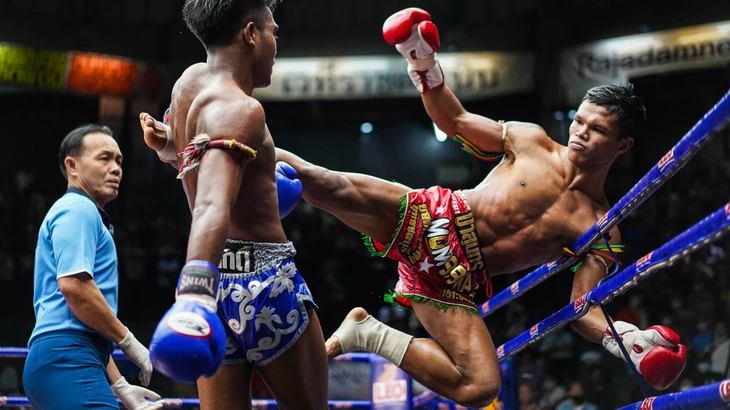
There is an endless debate between Muay Thai and Khmer kun - Photo: ON
The never-ending debate
At the 32nd SEA Games, Cambodia - as host - removed Muay Thai from the competition program and replaced it with its national martial art, Kun Khmer.
Similar stories have appeared many times in the history of the SEA Games, when each country respects its own martial arts. But in the case of Muay Thai and Khmer kun, it is a matter of "one lose one win" controversy.
Muay Thai and kun Khmer both originate from ancient martial arts traditions in Southeast Asia, using the “eight limbs” - hands, feet, knees, elbows... and both have strong cultural and ritual elements.
There have been many analyses of these two martial arts, and the conclusion is: Muay Thai and Kun Khmer are more than 90% similar in terms of technical factors, style, moves...
Most scholars, martial artists and people in both countries consider their own martial art to be the “original”. And this leads to the endless debate between Muay Thai and Kun Khmer.
The last two consecutive SEA Games are examples of how severe cultural conflicts can impact sports .
In Cambodia, Muay Thai was eliminated. And conversely, when Thailand hosted the SEA Games, Khmer kun was also eliminated. Both countries also refused to send their athletes to compete in the opponent's "national martial art", although in essence, the two sides' martial arts are almost the same.
The conflict between Muay Thai and Khmer kun is endless, but then there appeared a ring that included both amateur (Olympic movement system) and professional elements, becoming a place for the fighters of the two countries to compete. That is kickboxing.
Kickboxing, with its internationalized competition rules, unrelated to traditional rituals, becomes a logical choice.
Many famous Muay Thai fighters have turned to professional kickboxing, the legendary Buakaw Banchamek being one of the most prominent examples. After retiring from the ring, the famous Thai boxer led his country's kickboxing team.
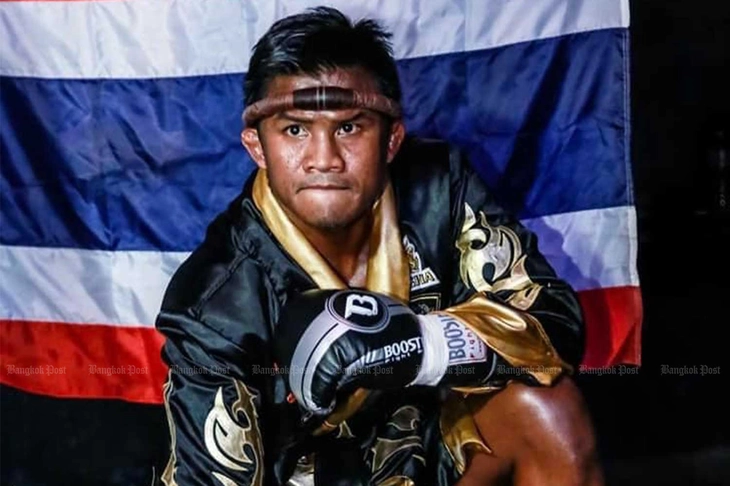
Legend of Thai martial arts Buakaw Banchamek - Photo: TC
On the Cambodian side, many Khmer kun fighters also accepted to switch to kickboxing to have more opportunities to compete. A typical case is Thoeun Theara - in addition to his Khmer kun background, he competed in kickboxing, winning a title at the Thai Fight international tournament.
Cambodian fighter Prom Samnang, famous in kun Khmer, has competed in Thai Fight and is considered one of the most successful Khmer fighters in the kickboxing/kun-lai scene.
Why is kickboxing popular?
Modern kickboxing, specifically K-1, favors punches, kicks, single knees, and prohibits the use of elbows. This makes kickboxing a shortened variation of both Muay Thai and Khmer kun.
According to British martial arts expert Jack Slack, kickboxing “retains the speed, simple sequences and high efficiency of muay. However, it abandons the rituals and long-lasting elbow-knee techniques that are characteristic of traditional martial arts.”
This opinion is agreed by many Southeast Asian coaches because both Muay Thai and Kun Khmer are built from the foundation of strong kicks, low center of gravity, and the ability to change rhythm continuously, suitable for the high intensity fighting environment of kickboxing.
This explains why Thai fighters, accustomed to the full eight-limb muay system, often have no difficulty transitioning to kickboxing.
Buakaw Banchamek once told the Japanese press that competing in K-1 “was like turning off some of the switches in Muay Thai. But the core of leg strength, speed and toughness remained intact.”
According to data from the Japanese K-1 League, more than 40% of fighters who have achieved high results in international kickboxing competitions have a Muay Thai background.
Phnom Penh Crown Gym coach Prum Sambo told the Phnom Penh Post that “Kun Khmer is almost 70% compatible with kickboxing, just need to adjust combos and reduce the use of elbows”.
In fact, Khmer kun fighters like Prom Samnang or Thoeun Theara have switched to hybrid tournaments (kickboxing - muay - kun) without encountering major technical obstacles.
Tactically, both Muay Thai, Kun Khmer and kickboxing aim for “pressure priority”, meaning that fighters seek to control space, attack first and maintain a rhythm of attacks, instead of going into grappling too much like MMA or using long footwork like karate.
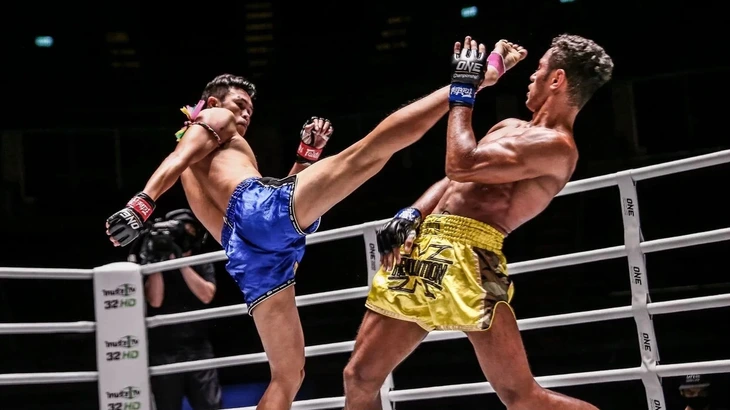
Many Thai and Cambodian boxers compete in the kickboxing ring - Photo: KB
Analyst Michael Schiavello (K-1 Commentary) once described kickboxing as “a place where both Muay Thai and Khmer kun fighters can achieve maximum effectiveness by simply changing their angle and footwork.”
This is also the reason why many Southeast Asian boxers choose kickboxing as an international career path, instead of just staying within the scope of traditional boxing rings.
Independent Singaporean martial arts expert Lee Kiat, who has studied the three schools, believes that technical similarities are the key to keeping Thai-Cambodian fights exciting.
“When both Muay Thai and Kun Khmer cut out the rituals, reduced the elbows and clinch, they became versions that were very close to kickboxing. So every time boxers from both countries entered the kickboxing ring, it was not just a fight but also a way for them to prove that their martial arts were more effective in the modern environment,” he commented.
Source: https://tuoitre.vn/kickboxing-noi-nguoi-thai-lan-va-campuchia-giai-quyet-xung-dot-ve-quoc-vo-20251129230608592.htm
![[Photo] Prime Minister Pham Minh Chinh receives President of Cuba's Latin American News Agency](/_next/image?url=https%3A%2F%2Fvphoto.vietnam.vn%2Fthumb%2F1200x675%2Fvietnam%2Fresource%2FIMAGE%2F2025%2F12%2F01%2F1764569497815_dsc-2890-jpg.webp&w=3840&q=75)








































































Comment (0)