


Interest rates reached 14% per year.
Regarding deposit interest rates, according to a survey conducted in early February, among the "Big 4" banks, the Vietnam Agricultural and Rural Development Bank ( Agribank ) significantly increased its interest rate schedule, applicable to most terms from 1 to 24 months. According to the newly updated online deposit interest rate schedule, the interest rate for 1-2 month terms increased by 0.2% to 3.2%/year; the 3-5 month term also increased by 0.2% to 3.7%/year; 6-9 month increased by 0.7% to 5.7%/year; and the 12-24 month term increased by 0.7% to 6%/year after more than two years.
According to the online savings interest rate charts of the Vietnam Investment and Development Bank ( BIDV ) and the Vietnam Joint Stock Commercial Bank for Industry and Trade (VietinBank), the interest rate for 1-2 month terms is 3%/year; 3-5 month terms is 3.4%/year; 6-11 month terms is 4.5%/year; and 12 month terms is 5.2%/year. The highest interest rate is 5.3%/year, applicable to terms of 13-36 months. Meanwhile, the Vietnam Foreign Trade Joint Stock Commercial Bank (Vietcombank) maintains low deposit interest rates, with 2.1%/year for 1-2 month terms; 2.4%/year for 3-5 month terms; 3.5%/year for 6-11 month terms; and 5.2%/year for 12-24 month terms.
Among joint-stock commercial banks, interest rates are quite differentiated, especially for medium and long-term deposits. Specifically, for 1-3 month terms, the common interest rate is 4-4.75%/year; for 6-9 month terms, it's 6-6.5%/year, and even exceeds 7%/year (PGBank offers 7.1%/year,SHB applies 7.5% for online deposits...). For longer terms of 12-18 months, deposit interest rates continue to be pushed to high levels of 6.5% or higher.
Rising deposit interest rates have led banks to simultaneously adjust lending rates upwards, especially in the real estate sector. Even the "Big 4" banks are applying real estate lending rates exceeding 10% per year. According to experts, the lending interest rate policy of state-owned banks is allocated according to the purpose of capital use, thereby reflecting the policy of controlling credit to real estate and prioritizing capital flows for production and business activities. Specifically, the average real estate lending interest rate is at least 9.7% per year when fixed for the first 6 months; 10.1% per year when fixed for 12 months; and 13.5% per year when fixed for the first 18 months. Meanwhile, interest rates for loans to meet living needs with collateral (not intended for real estate purchase), such as car loans or loans to repay debts early at other credit institutions, are significantly lower, commonly below 9% per year.
Be cautious when taking out a mortgage.
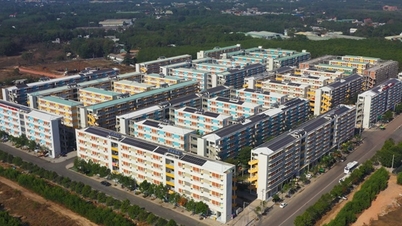
Explaining the reasons for the increase in real estate loan interest rates, Ms. Tran Hong Phuong, a real estate consultant in the Long Bien area, said that the real estate market is facing many risks, especially in the segment of properties under construction. In reality, many developers are applying policies of grace periods for interest and principal, so the financial pressure is not yet clearly apparent, but significant risks are predicted to emerge in the coming period. The interest rates applied by major banks for real estate loans, at 12-14% per year, are considered very high compared to before and are only fixed rates applied for 6-12 months. After the grace period ends, the addition of floating interest rates creates very heavy pressure on borrowers.
Based on these interest rates, a borrower of 2 billion VND over 20 years would have to pay approximately 25-26 million VND per month in interest. If borrowing 4-5 billion VND, the amount the borrower would have to pay would exceed 50 million VND per month, not including the principal repayments. With these interest rates, many experts predict that real estate prices may "cool down" by the end of 2026 as many investors are forced to "sell off" their properties due to the unbearable pressure of high interest rates.
Economist Dr. Chau Dinh Linh (Ho Chi Minh City University of Banking) believes that real estate and banking are two sectors with a symbiotic relationship, closely linked and intertwined. However, in recent times, real estate has mainly focused on the mid-range and high-end segments, not to mention commercial real estate and speculative activities. Rapidly rising interest rates will cause liquidity problems. The real estate market will gradually become less liquid, even "freezing" in some segments, and the banking system itself will be significantly affected. These impacts will be reflected in loan growth, asset quality, and the profitability of banks. High interest rates can be seen as a major "test" for the real estate industry, and also a test for the banking system.
Forecasts suggest that primary real estate prices may see a slight downward adjustment in 2026, following sharp increases in previous years, based on two main factors: increased supply as new projects enter the market and the rise in mortgage interest rates over the past year. Therefore, experts also advise small-scale investors to be cautious when borrowing from banks to buy houses, avoiding interest rate "traps" after the preferential period, when banks apply floating interest rates based on market conditions.
Source: https://hanoimoi.vn/lai-suat-cho-vay-tang-kho-luot-song-bat-dong-san-733005.html



































































































Comment (0)