

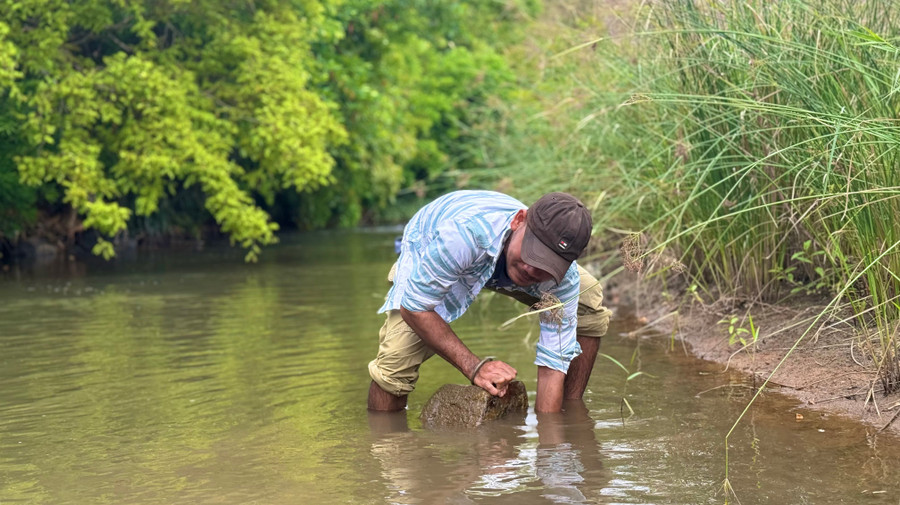
One afternoon in late March, as the Central Highlands sun began to soften, Mr. Rcom Dam Mơ Ai (residing at 22 Tang Bat Ho Street, Doan Ket Ward, Ayun Pa Town) led us up the mountain to hunt for rock crabs. Crossing a forest path overgrown with weeds, we arrived at the foot of the Ia Rbol spillway (Ia Rbol Commune, Ayun Pa Town). At this time of year, the water recedes, revealing large and small rocks clustered together. Pointing to the clear streams, Mr. Mơ Ai said: “That’s where many rock crabs live.”
Rock crabs, also known as mountain crabs, mainly live in streams and rocky crevices where the water is clean and minimally polluted. At first glance, rock crabs and freshwater crabs may seem similar, but they are actually very different. Rock crabs are usually reddish-brown, dark purple, or dark black, with large, strong claws and a hard, rough shell like a boulder. In contrast, freshwater crabs are earthy brown or yellowish-brown, with a softer shell and smaller claws. Furthermore, rock crabs are very aggressive, readily using their large, strong claws to grip prey and defend themselves against enemies.
According to Mr. Mơ Ai: In Ayun Pa, rock crabs mainly live in rocky streams such as Ia Rbol, Đá stream, or mountain streams. From May to July, when the rainy season begins, the crabs come out of their burrows to forage. In March, they begin laying eggs. During this time, female crabs move less and hide deep in their rocky burrows to protect their eggs, so catching them requires patience. Sometimes it takes 5-10 minutes to pull out one crab. Crabs usually hide under deep rock crevices or dig burrows about 1 meter deep along the stream banks—where there are many hard rocks—so digging is quite difficult.
According to Mr. Mo Ai, hunting rock crabs is not easy and requires extensive experience. Local people usually go crabbing in the early morning or late afternoon, when the crabs crawl out of their burrows to find food. Because rock crabs move quickly and skillfully hide in the crevices of rocks, crab hunters need to be quick-eyed and quick-handed.
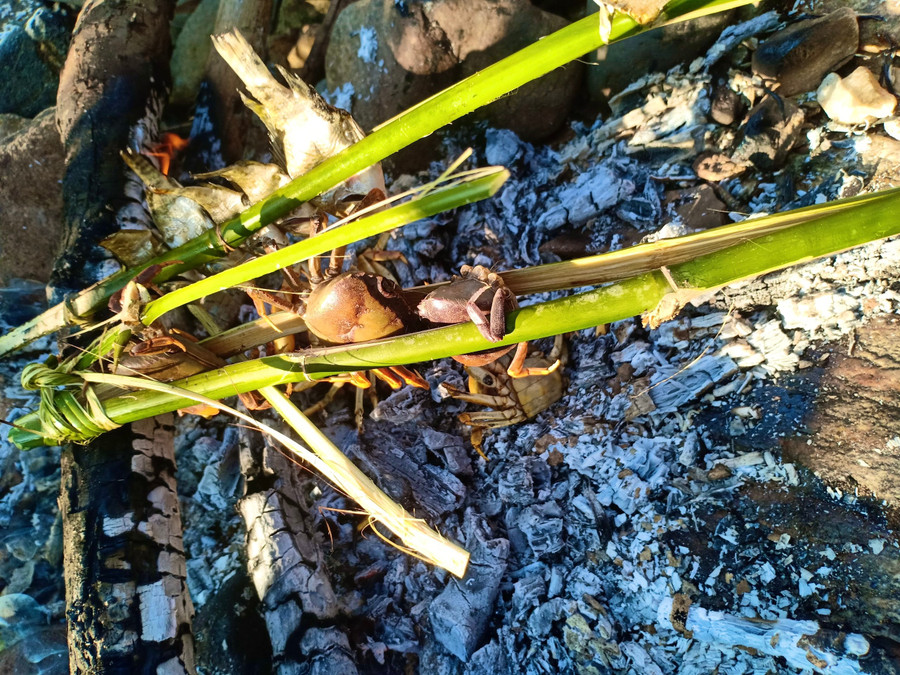
Stone crab meat is firm, chewy, sweet, and has a distinctive aroma. Stone crab eggs are orange-yellow or bright red, clinging tightly to the underside of the shell. During the breeding season, female crabs carry their eggs for several weeks before the eggs hatch into baby crabs and drift with the current. The Jrai people here often prepare stone crabs in many ways, such as grilling over a fire, dry-roasting, or boiling. When cooked, the crab shell turns a beautiful golden yellow. To enhance the flavor, the Jrai people in the Ayun Pa valley often pound the crabs with basil leaves, yellow ant salt, or wild betel leaves. The pounded crabs, mixed with fragrant basil leaves and the sour and spicy yellow ant salt, create a dish that anyone who tastes it will never forget.
Taking advantage of their free evenings, Nay Nhân (from Hiao hamlet, Chư Băh commune, Ayun Pa town) and other young people in the village go to Đá stream to catch crabs. During the rainy season, there are many crabs, and he can catch more than 30 per night. "During the dry season, the crabs hide in deep burrows, so catching just a few is a great achievement. Here, people mainly catch crabs to eat and to give to honored guests," Nhân shared.
Ksor Mgố (from the same village) said: His childhood was closely associated with rock crabs. When he was little, every time he followed his father to the fields, he would take the opportunity to wade in the stream to catch crabs. Just a few rock crabs grilled over charcoal were enough to warm the stomachs of the village children. According to Mgố, the rock crabs in Ayun Pa are delicious, and even with simple preparation, they retain the characteristic sweetness of the mountains and forests. "During the rainy season, when the stream water rises, catching crabs is difficult, but that's also when the crabs have the most meat and are the firmest, making any dish taste delicious," Mgố happily said.
According to locals, this area used to have a lot of rock crabs, but due to environmental changes and water pollution, the number of rock crabs has gradually decreased. "Nowadays, people are more aware of protecting rock crabs. They only catch adult crabs to avoid over-extinction and preserve the resource in the long term," added Mr. Mơ Ai.
Source: https://baogialai.com.vn/len-nui-san-cua-da-post316214.html


Comment (0)