

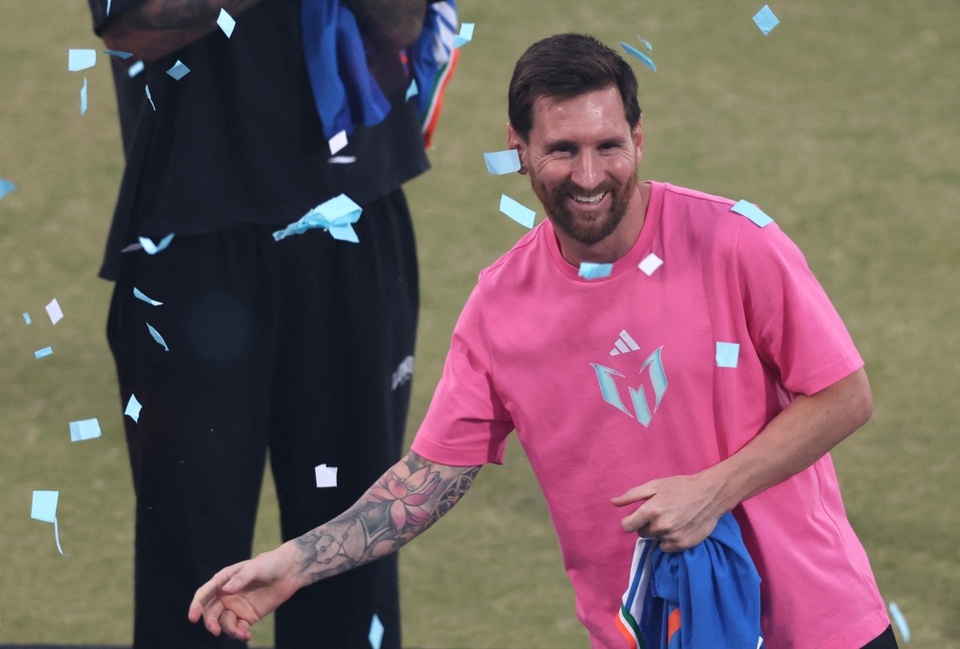
 |
Messi has just arrived in India. |
Lionel Messi arrived in India in his familiar role: the biggest star, the absolute center of attention, an icon beyond football. For millions of fans in the world's most populous nation, simply seeing Messi in person was a dream. But it was the gap between that dream and reality that created one of the ugliest images in the promotional journey of the player widely considered the greatest of all time.
The GOAT India Tour 2025 was designed as a perfect event: four cities, three days, Messi, Luis Suarez, and Rodrigo De Paul. Tickets sold out. Media coverage exploded. Expectations were at their highest. And as usual, when expectations exceed organizational capacity, football ceases to be the main character.
When global icons clash with local realities
In Kolkata, it all started with excitement. Thousands of people stayed up all night waiting outside hotels just to catch a glimpse of Messi. Tickets were not cheap compared to the average income in India, but they still sold out. Many people were even willing to pay three or four times the original price. For them, it wasn't just about buying a football ticket; it was about buying a memory.
The problem is that memory doesn't come.
Messi made an appearance, but in a way that left the crowd disappointed. A grand unveiling ceremony for a 70-foot statue was held, but Messi was only present through a screen. A stadium plan was announced to last an hour, but it ended after about 20 minutes. No friendly match. No proper performance. And for most of the audience, there wasn't even a clear glimpse of Messi's face.
 |
Messi remains an icon of world football. |
In that context, anger is understandable. When football fails to deliver on its promises, the crowd's emotions shift instantly. The stadium becomes a dumping ground. Banners are torn down. Plastic chairs are thrown. Images of Messi, instead of being associated with joy, emerge amidst the chaos.
It needs to be made clear: Messi was not the one who caused the chaos. He did exactly what was agreed upon. But modern football doesn't just operate by contracts. It also operates by the emotions of the fans. And in Kolkata, those emotions were abandoned.
A costly lesson for football in the age of stars.
The incident in Kolkata is not an isolated case. It reflects a larger problem: when football is commercialized to an extreme, the line between honor and exploitation becomes blurred. Messi is presented as an icon to sell tickets, his image, and his dreams. But those dreams need to be secured by a competent organizational system.
India is a huge market, but football there lacks the organizational infrastructure to match the scale of such events. When a global star emerges, every flaw is immediately magnified. Security is lax. Procedures lack transparency. Information is unclear. And the fans are the first to suffer.
 |
People in India are eager to see Messi. |
The fact that local authorities had to issue an apology and launch an investigation shows the seriousness of the issue. The organizer was arrested. Domestic media criticized the event harshly. What should have been a symbolic tour has left a negative impression.
The rest of the tour went more smoothly in Hyderabad, Mumbai, and New Delhi. Messi stayed on the pitch longer. Children were passed the ball around. Fans received autographs. But these positive images weren't enough to erase the negative impression from the start.
For Messi, this is an unnecessary blemish in the final stages of his career. For Indian football, it's a clear wake-up call. Bringing in a big star doesn't automatically create a celebration. Football needs to be organized with respect for the fans, not with flashy promises.
The GOAT Tour was supposed to be a journey honoring a legend. But in Kolkata, it reminded the world that even Messi couldn't save an event built on weak foundations.
Source: https://znews.vn/messi-va-chuyen-du-dau-vo-mong-o-an-do-post1611852.html
![[Image] Leaked images ahead of the 2025 Community Action Awards gala.](/_next/image?url=https%3A%2F%2Fvphoto.vietnam.vn%2Fthumb%2F1200x675%2Fvietnam%2Fresource%2FIMAGE%2F2025%2F12%2F16%2F1765882828720_ndo_br_thiet-ke-chua-co-ten-45-png.webp&w=3840&q=75)


![[Photo] Prime Minister Pham Minh Chinh receives Lao Minister of Education and Sports Thongsalith Mangnormek](/_next/image?url=https%3A%2F%2Fvphoto.vietnam.vn%2Fthumb%2F1200x675%2Fvietnam%2Fresource%2FIMAGE%2F2025%2F12%2F16%2F1765876834721_dsc-7519-jpg.webp&w=3840&q=75)









































Comment (0)