

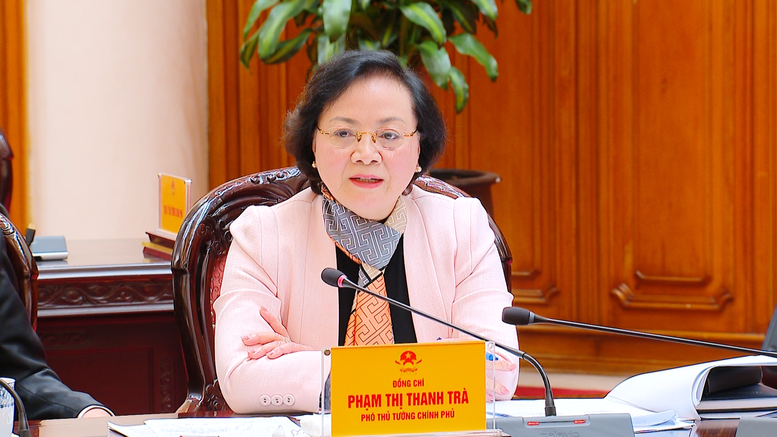
Deputy Prime Minister Pham Thi Thanh Tra speaks at the meeting - Photo: VGP/TG
On the morning of December 16th, the Standing Committee of the Government held a meeting on the implementation of the two-tiered local government model. The meeting focused on evaluating the results of the implementation after five months, and clearly identifying key tasks and solutions for the future to improve the quality and efficiency of the new model.
After listening to the reports and discussions, Deputy Prime Minister Pham Thi Thanh Tra assessed that, at this point, the implementation of the two-tiered local government system has basically resolved the fundamental issues regarding the conditions for its implementation.
The system operates smoothly, synchronously, and interconnectedly across all levels of government; initial obstacles have been gradually overcome, leading to positive changes in practice.
According to the Deputy Prime Minister, the results achieved show that the policy of organizing local government into two levels is correct and in line with the requirements of reforming the organizational structure, improving the effectiveness and efficiency of state management, and meeting the development requirements in the new period.
In the coming period, Deputy Prime Minister Pham Thi Thanh Tra requested that ministries, sectors, and localities focus on implementing a number of key tasks and solutions.
First and foremost, it is necessary to thoroughly understand and seriously implement the conclusions of the Politburo , especially Conclusion No. 210 and Conclusion No. 221. Regarding central ministries and agencies, the Deputy Prime Minister emphasized the requirement to review and improve the entire system of institutions and policies related to the operation of the two-tiered local government system.
Ministries such as the Ministry of Interior, the Ministry of Agriculture and Environment, the Ministry of Construction, the Ministry of Education and Training, and the Ministry of Health need to urgently address outstanding issues. The Ministry of Interior must soon finalize the decree amending and supplementing several articles of Decree No. 150/2025/ND-CP (Decree 150) regulating the organization of specialized agencies under the People's Committees of provinces and communes, wards, and special zones within provinces and cities, as an important legal basis for the reorganization of local administrative structures, especially at the commune level.
The second key task is to continue addressing difficulties and obstacles in decentralization, delegation of power, and delineation of authority. The Deputy Prime Minister assigned the Ministry of Interior to take the lead in urging ministries and agencies to complete the responses and clarifications on 355 issues that localities are still reporting as unresolved.
The principle is that any content already covered by guidelines but lacking clarity must be addressed with more specific instructions; any content that is overlapping or inadequate must be addressed with timely proposed adjustments. Relevant ministries and agencies must complete their assigned tasks, ensuring they are finalized within the stipulated timeframe.
Notably, the 10 tasks of the Ministry of Agriculture and Environment, the Ministry of Construction, and the Ministry of Science and Technology related to adjusting authority between the central and local governments or between different levels of local government require urgent development of proposals to adjust authority and provide guidance for amendments and additions to current laws, decrees, and legal documents.
The Deputy Prime Minister also requested that ministries and agencies continue to urge localities to promptly review and finalize provincial planning, considering this an important basis for implementing socio-economic development tasks in the coming period. The Ministry of Finance was assigned to take the lead in accelerating progress and ensuring it meets practical requirements.
Focus on reorganizing public service units.
In addition, ministries and agencies need to focus on urging and guiding the restructuring of public service units, with a focus on education and health, in accordance with the Politburo's directives. At the same time, they should guide the establishment of public service units providing essential public services at the commune level, especially in the fields of agriculture, environment, and construction, to ensure the provision of multi-sectoral and multi-field services to meet the needs of the people.
Another important aspect is the timely handling of issues arising after the restructuring, in which the Deputy Prime Minister requested the Ministry of Finance to focus on resolving issues related to surplus public assets, procurement of equipment, and working conditions.
Regarding the archiving of records and documents – an area currently facing numerous difficulties – the Deputy Prime Minister assigned the Ministry of Interior to take the lead in guiding and urging localities to promptly address the issue, ensuring compliance with legal regulations.
In addition, Deputy Prime Minister Pham Thi Thanh Tra emphasized the need to strengthen the connection of specialized databases and information technology infrastructure, ensuring interoperability between ministries, sectors, and localities, effectively serving the online processing of administrative procedures.
According to the Deputy Prime Minister, strengthening the application of science, technology, innovation, and digital transformation is crucial for the effective operation of local governments at both levels. The Ministry of Science and Technology is tasked with leading, guiding, and promoting strong digital transformation; and simultaneously mobilizing students to participate in supporting the "digital literacy" movement in the community.
Regarding local authorities, the Deputy Prime Minister requested that they urgently review and finalize provincial planning; reorganize the administrative apparatus and ensure that the staff of officials and civil servants meet the requirements for operating local government at the commune level.
The Deputy Prime Minister stated that the Ministry of Interior will soon advise on amending Decree 150 so that it can be issued before December 25th. This will allow localities to use the amended decree to reorganize specialized departments under the People's Committees at the commune level, and to allocate and strengthen the staff of officials and civil servants from the provincial level to the commune level.
In addition, localities are focusing on reorganizing public service units, while definitively resolving issues arising related to assets, facilities, and record keeping.
Regarding the training and professional development of officials and civil servants, the Deputy Prime Minister requested that localities proactively identify practical needs and organize implementation. The Ministry of Interior was urged to promptly finalize the plan for training and professional development of officials and civil servants so that it can be implemented from January 1, 2026.
Internal administrative procedure reform – an indispensable step.
The Deputy Prime Minister particularly emphasized the need to accelerate internal administrative procedure reforms in conjunction with digital transformation. In reality, internal administrative procedures in many localities remain complex, while some localities have not paid sufficient attention to this issue, yet are still proposing reforms to the central government.
"With procedures that have been decentralized, localities have the right to proactively adjust them to suit their needs, and should not wait for or depend on the central government," the Deputy Prime Minister said.
Deputy Prime Minister Pham Thi Thanh Tra emphasized the general principle of clearly defining responsibilities and authority, and improving the quality and efficiency of the operation of local governments at both levels.
At the same time, it is requested that the Ministry of Interior and other ministries and agencies fully incorporate the opinions expressed at the meeting, finalize the report, clarify the specific tasks of each central and local agency from now until the end of December, and develop a plan for implementing the two-tiered local government system in 2026, ensuring synchronicity, effectiveness, and sustainability.
According to the Ministry of Interior, regarding the framework for the number of specialized departments under the People's Committee at the commune level, Decree 150 currently stipulates a framework for the number of specialized departments under the People's Committee at the commune level, including 3 specialized departments and a public administrative service center. However, during the operation of the two-tiered local government system, many proposals and recommendations have been made to increase the number of specialized departments under the People's Committee at the commune level to promptly handle procedures and serve the essential needs of the people. Therefore, based on the overall criteria for classifying administrative units, the draft Decree amending Decree 150 stipulates that the establishment of additional specialized departments must meet the criteria according to the classification of administrative units in type 1 wards and communes with over 35,000 inhabitants and in special zones with over 35,000 inhabitants. Accordingly, localities should determine the number of specialized departments under the People's Committee at the commune level based on the actual situation, ensuring that it does not exceed an average of 4.5 departments and equivalents per commune-level administrative unit. |
Source: https://dangcongsan.org.vn/tin-hoat-dong/khan-truong-sua-nghi-dinh-150-lam-can-cu-sap-xep-cac-phong-chuyen-mon-cap-xa.html
![[Image] Leaked images ahead of the 2025 Community Action Awards gala.](/_next/image?url=https%3A%2F%2Fvphoto.vietnam.vn%2Fthumb%2F1200x675%2Fvietnam%2Fresource%2FIMAGE%2F2025%2F12%2F16%2F1765882828720_ndo_br_thiet-ke-chua-co-ten-45-png.webp&w=3840&q=75)
![[Photo] Prime Minister Pham Minh Chinh receives the Governor of Tochigi Province (Japan)](/_next/image?url=https%3A%2F%2Fvphoto.vietnam.vn%2Fthumb%2F1200x675%2Fvietnam%2Fresource%2FIMAGE%2F2025%2F12%2F16%2F1765892133176_dsc-8082-6425-jpg.webp&w=3840&q=75)
![[Live] 2025 Community Action Awards Gala](/_next/image?url=https%3A%2F%2Fvphoto.vietnam.vn%2Fthumb%2F1200x675%2Fvietnam%2Fresource%2FIMAGE%2F2025%2F12%2F16%2F1765899631650_ndo_tr_z7334013144784-9f9fe10a6d63584c85aff40f2957c250-jpg.webp&w=3840&q=75)

![[Photo] Prime Minister Pham Minh Chinh receives Lao Minister of Education and Sports Thongsalith Mangnormek](/_next/image?url=https%3A%2F%2Fvphoto.vietnam.vn%2Fthumb%2F1200x675%2Fvietnam%2Fresource%2FIMAGE%2F2025%2F12%2F16%2F1765876834721_dsc-7519-jpg.webp&w=3840&q=75)


































![[Photo] Prime Minister Pham Minh Chinh attends the Vietnam Economic Forum 2025](https://vphoto.vietnam.vn/thumb/402x226/vietnam/resource/IMAGE/2025/12/16/1765893035503_ndo_br_dsc-8043-jpg.webp)























Comment (0)