

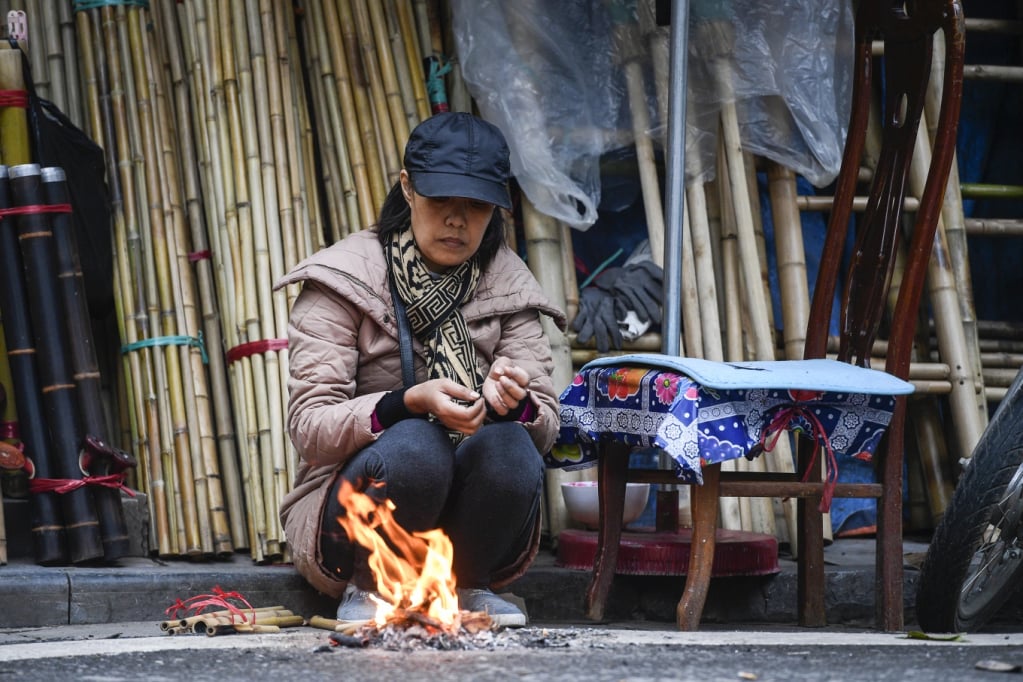
According to the National Center for Meteorological and Hydrological Forecasting, the cold air mass has affected most of the Northern region, causing rain. Strong gusts of wind are expected at sea, reaching levels 7-8 with gusts up to level 9 at Bach Long Vi; level 6 with gusts up to level 7 at Hon Ngu; and levels 6-7 with gusts up to level 8 at Ly Son.
Tonight and tomorrow night, the cold air mass will continue to expand its influence in Northern Vietnam. During this cold spell, the lowest temperatures in the Northern delta will generally be 12-15 degrees Celsius, in mountainous and midland areas 9-12 degrees Celsius, and in high mountainous areas, temperatures may drop below 5 degrees Celsius. Hanoi's temperature is forecast to drop to 13-17 degrees Celsius on November 19th, then gradually increase to 15-24 degrees Celsius by the end of the week. High-altitude areas above 1,500 meters, such as Sa Pa ( Lao Cai ), will experience the lowest temperatures of the spell tomorrow, ranging from 5-11 degrees Celsius, before rising to 7-16 degrees Celsius.
Central Vietnam has also been affected by the cold air mass. The lowest temperatures in North Central Vietnam are generally 12-15 degrees Celsius, 9-12 degrees Celsius in mountainous and hilly areas, and below 5 degrees Celsius in high mountainous areas. In the provinces from Quang Tri to Hue, temperatures were around 19-21 degrees Celsius on November 19th, dropping to 17-19 degrees Celsius on November 20th.
Cold air combined with disturbances in the easterly wind zone will continue to bring rain to central Vietnam.
From November 19th to 20th, Da Nang, the eastern parts of Quang Ngai to Dak Lak provinces, and northern Khanh Hoa will receive 100-200 mm of rain, with localized rainfall exceeding 300 mm. Thua Thien Hue and southern Khanh Hoa will receive 30-70 mm of rain, with localized rainfall exceeding 150 mm.
Source: https://quangngaitv.vn/mot-so-noi-mien-bac-duoi-5-do-c-6510476.html
![[Photo] Conference announcing the Politburo's Decision on organizational and personnel matters](https://vphoto.vietnam.vn/thumb/1200x675/vietnam/resource/IMAGE/2026/04/01/1775017881825_bnd-2410-1472-jpg.webp)
![[Photo] Conference on the transfer and reception of Party organizations and Party members between the Party Committee of the Government and the Party Committees of the Central Party Agencies](https://vphoto.vietnam.vn/thumb/1200x675/vietnam/resource/IMAGE/2026/04/01/1775036784472_ndo_br_bnd-2620-jpg.webp)


































![[Photo] Prime Minister Pham Minh Chinh receives the Ambassador of the Russian Federation to Vietnam](https://vphoto.vietnam.vn/thumb/402x226/vietnam/resource/IMAGE/2026/04/01/1775046774818_anh-man-hinh-2026-04-01-luc-19-32-33.png)














Comment (0)