


John Rockhold, Co-Chair of the American Chamber of Commerce in Vietnam (AmCham), shared with VTC News reporter discusses the relationship between the two countries ahead of AmCham's anniversary celebration in 2024.
- As someone who has worked in Vietnam for many years, how do you assess the changes in the investment and business environment over the past few years?
When American businesses first came here, it was a huge learning process about how to do business and coordinate. We navigated through a multitude of laws and regulations, such as work permits, residency, foreign worker regulations, work practices, and recruitment procedures.
The current environment is very stable. American companies have found that Vietnamese workers learn very quickly. Within just a few years, Vietnamese managers working with American companies can leave and start their own businesses.
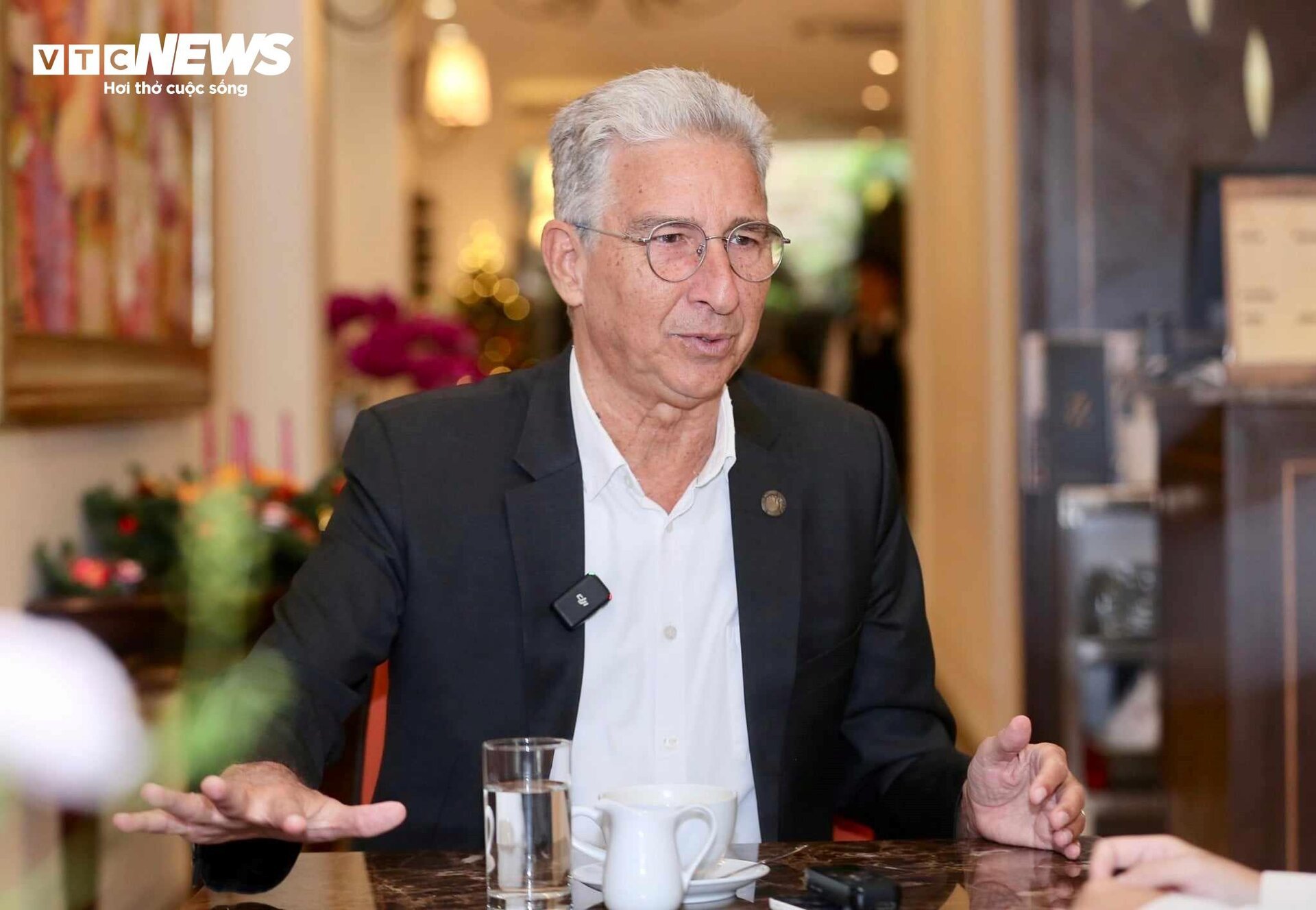
John Rockhold, Co-President of the American Chamber of Commerce in Vietnam (AmCham). (Photo: Ngo Nhung)
When we came to Vietnam, we worked and contributed to the improvement and development of infrastructure. It only took a few years for Vietnamese companies to replace our engineering and construction companies in doing these things. We've seen the same thing in the business sector.
There are new challenges in the high-tech sector. It's crucial now to train the right workforce, not just university graduates, but also skilled technicians. The United States is also struggling with this, as we sometimes have to recruit skilled workers from abroad.
This is a common challenge stemming from the rapid changes in science and technology, so the approach to training and interacting with learners to ensure they enter the workforce with the right skills will also have to improve.
Let's consider some of Vietnam's most recent proposals on environment and energy development. These are very good plans, showing a strategic vision of where Vietnam wants to go and what it wants to achieve. However, there is no mechanism or policy in place to implement these plans in practice. Essentially, what American businesses want to see is fair and transparent trade practices that allow Vietnamese and American businesses to cooperate in implementing such plans.
Therefore, these will be the areas where we will work together next year. For example, primarily in the energy sector, we will cooperate very closely with Vietnam on energy policy and the mechanisms that need to be implemented to attract investment in these areas. These will be prerequisites for us to be able to conduct more business together.
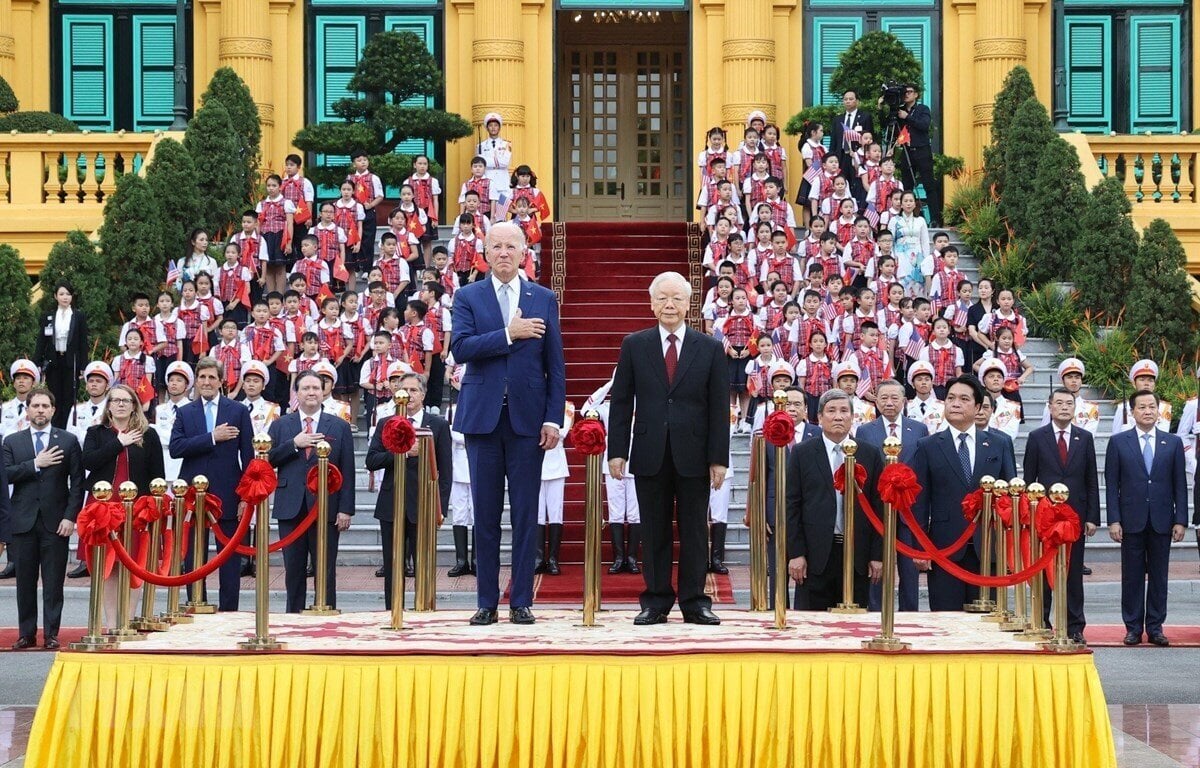
General Secretary Nguyen Phu Trong welcomed US President Joe Biden during his official visit to Vietnam in September 2023.
- One of the pillars of cooperation outlined in the joint statement between the two countries is the development of semiconductor technology and supply chains. In your opinion, where does Vietnam stand on this map, and what does Vietnam need to do to leverage its existing potential and position?
Cooperation between Vietnam and the US in technology, including semiconductors, chips, and related fields, is a major issue.
Currently, Vietnam is focused on assembling and testing high-tech chips, rather than manufacturing and developing its own chips. The next step Vietnam needs to take is to move beyond assembly and into actual production. To achieve this, Vietnam needs to do much more in terms of infrastructure, especially energy infrastructure.
Another challenge is the need to promote energy infrastructure while aligning it with socio-economic development, ensuring affordability and sustainability, and guaranteeing profitability to attract investment. This is in addition to the pressure for greener development and greener production. Therefore, Vietnam needs to find ways to meet and adapt to these new requirements.
Another important aspect is the efficient use of rare earth elements. Vietnam has the rare earth resources necessary for renewable energy, high technology, etc. We also had a similar experience in Vietnam in the late 1990s and early 2000s with the coffee industry, when we sold coffee beans and became the world's second-largest producer, but the real profit lay in processing and handling, not simply in raw production.
- Vietnam is currently focusing on high-quality human resources and no longer wants to position itself as an investment environment with cheap labor. In your opinion, how will this trend affect investment by American businesses in Vietnam?
I think it's the opposite. And Vietnam has to do this.
We're not just talking about goals like training 50,000 people for the semiconductor industry, or improving 1 million hectares of high-quality rice cultivation, but about training millions of people who are capable of entering the 5th Industrial Revolution. Vietnam can achieve this, but there will also be challenges.
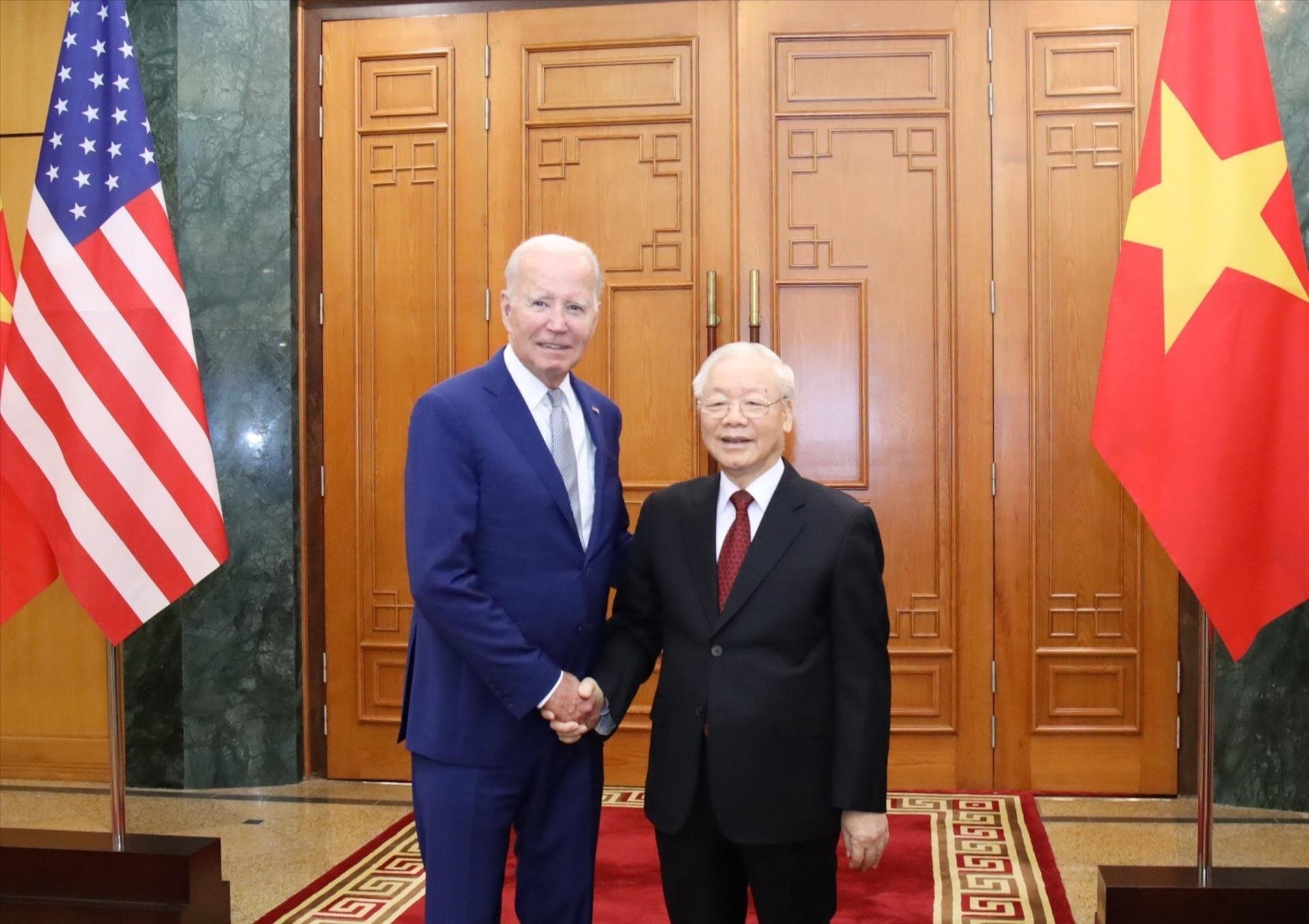
General Secretary Nguyen Phu Trong and US President Joe Biden before their meeting, September 2023.
As we advance to a higher level of technology, in the future, whether it's tennis shoes, clothing, or similar items, they won't be made by sewing machines but by robots, using technologies like AI. That's not far off, and when such factories exist, the factor of cheap labor will no longer be a consideration.
The next important factor to consider is logistics, given Vietnam's distance from major markets like Europe and the US. Vietnam must begin preparing for this new era, and improving infrastructure and training its young population to meet market demands are essential steps.
Another barrier affecting investment by Vietnamese companies is how to enhance their financial credibility in the international environment. Many companies want to borrow money, but they cannot pass the due diligence of international banks. They will need complete financial records and good audits if they want to partner with and become major business partners, attracting investment from other businesses. Adapting to these standards will be key to their growth and deeper participation in the global market.
- In line with the global trend of energy transition and combating climate change, what is the roadmap for US businesses investing in energy transition in Vietnam, sir?
You're seeing a lot of American companies committing to contributing to Vietnam's goal of achieving carbon neutrality by 2030. Therefore, there's a lot of pressure from American companies on their suppliers to become greener.
One area that has been implemented and proven cost-effective is the use of rooftop solar power for self-consumption. This trend will continue to grow, and companies may not invest in large-scale wind or solar energy projects until a more comprehensive legal framework for renewable energy is in place.
Another significant development is that American companies are partnering with Vietnam to supply low-cost natural gas, specifically liquefied natural gas (LNG). The US is the world's largest LNG producer. And by 2026, the Alaska natural gas field is coming online, with its first terminal on the west coast targeting the Southeast Asian market. Long-term deals are possible in this area.
In the short term, you will see Vietnam and we building gas-fired power plants, using cleaner technologies. These plants aim to transition to hydrogen and other alternative fuels in the future, in line with cleaner production goals.
- With the people-to-people and business relations between the two countries becoming increasingly close, what are your thoughts on the role and aspirations of individuals like yourself in the future of bilateral relations?
Many of us fought in Vietnam in the past without knowing what Vietnam was like.
After the war, what we saw when we returned to Vietnam was completely different. The Vietnamese people had started building social infrastructure, and the Vietnamese people welcomed us when we came to work with them and help with their development.
This collaboration fostered deep friendships and a willingness to work together, demonstrating a shared decision to look forward, not backward. This mindset was a crucial part of the healing process, especially for American veterans who fought in Vietnam.
Upon returning to Vietnam, these veterans encountered no hostility; instead, they found common ground and shared goals with the Vietnamese people. Many veterans chose to contribute positively to Vietnam through activities such as teaching English in remote areas.
For the families of those who participated in this journey, like mine, it was a process of learning. For example, looking at the strong friendship we have today, my children don't understand why America and Vietnam were once at war. We've had a journey to explain history and help them understand the transformation in the relationship. Now, we see that the relationship between Vietnamese and Americans is completely free of hostility, a testament to the power of reconciliation.
Thank you, sir!
Source

































































Comment (0)