

In Ho Chi Minh City , Mrs. Tien, 91 years old, experienced chest pain, risk of myocardial infarction, and anaphylactic shock after receiving a contrast agent injection for a CT scan. She was promptly treated by doctors.
On October 20th, Dr. Tran Vu Minh Thu, Head of Cardiology Department 2, Cardiovascular Center, Tam Anh General Hospital, Ho Chi Minh City, stated that the patient experienced unstable angina, severe myocardial ischemia, and a risk of myocardial infarction. For the previous month, Ms. Tien had experienced mild chest pain during exertion, which subsided after a few minutes and recurred after a few days. This time, while she was sleeping, she experienced severe chest pain radiating to her head and neck, accompanied by sweating and nausea, requiring emergency treatment at Tam Anh General Hospital.
The doctor ordered a coronary CT scan, but just after injecting 15 ml of contrast agent, the patient experienced third-degree anaphylactic shock with symptoms including limb spasms, hypotension (80/40 mmHg), urinary incontinence, shortness of breath, nausea, and increased mucus secretion.
Dr. Thu explained that intravenous contrast agents contain a small amount of iodine. The injection blocks X-rays from the CT scanner, highlighting the images and structures of organs on the scan.
Normally, the immune system does not react to contrast agents. However, in some people, the immune system overreacts, causing adverse reactions to the medication such as nausea, vomiting, itching, and in severe cases, anaphylactic shock.
The medical team administered intramuscular and intravenous medication to treat anaphylactic shock. The patient's condition gradually stabilized, and they were transferred to the monitoring room; a coronary CT scan was not yet possible.
Two days later, she experienced severe chest pain again. The doctor diagnosed a severe, progressive coronary artery stenosis that could block at any time, causing a myocardial infarction, and required coronary revascularization. Given the patient's advanced age, the coronary arteries were likely calcified, twisted, and severely narrowed, increasing the risk of a second anaphylactic shock that could cause cardiac arrest during the procedure.
According to MSc. Dr. Vo Anh Minh, Head of the Coronary Intervention Unit at the Center for Vascular Intervention, patients typically need 20-30 ml of contrast agent injected during coronary angiography. Ms. Tien has a history of anaphylactic shock, and even a small amount of contrast agent could easily lead to a recurrence of anaphylactic shock.
The doctor treated the patient with anti-allergic medication to prevent anaphylactic reactions, using two types of drugs: one administered one hour before the procedure; the other 12 hours and 2 hours before the procedure. In addition, the team used the Cardiac Swing technique for coronary angiography and intervention with minimal contrast agent, combined with a three-dimensional image analysis system. This reduced the contrast agent dose by almost half compared to conventional methods, minimizing the risk of kidney failure for the patient.
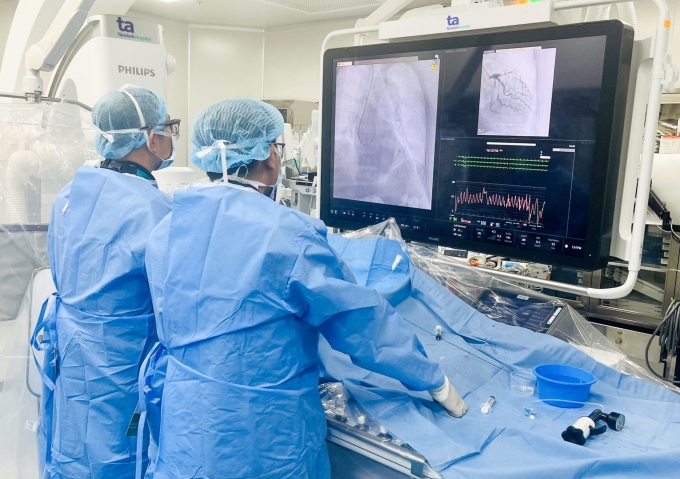
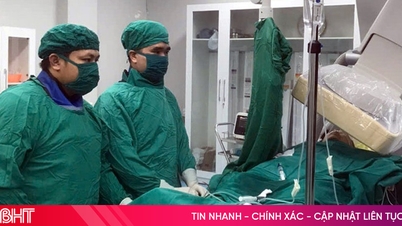
Doctor Minh (left) and his team perform coronary angiography and stent placement on a patient. Photo: Tam Anh Hospital
The procedure involved coronary angiography and placement of two stents to recanalize the 95-99% narrowed left coronary artery, guided by roadmap software and intravascular ultrasound (IVUS), using only 50 ml of contrast medium. The intervention was successful after 60 minutes.
After the stent placement, Mrs. Tien's chest pain and shortness of breath subsided, and her blood pressure and heart rate returned to normal. Thanks to the catheter being inserted through the radial artery in her wrist instead of the femoral artery, she was able to walk and carry out normal activities and was discharged from the hospital after two days.
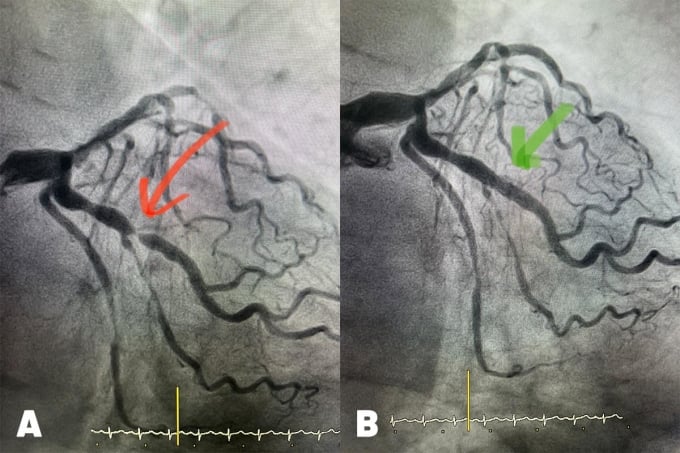
The patient's anterior interventricular artery was 99% stenotic (Figure A) and after stent placement for recanalization (Figure B). Photo: Tam Anh Hospital.
Along with medical treatment to prevent anaphylactic shock and renal failure, the Cardiac Swing technique in coronary angiography and intervention, guided by roadmap software and intravascular ultrasound, opens up opportunities for treating coronary artery disease in patients with allergies, anaphylactic shock risk, and renal failure risk with contrast agents, according to Dr. Minh.
Thu Ha
* Patient's name has been changed
| Readers can post questions about cardiovascular diseases here for doctors to answer. |
Source link
![[Image] Central Party Office summarizes work in 2025](/_next/image?url=https%3A%2F%2Fvphoto.vietnam.vn%2Fthumb%2F1200x675%2Fvietnam%2Fresource%2FIMAGE%2F2025%2F12%2F18%2F1766065572073_vptw-hoi-nghi-tong-ket-89-1204-jpg.webp&w=3840&q=75)

























































































Comment (0)