

While reading the poetry collection "It's Just Like Moss and Algae" by poet Nguyen Van Trinh.
Before transferring to Ba Ria - Vung Tau, I worked in Quang Tri for nearly fifteen years. In this land rich in hospitality, I became acquainted with most of the artists, writers, and journalists. However, I never met the poet Nguyen Van Trinh; I only read his poems in the Cua Viet magazine and the Quang Tri newspaper.
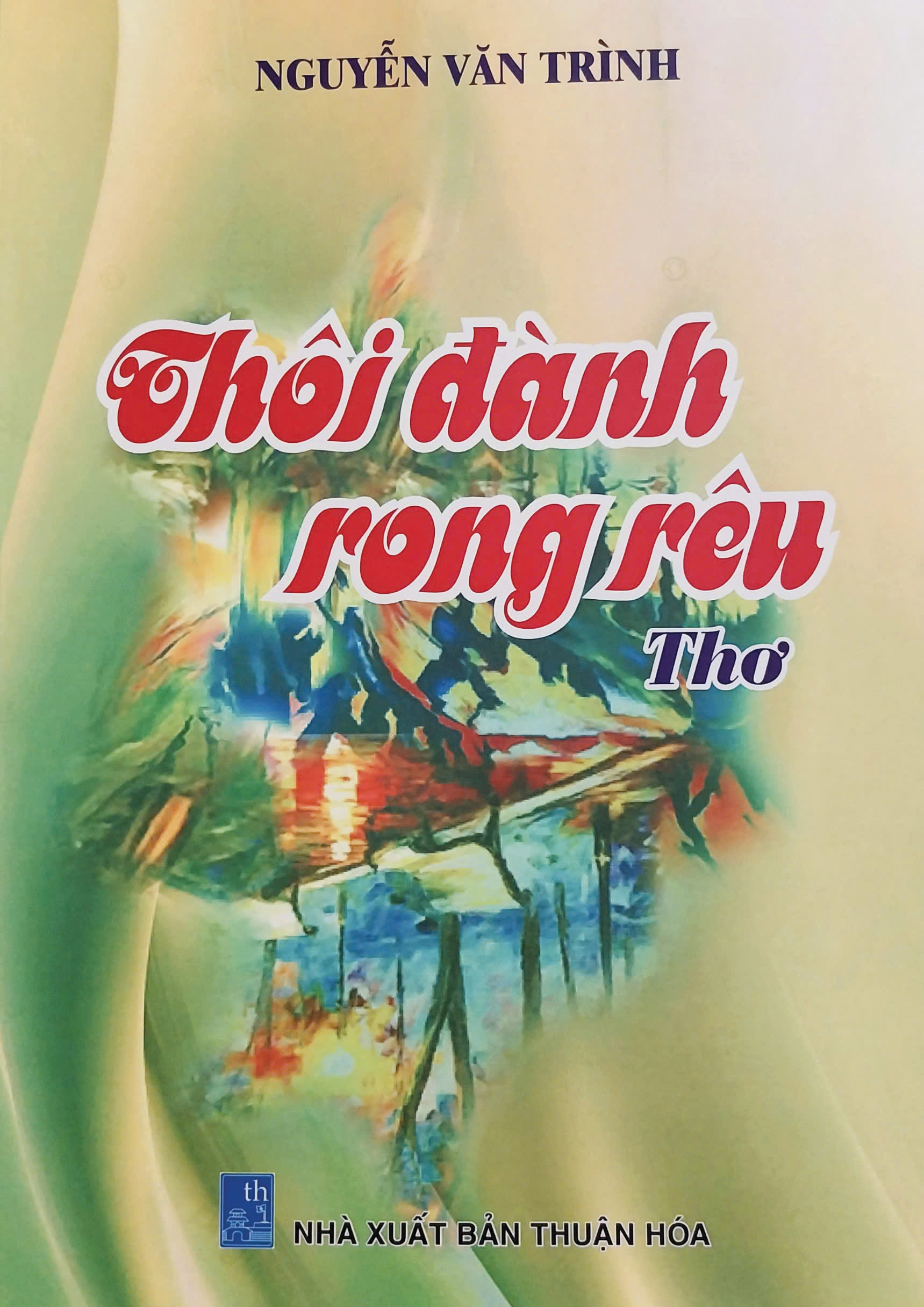
Recently, I read the poetry collection "It's Just Moss and Algae" by poet Nguyen Van Trinh, comprising 69 poems with diverse themes, clear structure, and overflowing emotions. The poems are about fathers and mothers, love, martyrs, soldiers, the river of his hometown, the four seasons and their fruits, the ways of the world, his beloved school and students... His poems are full of emotion, resonating with every nuance of feeling.
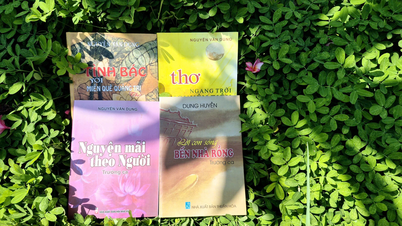
Previously, poet Nguyen Van Trinh had published three poetry collections: "White Clouds in the Sky" (Thuan Hoa Publishing House, 2011); "Dreamy Sunshine" (Vietnam Writers Association Publishing House, 2019); "Falling Evening Shadows" (Vietnam Writers Association Publishing House, 2022); and "It's Just Moss and Algae" (Thuan Hoa Publishing House, 2024). Among these, "Dreamy Sunshine" received the C prize in the Quang Tri Provincial Literature and Art Creative Award in 2019.
The teaching profession is respected and honored by society, likened to a gardener, a ferryman, a silkworm spinning its silk, a candle illuminating knowledge... As a literature teacher who lived a life of loyalty, Mr. Nguyen Van Trinh never forgot to write poems dedicated to the schools in his hometown where he once taught. I feel like I find a reflection of myself in them, because we share many similarities.
He and I, both high school students in the same province of Binh Tri Thien, had our poems published in newspapers. If I was a literature teacher before joining the army: “The homeland urges, I take up arms and go/ Months and years on the border, the sky filled with fire and bullets/ I had to leave behind my students, my lesson plans/ And the moon over the schoolyard” (Visiting the Old School), then he belonged to Unit C21, under the 10th Division, 3rd Corps, stationed in the former Bac Thai province, guarding an important border region of the Northeast of the country. Later, the unit moved to the Central Highlands before he became a literature teacher.
Both of us took up arms to fight off invading expansionist forces, defending every inch of our homeland's border. And coincidentally, we both lived on the same street named after a famous scholar from the Nguyen dynasty; I lived at the even number 66 Chu Manh Trinh Street, Vung Tau City, while the poet Nguyen Van Trinh lived at the odd number 65 Chu Manh Trinh Street, Dong Ha City.
According to the Russian literary critic Belinsky: "Poetry is first and foremost life, only then is it art." Therefore, in the poetry collection "Let's Just Leave It to the Moss," poet Nguyen Van Trinh, in his role as a literature teacher, not only imparts knowledge and inspires literary learning, but also awakens a passion for literature, broadens understanding of the vast world , and evokes empathy for all the diverse circumstances of life.
From then on, students loved literature, loved their literature teachers, and loved the profession of teaching literature. Besides that, literature teachers also equipped students with knowledge of proper conduct, taught them how to be useful members of society, and how to choose the right path, because "Literature is the study of humanity." Therefore, in his poetry, Nguyen Van Trinh wrote about the teaching profession with passionate and poignant verses: "I was intoxicated and burned with passion / On the podium with every word /...I still remember every page of the students' writings / Which essay needed the teacher's red ink mark?" (Trieu Phong of the old days is still here). Literature teachers overflow with emotion in imparting literary knowledge to their students.
The poet, with his soaring and uplifting spirit, composed verses "with wings." Yet, at times, he meticulously reviewed the outstanding events of Quang Tri's education sector over the past fifty years, overcoming numerous difficulties to achieve success in all aspects : "Today, the fruits are sweet, the blossoms are abundant / Quang Tri's education, fragrant with jasmine" (Cultivating People on Fiery Land).
With the sensitive soul of a teacher who also writes poetry, on a windy afternoon, he wandered back to his old school, Che Lan Vien High School, searching for memories, reminiscing about his former students, remembering the phoenix trees, the banyan trees, the stone benches, and the passionate hours of teaching, as if they were just yesterday: "The school of a bygone era of love / Remembering so many memories still lingering through the days" (A Place Where the Soul Anchors). After many years away from Dong Ha High School, one day he returned to visit, his heart filled with mixed emotions "among a hundred directions of affection": "Here is the lecture hall where the joys and sorrows of the lesson took place / The voice of the teacher still passionately and enthusiastically" (Fairy Tale of the Soul).
After a lifetime of diligently "ferrying passengers across the river," the respected "ferryman" reunited with a special "passenger" in the sunny southern land of Nguyen Xuan Hung, a former student of Dong Ha High School, now a successful businessman in Ba Ria-Vung Tau province. Teacher and student met after 27 years since graduation, their joy overflowing: "As summer arrives, I remember the day you left / Leaving Quang Tri for Phu My."
Writing about the teacher "stationed" in remote areas, the hardships are endless, sacrificing personal interests to expand knowledge for the children: "Tears well up on the road to class / Admiration for the teacher who sows knowledge in remote areas" (The Teacher in the Remote Area).
Now in his sixties, poet Nguyen Van Trinh still vividly remembers the image of his father working hard in the fields, regardless of sun or rain, to produce rice and potatoes so that his children could study and become successful: "The shadow of father plowing in the fields / Father toiling wholeheartedly for his children" (Father's Shadow). The image of his mother in his poetry is truly touching, her slender figure bearing so much hardship, caring for and educating her children meticulously: "Mother like a slender willow / Bearing so much hardship, tirelessly raising her children" (Mother).
No province has as many martyrs' cemeteries as Quang Tri. The graves of these heroes are neatly arranged, just as they were when they marched to battle in their youth. They rest peacefully under the shade of pine hills, surrounded by the vibrant purple of sim flowers, the bright red of ixora blossoms, and the lingering scent of incense. Bowing his head before the spirits of the martyrs, the poet sadly remembers his comrades who lie buried along the Vietnam-China border, whom he never had the chance to visit and light incense for: “Remembering you, I visit your graves and light incense / Letting tears fall, like dew drops” (Evening at the Cemetery).
It's understandable that soldiers who directly fight to defend the homeland sacrifice their lives, but even in peacetime, when there are no gunshots, soldiers still bravely sacrifice themselves while rescuing people from raging flash floods and landslides from high hills that bury houses : "Soldiers in peacetime face countless difficulties / Every mission involves sacrifice" (Soldiers in Peacetime).
Writing about soldiers, he praised the Border Guard, Coast Guard, and Navy soldiers stationed at remote island outposts, guarding every inch of borderland and every square meter of sea and islands day and night for the integrity of the country, as in poems such as: "Undercurrents in Truong Sa," "Purple hues of the border region," "Monuments protecting the sea," and "The aspirations of a naval soldier."
Vietnam is located in a tropical climate zone, experiencing four distinct seasons. The poet Nguyen Van Trinh cherishes all four seasons, expressing their unique beauty through his poems. Spring brings forth a thousand blossoming flowers, chirping birds, and swallows soaring through the tranquil countryside: “In the late afternoon, swallows fly swiftly / In the spring sky, they flutter and join each other in flocks” (Spring Arrives in Warm Sunshine).
The hot, humid summer, with its red flame trees and bright yellow mustard flowers, makes the poet feel a sudden sadness at being temporarily away from the lecture hall: "Golden summer in the countryside / Adding to the longing, intoxicating the heart" (Golden Summer). The cool autumn weather, with clusters of ripe yellow fruit hanging from the trees, seems to beckon, and the full moon hangs in the countryside sky, sowing a touch of melancholy in the poet's soul: "The cool autumn breeze arrives / The silvery mist hangs over the gloomy countryside" (Autumn Arrives). The bleak winter, with its biting cold, makes the poet sigh: "Late winter, cold wind by the window / The rain falls incessantly, making the heart even colder / The temple bells chime intermittently" (The Last Days of Winter).
I suspect that no poet in the land of "Lao winds and white sand" has written as many poems about flowers as poet Nguyen Van Trinh, because those flowers hold great significance in his work, love, and life: sunflowers, chrysanthemums, portulaca, periwinkle, crape myrtle, magnolia, orchid, rose, myrtle, and rhododendron...
Each flower has its own unique beauty; I will only highlight the beauty of the reeds in the poem "White Reeds on a Winter Day." The pristine white color of the reeds, swaying gently in the wind, makes it hard to resist the beauty of this simple flower. The poet uses the reeds to evoke memories of innocent love: "How easy it is to remember old love stories / The time of childhood, what is remembered and forgotten" and "Remembering the eyes, the smile of the past / Remembering the white reeds, remembering the innocent time."
Poet Nguyen Van Trinh's poetry is not merely about "admiring flowers, enjoying tea, and daydreaming"; at times, his poems are philosophical, clearly distinguishing truth from falsehood, reflecting on gain and loss, and admonishing himself with lines like: "Human life," "What is there to it?", "The shallowness and depth of life," "Life is so short," "Living is not about anything," "Truth and falsehood," "Then one day," "The world," "The twilight years"... hoping that "People live to love one another" (To Huu). And the poems he writes about Laotian girls, the sea, love, his hometown river, his village... with a gentle, simple, and intimate poetic style, touch the hearts of poetry lovers.
He dedicated his entire life to education and his beloved students. When he left the classroom to return to his family, he devoted himself to poetry and participated in field trips for creative writing. Decades spent with schools, colleagues, and students have become a thing of the past, and he accepts the laws of life to find new joy: “The cicadas’ song echoes wistfully / From the red phoenix tree, from the green willow branch / The young scholar in a white robe / So many memories, now left to wither like moss” (Left to wither like moss).
Due to the limited scope of this article, I will only highlight some outstanding poems to share with readers, along with the poet Nguyen Van Trinh. Hopefully, in the poetry collection "Let's Just Leave It to Moss and Algae," poetry lovers will find something interesting and captivating.
Nguyen Xuan Sang
Source: https://baoquangtri.vn/nhu-tim-thay-minh-188885.htm
![[Image] A brilliant symphony and explosive power in the skies of Da Nang.](https://vphoto.vietnam.vn/thumb/1200x675/vietnam/resource/IMAGE/2026/05/31/1780196945787_anh-man-hinh-2026-05-31-luc-10-08-51.png)







![[Video] Sunset at Lap An Lagoon – Where the sun sets over the fishing nets](https://vphoto.vietnam.vn/thumb/340x192/vietnam/resource/IMAGE/2026/05/31/1780192137701_beach-landscape-sea-water-nature-grass-745871-pxhere-com.jpeg)























































Comment (0)