

Along with rapid socio -economic development, attracting people from many provinces and cities to live and work, many new buildings have sprung up, while thousands of dilapidated old apartment buildings still exist without a mechanism for demolition and reconstruction, and the streets are congested and suffocating… urban reconstruction and renovation is one of the top priorities today. A series of policies have been issued to resolutely achieve this goal as soon as possible.
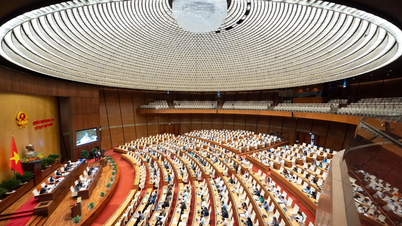
On December 11, 2025, with 431 out of 435 delegates voting in favor, the National Assembly passed a Resolution piloting a number of specific mechanisms and policies to implement large and important projects in the capital city, effective one day later (December 12, 2025), for a period of 5 years. Accordingly, a number of large and important projects such as urban renovation, upgrading, and reconstruction; rebuilding old apartment buildings; addressing urgent bottlenecks related to traffic congestion, flooding, environmental pollution, and urban order… will apply specific mechanisms and policies regarding the selection of investors and contractors, planning, architecture, land acquisition, allocation, and leasing, and capital mobilization… Some measures are very decisive, such as Hanoi being allowed to forcibly demolish old apartment buildings when more than 75% of homeowners and landowners agree.
Just two days after the National Assembly's Resolution was passed, the 16th Hanoi People's Council convened its 29th session to consider and decide on contents to concretize the National Assembly's Resolution. A series of decisions were passed. These included a Resolution creating a legal framework for the preparation, appraisal, and approval of the Capital City Master Plan with a 100-year vision, replacing the current Capital City Plan and General Capital City Plan; a streamlined preparation and appraisal process that still ensures transparency, scientific rigor, rationality, and suitability to development requirements and the new management model. It also included a Resolution to remove obstacles in compensation and resettlement for key projects. Furthermore, it included a Resolution to invest in the Red River Landscape Boulevard project, implemented along the Red River from Hong Ha Bridge to Me So Bridge, passing through 19 communes and wards; covering an area of approximately 11,000 hectares; comprising an 80km long main road. The project includes a 3,300-hectare system of landscaped parks and recreational areas; approximately 2,100 hectares for urban redevelopment; a total investment of approximately 855,000 billion VND, with an expected completion date of 2030...
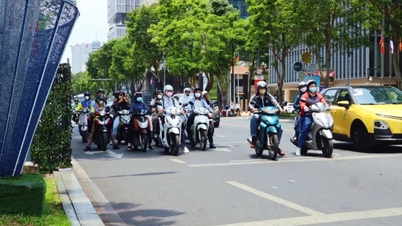
Previously, at the end of November 2025, the 28th session of the City People's Council also issued a Resolution on the roadmap for implementing low-emission zones from 2026 to 2030 in the city, restricting polluting and substandard vehicles.
The development of the capital city can be likened to the legendary hero Thánh Gióng, meaning the "garment" of the old mechanisms has become too tight and its buttons have come undone. The National Assembly's decision on piloting some special mechanisms for Hanoi and the implementing resolutions of the Hanoi People's Council, as mentioned above, are the new garment for the capital to perfect its institutions; remove "bottlenecks" and "obstacles"; implement breakthrough solutions to effectively deploy large projects, and improve the quality of life for the people. As a leader of the Hanoi People's Council put it, these decisions "show a new vision, a century-long mindset, promising to create a green, beautiful, and modern landscape for the capital city."
Source: https://baophapluat.vn/nhung-quyet-sach-xung-tam-thu-do.html
![[Photo] Prime Minister Pham Minh Chinh receives the Chinese Ambassador to Vietnam](https://vphoto.vietnam.vn/thumb/1200x675/vietnam/resource/IMAGE/2026/04/05/1775397481797_ndo_br_dsc-5512-jpg.webp)










































































![[INFOGRAPHICS] Exploiting children's personal images for profit can result in fines of up to 50 million VND.](https://vphoto.vietnam.vn/thumb/402x226/vietnam/resource/IMAGE/2026/04/06/1775442200854_1775442148.webp)


















Comment (0)