

Point Nemo, meaning "uninhabited area" in Latin, is considered the "pole of the ocean" and is essentially a desert in the middle of the sea.
People often speak vaguely of "nothingness," but it turns out that scientists have actually found exactly where that place is.
With a distance to the nearest mainland of 2,250 km, Point Nemo, meaning "uninhabited area" in Latin, is the most remote place on Earth, so far removed from human civilization that the closest "inhabitants" are the scientists on the International Space Station (ISS).
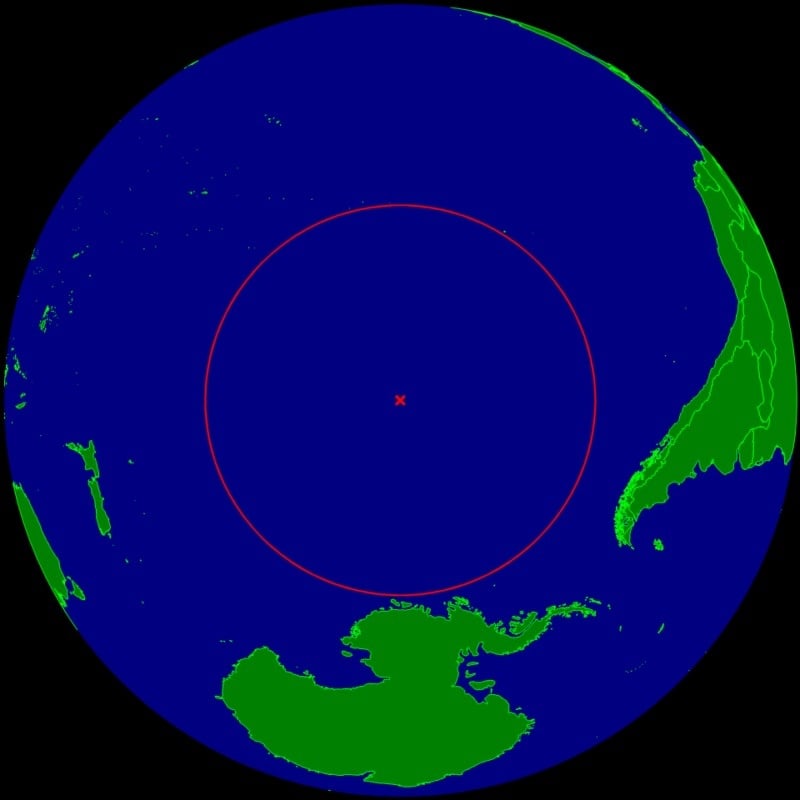 |
Point Nemo is located in the southern Pacific Ocean. Photo: Wikimedia. |
With its isolated location, Point Nemo is an ideal place for spacecraft to crash after completing their missions. Since its use in 1971, Point Nemo has served as the final resting place for over 270 spacecraft from the National Aeronautics and Space Administration (NASA) and several other space organizations.
"A desert in the middle of the ocean"
All That's Interesting calls Point Nemo the "inaccessible pole of the ocean" or the ocean's furthest point from land. Point Nemo is literally in the middle of nowhere, surrounded by over 1,600 km of ocean in every direction.
The islands closest to Point Nemo are also some of the most remote and rugged in the world . These include Pitcairn Island, a British overseas territory and the country's last remaining landmass in the Pacific, and Easter Island (Chile).
There are no inhabitants near Point Nemo. Therefore, scientists chose the name "Nemo" for the location, which in Latin means "no one," inspired by Captain Nemo's submarine in Jules Verne's novel Twenty Thousand Leagues Under the Sea .
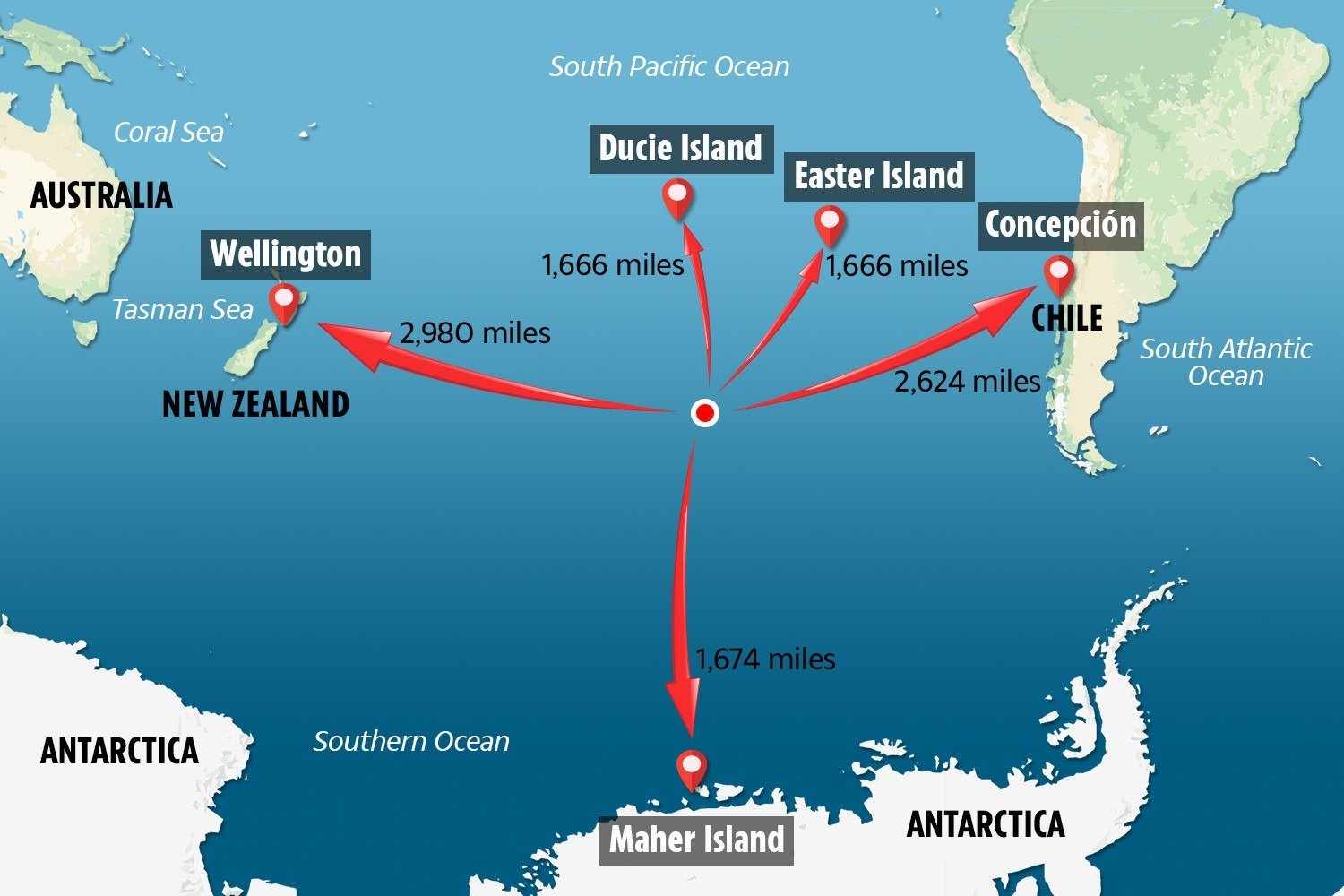 |
Point Nemo, in Latin, means "no-man's land." It's an invisible point in the middle of the Pacific Ocean, surrounded by Australia, South America, and New Zealand. Photo: The Sun. |
The people who "live" closest to this area are the scientists on the International Space Station (ISS). When flying past Point Nemo, the distance from the ISS to Earth is 360 km, much closer than any island on the planet's surface.
Even the first person to calculate the exact location of Point Nemo never visited it.
Specifically, the first person to discover the location of Point Nemo was Hrvoje Lukatela, a Canadian surveyor of Croatian origin. He used software to calculate the coordinates of the greatest distance between three equally spaced points, thus locating Point Nemo in 1992 without having to go there.
According to Live Science , the program calculated the coordinates as the greatest distance from three equally spaced land coordinates. Therefore, it is highly likely that no human has ever traveled through the exact coordinates of Point Nemo.
Not only are humans scarce, but the marine ecosystem here is also very underdiverted. Due to the nature of the ocean currents, this area is lacking in marine life, and there are no fishing boats because of the low nutrient content.
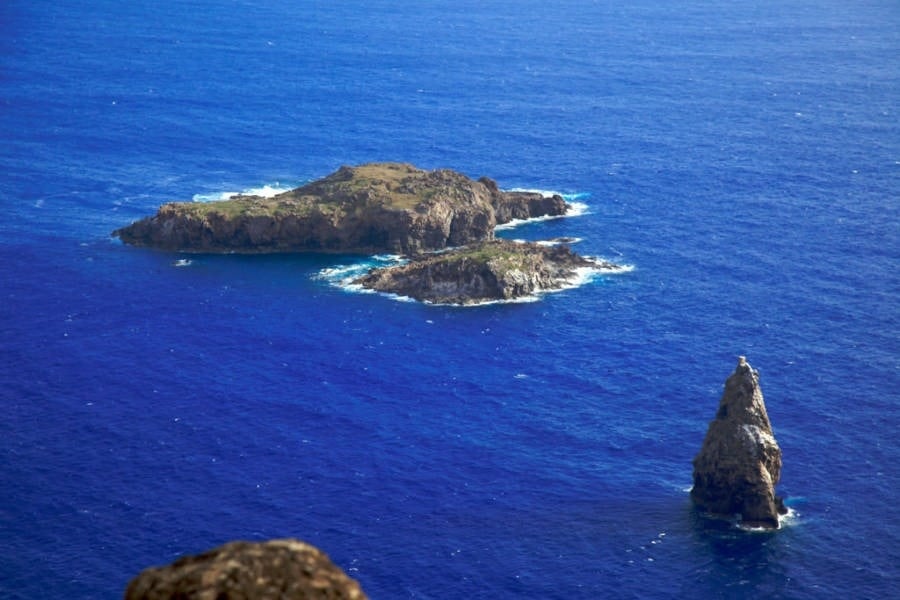 |
Motu Nui, one of the islands closest to Point Nemo. Photo: Flickr. |
Without any food source, sustaining life on Point Nemo in the middle of the vast ocean is nearly impossible.
"We were very surprised to find that the cell count on the surface of the South Pacific Ocean was about one-third lower than in the Atlantic Ocean current. This is probably the region of the ocean with the lowest cell count on the surface," said marine microbiologist Bernhard Fuchs of the Max Planck Institute for Oceanography in Germany after a trip in late 2015.
Mysteries surrounding Point Nemo
Vice describes Point Nemo as “the least biologically active area of the world’s ocean.” Yet, scientists were surprised when, in 1997, they discovered one of the loudest underwater sounds ever recorded near the ocean's apex.
Accordingly, a loud noise was heard about 2,000 km east of Point Nemo. The U.S. National Oceanic and Atmospheric Administration (NOAA) couldn't think of anything large enough to create such a loud sound underwater, so they dubbed it "The Bloop".
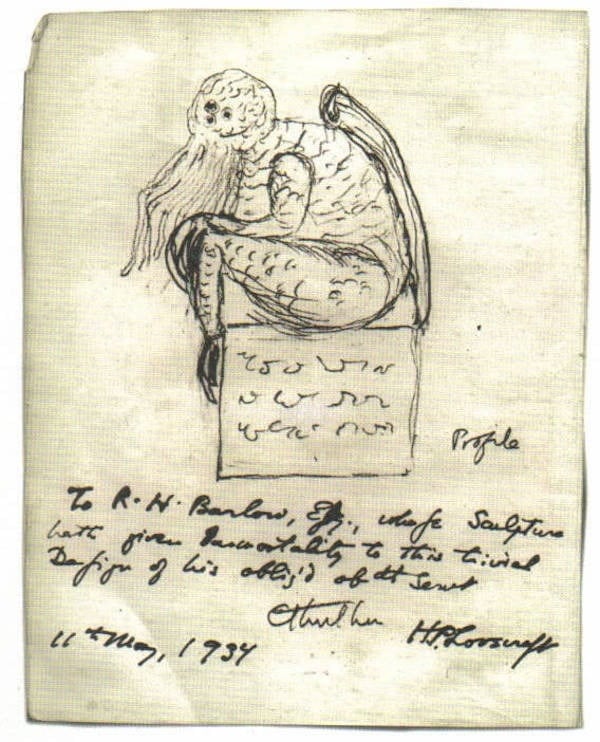 |
In his work, author H.P. Lovecraft placed the home of the mythical monster Cthulhu near the coordinates of Point Nemo in 1928, 66 years before Lukatela calculated Nemo's location. Photo: Wikimedia. |
The agency later concluded that it was simply the sound of ice breaking in Antarctica. However, science fiction enthusiasts quickly came up with a different explanation.
They cite that when writer H.P. Lovecraft first introduced his famous tentacled monster to readers in *The Call of Cthulhu* , he wrote that the creature's lair was the lost city of R'yleh in the South Pacific.
Coincidentally, R'yleh's coordinates are incredibly close to Point Nemo's coordinates, which is also where "The Bloop" appears.
Lovecraft first wrote about his sea monster in 1928, 66 years before Lukatela calculated Nemo's location. Therefore, some have speculated that this "desert in the ocean" is actually home to some undiscovered creature.
Because there is no life nearby, Point Nemo is the ideal place for spacecraft to crash after completing their missions. Since its use in 1971, Point Nemo has become the final resting place for more than 270 spacecraft from the US National Aeronautics and Space Administration (NASA) and several other space organizations.
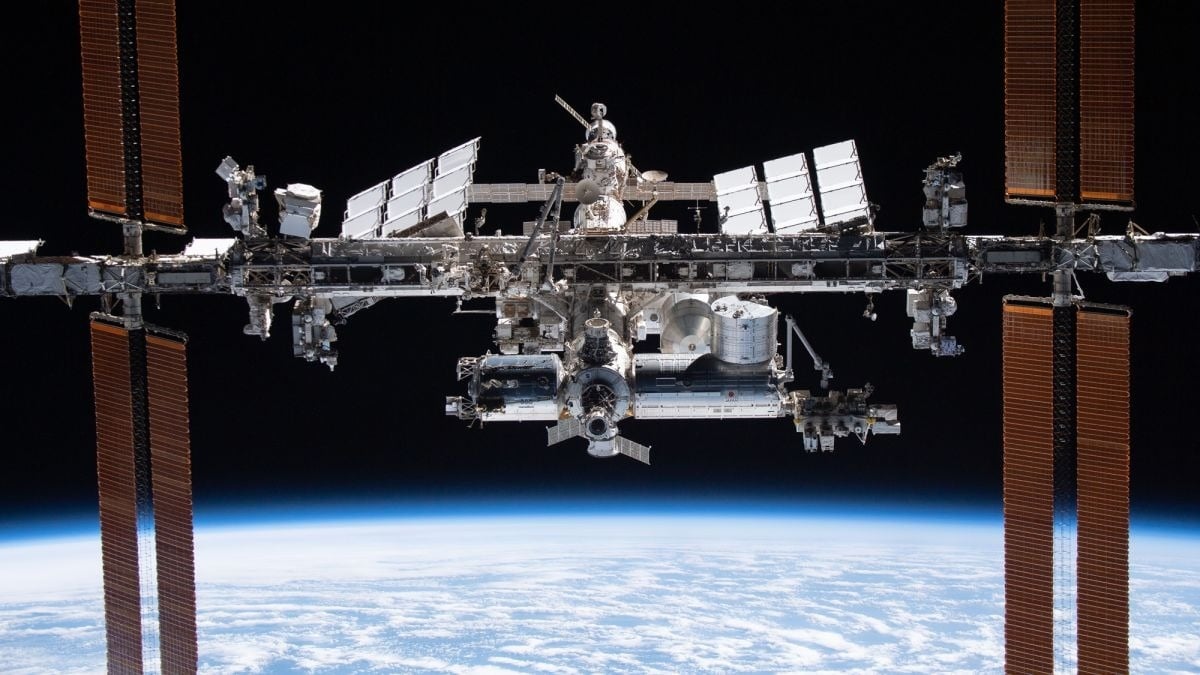 |
The International Space Station (ISS) is likely to be brought to Point Nemo in 2024. Photo: NBC News. |
Over a 45-year period, from 1971 to 2016, space agencies around the world brought 260 pieces of space debris to land in this area. With large objects like China's Tiangong 1 space station, which returned to Earth in 2018, the debris could stretch across the ocean for up to 1,600 kilometers.
The largest structure ever to fall at Point Nemo was the Russian Space Laboratory (MIR), weighing approximately 120 tons, which crashed in 2001 after 15 years of operation.
Many other spacecraft also rest at Point Nemo, such as European Space Agency transport ships, Japan's HTV cargo ship, and more than 140 Russian supply ships.
Source link































































































Comment (0)