

(NLĐO) - The Koleken inakayali beast closely resembles its T-rex relative, but has smoother skin and its forelimbs are almost completely absent.
Unusual fossil fragments unearthed in the Patagonia region of Argentina have helped paleontologists identify not just one species, but an entire new genus of dinosaur. This is the species Koleken inakayali, belonging to the genus Furileusauria.
This species lived 69 million years ago, near the end of the Cretaceous period, just 3 million years before the Chicxulub asteroid catastrophe wiped out all the dinosaurs, pterosaurs, griffins, ichthyosaurs, etc.
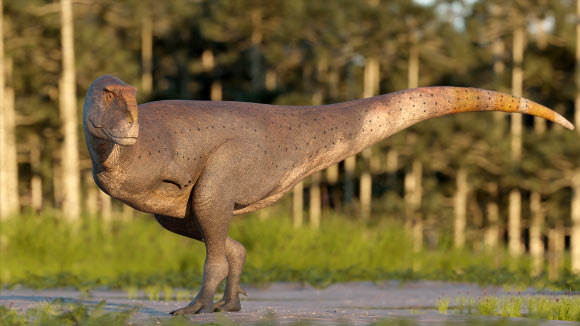
The appearance of the new monster Koleken inakayali has been recreated - Photo: Gabriel Díaz Yantén
According to an analysis by a research team from the Bernardino Rivadavia Natural Science Museum of Argentina and the National Council for Scientific and Technical Research of Argentina, this new species belongs to a larger group of dinosaurs called Abelisauridae.
Abelisauridae are distant relatives of the Tyrannosaurus Rex, which branched off from the mid-Jurassic period.
Therefore, the new beast's appearance shared many similarities with the T-rex and exhibited characteristics of theropod dinosaurs in general, including strong hind legs and shrunken "arms".
Koleken inakayali is perhaps one of the most severely atrophied "arms" in its lineage, with depictions showing them reduced to just two scraps of flesh.
However, the fossil remains of Koleken inakayali, including several skulls, nearly complete hind limbs, and other skeletal components, are sufficient to show that it was a dangerous carnivorous beast, according to a paper published in the scientific journal Classics.
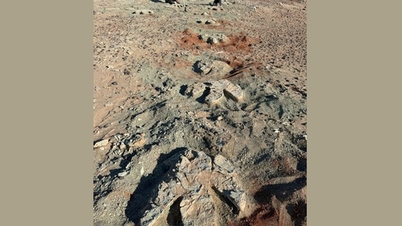
The fossil was found in the La Colonia Formation in the Cerro Bayo Norte area, eastern Sierra de La Colonia, in Chubut Province, Patagonia, Argentina.
The entire Patagonia region was once home to a vast array of ancient creatures, including herbivorous dinosaurs, reptiles, mammals, and amphibians.
Previously, another close relative of Koleken inakayali, Carnotaurus sastrei, had also been found in La Colonia.
This discovery further strengthens the evidence that Abelisauridae was the most abundant group of theropod dinosaurs during the late Cretaceous period, appearing in all regions of the southern supercontinent of Gondwana, except for Antarctica and Oceania.
Source: https://nld.com.vn/phat-hien-sat-thu-khong-tay-loai-quai-thu-moi-o-nam-my-196240528105309885.htm











![[GALLERY] Witnessing the first landing of an Italian F-35B fighter jet on a highway.](https://vphoto.vietnam.vn/thumb/402x226/vietnam/resource/IMAGE/2026/05/24/1779625960562_f-35b-della-marina-militare-2-jpg.webp)





















































































Comment (0)