

Bat Trang is not only famous for its pottery making, considered to create exquisite shapes from clay, but also as the cradle of a unique culinary tradition of the capital city.
Bat Trang is not only famous for its pottery making, considered to create exquisite shapes from clay, but also as the cradle of a unique culinary tradition of the capital city.
The artisan's feast
In the days leading up to Tet (Lunar New Year), Bat Trang ancient village in Gia Lam district, Hanoi , maintains its characteristic vibrancy as a long-standing pottery village – bustling with buyers and sellers, carts laden with goods, and villagers busily going in and out with their business affairs.
Deep within the village, where the imposing communal house overlooks the breezy Red River, lie about 20 ancient houses that have quietly stood for nearly several centuries. Connected to this space, the Bat Trang pottery tray has become the "soul" of the village's culture, a "hook" that draws visitors from all over to enjoy and admire its beauty.
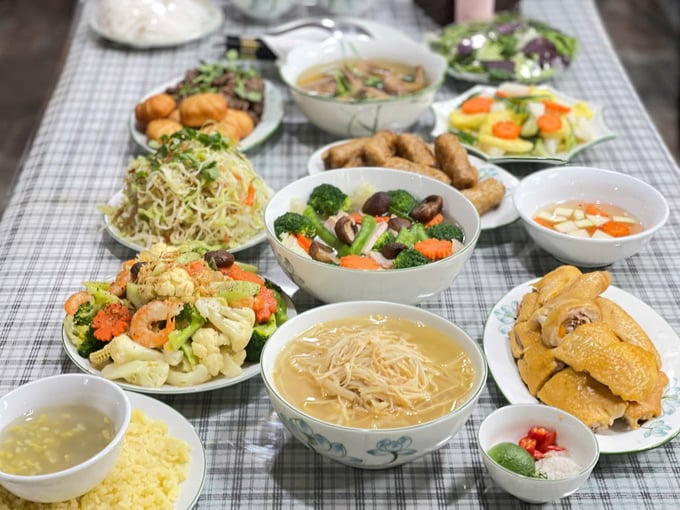
At first glance, the Bat Trang feast seems to have dishes similar to wedding or event banquets, but each dish on the platter is the result of a very meticulous process of selecting ingredients and cooking. Photo: Linh Linh.
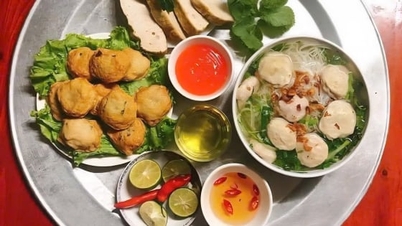
The Bat Trang feast is both familiar and unique, featuring many common dishes found every Tet (Lunar New Year) such as banh chung (sticky rice cake), nem ran (fried spring rolls), and canh tom gio thit moc (shrimp soup with meatballs)... But there are also some rather unusual dishes, which at first glance might be mistaken for a wedding feast, but in reality are indispensable dishes in Bat Trang's celebrations, festivals, funerals, and weddings for hundreds of years.
“Bat Trang's traditional feasts are elaborate, from the preparation of ingredients to the cooking methods. Even with the same dish and the same recipe, someone from outside the village might not be able to cook it as well as they do here,” said young culinary artist Pham Thi Dieu Hoai from Hamlet 2, Bat Trang, while busily preparing ingredients for about a dozen feasts to be served that day.
In the old days, due to its proximity to a large river, this area was a bustling trading hub with regions far and wide. Delicious and exotic foods from all over naturally arrived and were selected and adapted by the locals into everyday dishes. The skillful hands, carefulness, and perseverance stemming from their daily pottery work gradually refined these culinary traditions.
To live up to the value of traditional dishes, modern-day chefs like Ms. Hoai invest considerable effort in learning, maintaining, and developing them. Originally a lover of cooking, this petite woman has been recognized as one of the five youngest culinary artisans in the ancient village.
As one of the villagers who regularly maintains the culinary culture and also bears the "heavy responsibility" of a young culinary artist, Ms. Hoai focuses on and meticulously prepares each dish in the feast.
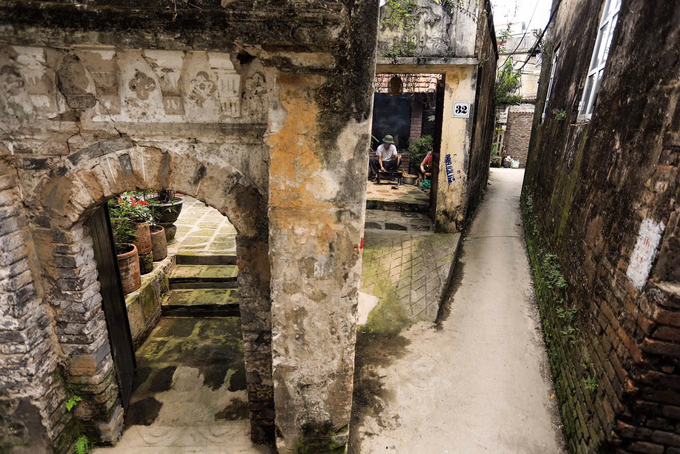
The path beside the ancient village temple leads to houses nearly a hundred years old, the birthplace of famous dishes from the capital city.
"Preparing a feast as an artisan is very different. Tourists come to me out of curiosity about the feast prepared by an artisan, so they not only enjoy it but also judge it. If it's not done properly, if I don't pay attention to each dish, it will not only affect my own brand but also the efforts of the village's culinary artisans over the past hundreds of years," Ms. Hoai shared.
Ms. Hoai is not the only one with this thought. As the next generation continuing his family's tradition of preparing traditional dishes, Mr. Le Huy, son of culinary artisan Nguyen Thi Lam from Hamlet 1, Bat Trang Village, also emphasized the two elements of "tradition" and "preservation" throughout his conversation over the traditional feast of the pottery village.
Without extensive advertising, Mr. Huy's kitchen consistently receives orders for 5-10 banquet meals daily during the Lunar New Year season, even resolutely refusing more orders to ensure the highest quality of the dishes. This is also the wish of artisan Nguyen Thi Lam, who is about to turn 90. Despite her limited health and inability to stand in the kitchen, she regularly inquires about and passes on her lifelong experience to the younger generation. Therefore, alongside her business acumen, the work of preparing banquet meals for guests from all over continues daily with dedication, aiming to preserve the family tradition and the unique culinary culture of the village.
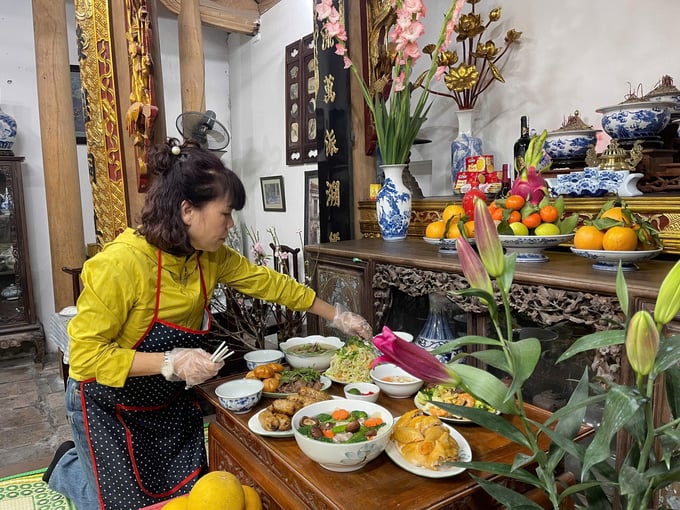
Ms. Hang, daughter-in-law of culinary artist Nguyen Thi Lam, is the next generation, continuing the family tradition of preparing feasts. Photo: Bao Thang.
"Family members actively participate in the cooking process, both to continue their parents' work and to maintain the joy and pride of the family. Making traditional dishes is a passion, a source of joy for us," Huy shared.
Meticulous attention to detail in every dish.
In the early days of the new year, a visit to Bat Trang to enjoy the new feast and experience the culinary sophistication of the pottery village is a must. Just consider the bamboo shoot and squid soup; when served, the bowl of soup, while not overly vibrant in color, possesses an elegant beauty. The delicate bamboo shoots and squid intertwine, blending in a rich broth that harmoniously combines the sweet and savory flavors of chicken broth, pork bone broth, and shrimp.
Artisan Pham Thi Dieu Hoai shared that the famous bamboo shoot and squid soup is renowned not only for its elaborate and meticulous preparation but also for its exquisite flavor, a perfect blend of precious ingredients from the mountains (bamboo shoots) and the sea (squid). This dish is not only a symbol of the harmony between earth and sky but also carries a profound meaning of the convergence of culinary excellence from all directions. Therefore, in the past, bamboo shoot and squid soup was considered a delicacy, once offered to the king as a symbol of reverence and elegance.
In special feasts, the famous squid and bamboo shoot soup not only demands sophistication but also requires the highest quality ingredients. The squid used must be fresh, caught squid, undergoing many elaborate processing steps such as peeling the shell, soaking in ginger wine to remove the odor, grilling over charcoal, then pounding and shredding it, and finally stir-frying it until golden brown to enhance the aroma. The bamboo shoots must also be the best parts, discarding the tender and tough ends, meticulously peeled into thin strands so that they are both soft and retain their natural crispness. Surprisingly, in today's advanced age, the process of peeling the bamboo shoots and squid to achieve these thin, toothpick-like strands is still done by hand with a needle and thread.
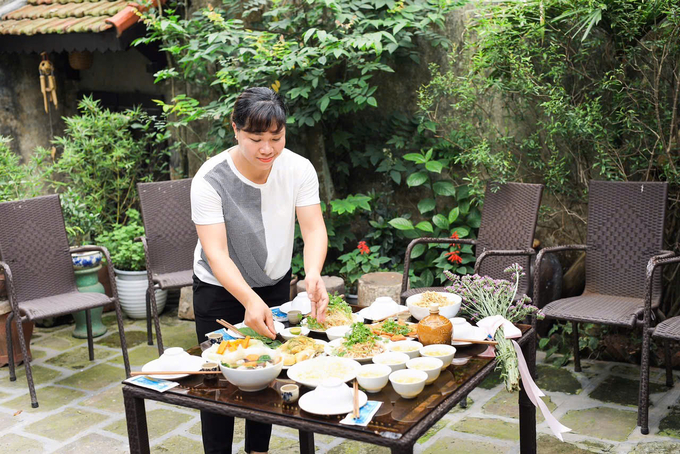
Artisan Pham Thi Dieu Hoai prepares a feast at the old house.
It's not just the people of Hanoi's Old Quarter who are refined in their cuisine; the people of Bat Trang also appreciate seasonal flavors, striving to capture the essence of nature in each dish. Just as flowers bloom in different seasons, some delicious dishes are only truly at their best when served in the right season. In February and March of the lunar calendar, when sardines and other fish return to the Red River, the Bat Trang village market bustles with fresh catches, waiting for artisans to select them.
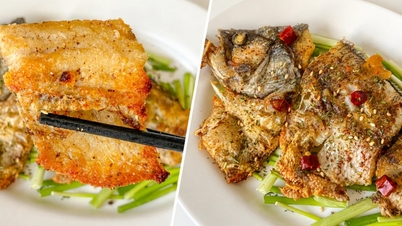
Sardines are often grilled, their skin crispy and their flesh rich and flavorful. Sardines, on the other hand, are prepared more elaborately by finely grinding the fish meat, skillfully mixing it with minced pork, dill, garlic, and chili peppers, then shaping it into small balls. Chefs can steam, fry, or cook these meatballs in a soup with green plums; each method of preparation creates a unique, rich yet delicate flavor.
The meticulous and elaborate preparation methods are unique to Bat Trang. That's why Mr. Le Huy can confidently say that if you were to share the recipes for Bat Trang's traditional dishes with curious guests, few could replicate their deliciousness and authentic taste. It is this refined expertise, passed down through generations, that, through the skillful and careful hands of the pottery village artisans, imbues each dish with the rich flavors of the past.
Source: https://nongsanviet.nongnghiep.vn/phong-vi-am-thuc-ben-lang-gom-co-d418077.html

![[Photo] General Secretary and President To Lam presides over a working session with the Central Policy and Strategy Committee on the development of the materials industry.](https://vphoto.vietnam.vn/thumb/1200x675/vietnam/resource/IMAGE/2026/05/21/1779359935432_a3-bnd-3129-1412-jpg.webp)


































































Comment (0)