

There's only one week left until the university entrance exam in South Korea, also known as Suneung.
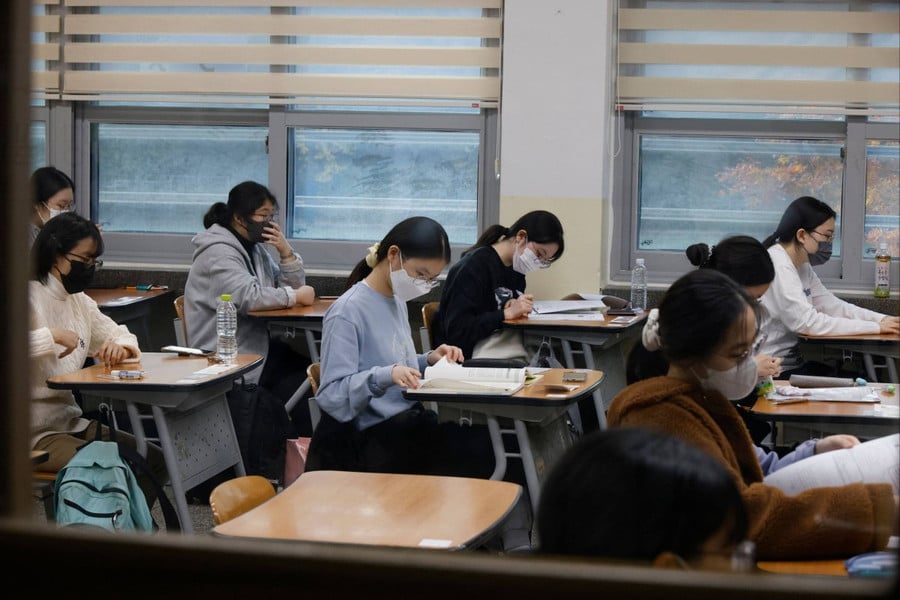
Korean students participate in the national university entrance examination.
To manage their children's anxiety before exams, many parents are rushing to buy pills advertised as making users smarter.
Lee, 18, currently attending a private high school in Incheon, South Korea, is one of the users of the medication. In addition, the student avoids fatty and starchy foods and adopts a healthy diet to maximize the drug's effectiveness.
Lee said, "I heard this is a traditional medicine that helps reduce anxiety symptoms like rapid heartbeat and sweaty hands, and improves concentration. Trying a medicine is better than doing nothing before an exam that could change my life."
The medication Lee used was called "Cheongsimhwan," advertised as a traditional herbal remedy for anxiety and stress. It's often used to recharge energy before an important event. For students, the medication helps treat excessive anxiety by stabilizing heart rate and blood circulation.
Similarly, many herbal remedies such as "gongjindan" and "cheonwangbosimdan" are now available on the market to improve anxiety and insomnia in students. These products are sold at pharmacies without a prescription. Traditional Chinese medicine practitioners also recommend using herbal remedies one or two weeks before exams.
However, the Korean Medical Association warns that using medication when students "don't feel overly anxious" can have negative effects such as diarrhea and dizziness, thereby affecting the results. The effects of various anti-anxiety supplements vary depending on each individual's body and the dosage used; without careful consideration of all factors, dangerous side effects can occur.
Besides traditional medications, parents and students are also turning to unregulated dietary supplements available on the market. These are advertised as enhancing cognitive abilities and performance. These products are available without a prescription and can be purchased online.
Furthermore, many people are even seeking out medications for attention deficit hyperactivity disorder (ADHD) to improve their concentration. Health authorities discovered nearly 700 cases of illegal sales of ADHD medication to 12th-grade students between August 4th and 14th. This number is three times higher than the period before the Suneung exam last November.
Instead of using medications of unknown origin and usage, healthcare professionals advise students, especially those preparing for university entrance exams, to eat a balanced diet to reduce anxiety.
Professor Baek Yu-jin, a family medicine expert at Sacred Heart Hospital in South Korea, warns parents and exam candidates against being swayed by misleading advertisements for dietary supplements that claim to "support learning" or "enhance memory." During the final stages of exam preparation, candidates should maintain their physical and mental health through a healthy, balanced diet rather than relying on supplements.
Professor Lee Hae-kook, a psychiatrist at the Catholic University of Korea, emphasized that ADHD medication is for patients who have difficulty regulating their cognition and behavior. Taking medication does not help students improve their concentration or cognitive abilities if they do not have ADHD; on the contrary, it can cause side effects such as loss of appetite, increased heart rate, insomnia, and even hallucinations.
Source: https://danviet.vn/phu-huynh-han-quoc-do-xo-mua-thuoc-thong-minh-20241109094017823.htm


![[Image] Nearly 125,000 Hanoi students completed the Literature exam for the 10th grade entrance exam.](https://vphoto.vietnam.vn/thumb/1200x675/vietnam/resource/IMAGE/2026/05/30/1780117233041_ndo_br_thiet-ke-chua-co-ten-2-png.webp)














![[Video] 2 candidates violate exam regulations on the first day of the 10th grade entrance exam in Hanoi.](https://vphoto.vietnam.vn/thumb/402x226/vietnam/resource/IMAGE/2026/05/30/1780156540244_dung01-11-24-36099still011-png.webp)


























































































Comment (0)