

For several months now, Mr. Tran Son (40 years old, residing in Hoang Mai, Hanoi) has been continuously advertising the sale of his homestay complex, spanning over 3 hectares in Ba Vi, on various information channels. Mr. Son's land includes over 500 square meters of residential land, which he purchased for 20 billion VND. At the end of 2021, his family invested an additional 15 billion VND to build the homestay complex with over 5 spacious and well-equipped villas, hoping to develop a resort tourism business model, utilizing the large land area while also providing additional work and income for the whole family. However, running a homestay business is not simple; upon operation, his family discovered numerous problems and expenses.

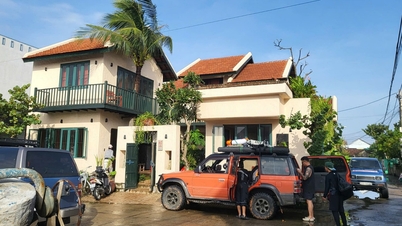
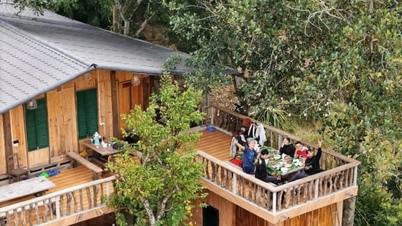
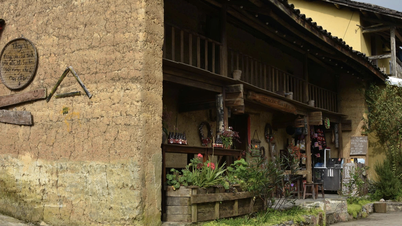
The homestay business is sluggish even in the middle of the peak tourist season. (Illustrative image)
Due to significant borrowing for investment, burdened by high interest rates, and low profit margins, Mr. and Mrs. Son decided to sell their homestay to recoup some of their capital. The asking price has been drastically reduced, but so far, no buyers have been found. The number of inquiries is also low, as the land value is considerable, and the homestay business is no longer as booming as before.
" While homestays boomed as a new trend in the real estate business many years ago, this model has now become saturated, even resulting in losses ," Mr. Son said sadly.
Sharing Mr. Son's opinion, Ms. Pham Loan (owner of a homestay in Luong Son - Hoa Binh ) admitted that operating a homestay is not simple at all. “ Besides buying land, designing and building a homestay is very expensive because it's not just about building the house; we also need to have complete infrastructure to ensure a beautiful and attractive natural landscape. The newer, more unique, and better-invested the homestay is, the more tourists it will attract. However, compared to the money invested, the profit generated is currently insufficient to cover expenses, while most business owners have to borrow from banks. Especially in the current period of high interest rates, carrying the burden of interest is truly a huge weight ,” Ms. Loan said.
According to Ms. Loan, despite being well-invested, her homestay business suffers from inconsistent tourist numbers. “ The company has spent money selling to customers through various travel channels, even investing in advertising and increasing interaction on social media, but the number of guests is not high, and rooms are rarely fully booked. Meanwhile, the homestay owner still has to maintain staff to ensure operation. Even in a favorable business environment, it takes 5 years for a homestay investor to recoup their investment. Therefore, anyone using financial leverage in this type of business is facing a high risk of bankruptcy ,” Ms. Loan added.
Ms. Nguyen Hong Nhung, a homestay investor for many years, said that the homestay market "collapsed" partly because many people rushed to invest following the trend without anticipating the real estate market bottoming out from mid-2022 to the present. " Most of the friends I've met later in the homestay business are newcomers, following the trend when the market was booming three years ago. At that time, interest rates were only 7-8%, but now the interest rates investors are facing are up to 12-13%. With interest rates still high, the real estate market sluggish, and the economy struggling, resulting in low tourist numbers, how can homestay businesses possibly be profitable? Many homestay investors are now trying to operate at a minimal level, while the majority are looking to sell off their properties ."
A survey by VTC News reporters also shows that there is a lot of information about homestay properties for sale on current online forums.
On the Homestay Ba Vi, Hanoi fanpage, a nearly 7000 m2 homestay (including 200 m2 of residential land), recently built but still under construction, is being offered for sale at a discounted price of 9 billion VND. According to real estate agents, the homestay is estimated to be worth between 13-15 billion VND. However, due to financial pressure, the owner needs to sell quickly and is accepting an unprecedentedly deep price reduction.

Homestay for sale on real estate channels. (Screenshot)
On the Hoa Binh homestay channel, a homestay in Luong Son, spanning 6,000 square meters, including 400 square meters of residential land, is also being advertised for sale at over 15 billion VND. A real estate agent stated that this figure is only 70% of the initial investment value of the homestay business owner.
In Ba Vi, the owner of a 1.4-hectare plot of land, considered to have a prime location with a lake and stream ideal for tourism and resort development, is offering it for sale at 26 billion VND.
A homestay resort in Yen Bai, Ba Vi, with an area of 2,500 m2 and 500 m2 of residential land, is being advertised for 24 billion VND.
According to Pham Van Nam, a real estate broker specializing in resort properties in the areas surrounding Hanoi, the number of clients listing homestays for sale has increased two to three times compared to previous years. Although prices have been reduced, the number of successful transactions remains low. “ I haven’t even closed a single homestay deal since the beginning of the year. This isn’t just because the real estate market is at its lowest point, but largely because the trend of investing in homestays has become saturated. The ‘city-to-country’ trend is no longer popular. Now, if they have money, most real estate investors still choose safer investment channels in major centers, mainly properties in the city to preserve property value, rather than buying homestays in suburban areas. Furthermore, in the context of banks tightening credit, high interest rates, and a sluggish tourism business, few people dare to invest in homestays .”
Commenting on the current homestay market segment, Mr. Nguyen Van Dinh - Chairman of the Vietnam Real Estate Brokers Association - warned about the use of financial leverage for business. According to Mr. Dinh, there have been many lessons learned, even losses of assets, due to investing with borrowed capital without properly calculating the balance of interest rates and income-expenses. In particular, running a homestay business requires a great deal of knowledge and practical experience in managing cash flow, investment efficiency, operations, and customer service.
" Any type of real estate project needs to avoid the phenomenon of mass investment and following trends, because abusing this can easily lead to collapse. In reality, currently in many suburban areas of Hanoi, it is common for more than half of villages and communes to develop homestays and resorts, while the number of tourists coming to experience them is sparse, not enough to generate profits compared to the capital invested ," Mr. Dinh said.
Dao Bich
Beneficial
Emotion
Creative
Unique
Wrath
Source





























































































Comment (0)