

With temperatures exceeding 1,000 degrees Celsius, very few objects can stop the flow of volcanic lava.
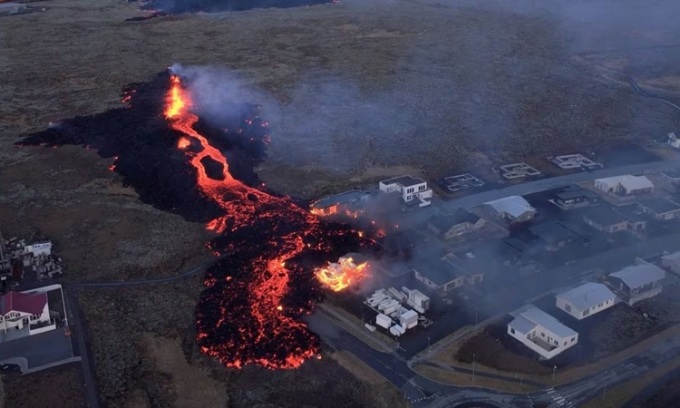
Lava flowing from the volcano caused houses to catch fire in Grindavik on January 14. Photo: Bjorn Steinbekk
Lava flows erupted from the Sundhnúkur volcanic system in southwestern Iceland on January 14, 2024. The lava blocked numerous roads and surged from a new fissure into the outskirts of the coastal town of Grindavík, burning at least three homes in its path. Nearby, construction vehicles that had been working for weeks to build earth dams and barriers in an attempt to divert the lava flow were forced to retreat, according to Popular Science .
Humans have tried many ways to stop lava flows in the past, from attempting to freeze them in place with seawater to using explosives to block the supply and building earthen barriers. It is too early to determine whether the Icelandic earth dam will successfully save the town of Grindavík, with its approximately 3,500 residents and nearby geothermal power plant. However, the most successful efforts to stop or divert lava flows have included building dams like the one in Iceland.
Lava is a slow-flowing, viscous liquid similar to asphalt. It is subject to gravity, so like other liquids, it will flow from high to low along the steepest slope. With molten rock temperatures typically above 1,000 degrees Celsius, few objects can block the flow of lava.
The lava solidifies along its path.
In 1973, Icelanders conducted their most famous experiment: "freezing lava." They used water jets from small boats and fishing vessels to protect the community on Heimaey Island from the lava flow of Mount Eldfell. The lava flow threatened to close a harbor crucial to the region's fishing industry. The eruption ended before authorities could fully assess the success of the measure, but the harbor was not destroyed.
Dealing with lava using explosives.
Hawaiians used explosives dropped from airplanes in 1935 and 1942 to block lava flows from Mauna Loa, which threatened the town of Hilo on the Big Island. Their idea was to block the channel or tube of lava within the volcano that supplied lava to the surface. None of these attempts were successful. The explosives created new channels, but the newly formed lava flows quickly merged with the existing ones.
Lava barriers and diversion
Recent efforts have focused on a third approach: constructing dams or channels to divert lava flows along different slopes. These have yielded both successes and failures, but diversion is considered successful if it can channel the lava into a separate area where it flows naturally without threatening other communities. However, many lava diversion attempts have failed. For example, barriers built in Italy to contain the lava flow from Mount Etna in 1992 slowed the flow, but the lava eventually overflowed them.
Iceland's efforts to divert lava flows.
Icelandic authorities evacuated residents in Grindavík in November 2023 after several earthquakes revealed the nearby volcanic system had become active again. Shortly afterward, construction began on a barrier to protect the town and nearby crucial infrastructure, the Svartsengi geothermal power plant. Construction was halted in mid-December last year when the first volcanic eruption occurred 4 km northeast of Grindavík, but resumed in January 2024. Construction continued when magma surged to the surface again on January 14th.
Redirecting lava in this area is difficult, partly because the land around Grindavík is relatively flat. This makes identifying a clear alternative ramp to divert the lava more challenging. On January 15, Icelandic authorities announced that most of the lava from the main fissure was flowing outside the containment barrier; however, a new fissure had opened inside the outer perimeter, allowing lava to flow into residential areas, thus keeping Grindavík under threat.
An Khang (According to Popular Science )
Source link

![[Live] 2025 Community Action Awards Gala](/_next/image?url=https%3A%2F%2Fvphoto.vietnam.vn%2Fthumb%2F1200x675%2Fvietnam%2Fresource%2FIMAGE%2F2025%2F12%2F16%2F1765899631650_ndo_tr_z7334013144784-9f9fe10a6d63584c85aff40f2957c250-jpg.webp&w=3840&q=75)
![[Photo] Prime Minister Pham Minh Chinh receives the Governor of Tochigi Province (Japan)](/_next/image?url=https%3A%2F%2Fvphoto.vietnam.vn%2Fthumb%2F1200x675%2Fvietnam%2Fresource%2FIMAGE%2F2025%2F12%2F16%2F1765892133176_dsc-8082-6425-jpg.webp&w=3840&q=75)
![[Image] Leaked images ahead of the 2025 Community Action Awards gala.](/_next/image?url=https%3A%2F%2Fvphoto.vietnam.vn%2Fthumb%2F1200x675%2Fvietnam%2Fresource%2FIMAGE%2F2025%2F12%2F16%2F1765882828720_ndo_br_thiet-ke-chua-co-ten-45-png.webp&w=3840&q=75)
![[Photo] Prime Minister Pham Minh Chinh receives Lao Minister of Education and Sports Thongsalith Mangnormek](/_next/image?url=https%3A%2F%2Fvphoto.vietnam.vn%2Fthumb%2F1200x675%2Fvietnam%2Fresource%2FIMAGE%2F2025%2F12%2F16%2F1765876834721_dsc-7519-jpg.webp&w=3840&q=75)
![[Image] The tenacious fighting spirit of Vietnamese women's football](/_next/image?url=https%3A%2F%2Fvphoto.vietnam.vn%2Fthumb%2F1200x675%2Fvietnam%2Fresource%2FIMAGE%2F2025%2F12%2F17%2F1765990260956_ndo_br_4224760955870434771-copy-jpg.webp&w=3840&q=75)






















































![[Live] Closing Ceremony and Award Presentation for the "Impressive Vietnam Tourism" Video/Clip Creation Contest 2025](https://vphoto.vietnam.vn/thumb/402x226/vietnam/resource/IMAGE/2025/12/17/1765974650260_z7273498850699-00d2fd6b0972cb39494cfa2559bf85ac-1765959338756946072104-627-0-1338-1138-crop-1765959347256801551121.jpeg)



















Comment (0)