

Tet in a place of splendor
Sharing her thoughts on the Lunar New Year, Dr. Nguyen Thi Nguyet, a specialist in folklore research, stated that the Lunar New Year has very ancient origins, closely linked to the rice- farming agricultural civilization. The New Year plays a particularly important role in the cultural and spiritual life of the Vietnamese people, not only as the biggest holiday of the year but also as a time when many historical, social, and spiritual values, accumulated over thousands of years, converge. The New Year is also closely associated with traditional customs, from family reunions and ancestral offerings to giving lucky money and praying for good fortune at the beginning of the year, all creating a sacred and warm atmosphere of spring.
 |
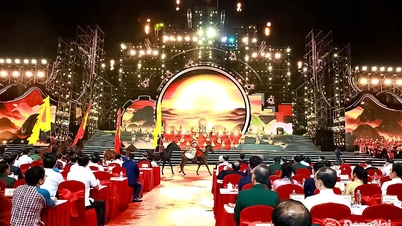
| Recreating traditional Tet celebrations in the "Vietnamese Tet at Thang Long Imperial Citadel" program in 2025. Photo: VNA |
In the minds of every Vietnamese person, Tet (Lunar New Year) always includes "fatty pork, pickled onions, red couplets / New Year's pole, firecrackers, green sticky rice cakes." However, the traditional Tet, especially Tet in the royal court, was quite different. The appeal of Tet in the golden age lies in the author's vivid and relatable portrayal of Tet life in the royal court. Tet was not only a time for rest and celebration but also a particularly important time politically and culturally. In the first days of the year, the king, on behalf of the nation, performed grand ceremonies such as offering sacrifices to heaven and earth, bestowing a new calendar, and rewarding his officials, demonstrating the central role of royal power in the spiritual life of society.
 |
The author views Tet (Vietnamese Lunar New Year) from a royal court perspective, a viewpoint unfamiliar to most modern readers. In this opulent setting, Tet begins very early, with a series of ceremonial and administrative preparations. The book guides the reader through the rhythm of spring in the royal court: from pre-Tet preparations with their meticulous rituals to the main Tet days and early-year activities. Through each small story, the reader gains a deeper understanding of why each ritual carries profound meaning, reflecting the ancient people's conception of social order, the relationship between humans and nature, and the divine.
The book states: “During Tet (Lunar New Year), the feudal court of our country conducted a series of complex rituals, but focused on two main aspects: sacrifices and ceremonies. Regarding sacrifices, the most important was the king offering sacrifices to heaven and earth, to the gods and spirits, and to his ancestors. The king, as the “Son of Heaven,” would represent the people in offering sacrifices to heaven, praying for a prosperous new year…” Along with this are many interesting stories, from the spring military drills, the spring sacrifices, King Gia Long celebrating Tet in Thang Long, King Minh Mang celebrating Tet, the prince's opening of the school year… to the court's pastimes during Tet. These include court music , the king's first cup of tea of the new year, and even measures to prevent gambling at the beginning of the new year.
According to the author, today's readers will be curious about whether the king rewarded his subjects during Tet (Vietnamese New Year), and how the rituals of worship in the Vietnamese court differed from those in other culturally similar countries. The answers will be provided in this small book. The author also hopes that through this book, young readers will learn many interesting things, thereby gaining a better understanding of the dynasties, history, and culture of their country.
Further appreciate traditional cultural values.
Although based on historical sources, "Tet in the Golden Land" avoids the dry tone of purely historical books. The author chooses a gentle storytelling style, focusing on details of daily life, making the images of kings and officials celebrating Tet, enjoying the festivities, going on spring excursions, or organizing ceremonies appear both dignified and approachable.
In "Tet in the Golden Age," readers will also realize that many Tet customs today originated from the royal court and then spread to folk life. This helps us understand that Tet is not just a traditional holiday but also the culmination of history, culture, and layers of time.
When writing about Tet in the opulent royal court, author Yen Ba stated: "I boldly call it a 'history,' because the author primarily relies on the vast historical records of our ancestors, meticulously selecting, compiling, and connecting facts, characters, and stories to form smaller narratives, so that people today can learn about the past, how the royal court celebrated spring and Tet."
With its rich cultural content, accessible writing style, and themes perfectly suited to the springtime atmosphere, "Tet in the Golden Land" is a worthwhile read during the Tet holiday. Beyond simply learning about the past, the book inspires readers to appreciate the traditional cultural values that have shaped the identity of Vietnamese Tet over the centuries.
Reader Nguyen Thi Huyen (residing in Tran Bien ward, Dong Nai province) commented: Tet is also an opportunity to read and understand the traditional Tet of the nation, especially Tet of the past. One value of Tet in the imperial court is its ability to connect the past with the present. When understanding the Tet in the imperial court, we can easily recognize that many folk Tet customs today have their roots in the ancient court rituals. The rituals have been simplified and modified to suit everyday life, but the core spirit - the yearning for roots, the desire for harmony, and a new beginning - is still preserved. Therefore, the book not only provides knowledge but also helps readers view modern Tet with a more understanding and appreciative eye.
Nhat Ha
Source: https://baodongnai.com.vn/dong-nai-cuoi-tuan/202602/tet-xua-qua-sach-f0729d7/
![[Photo] General Secretary and President To Lam works with the Party Committee of the Ministry of Health on the work of Vietnamese traditional medicine.](https://vphoto.vietnam.vn/thumb/1200x675/vietnam/resource/IMAGE/2026/05/20/1779294323718_a1-bnd-2978-3319-jpg.webp)
![[Image] "Journey of Hope" promotes the organ and tissue donation movement in Vietnam.](https://vphoto.vietnam.vn/thumb/1200x675/vietnam/resource/IMAGE/2026/05/20/1779294400833_1-8910-jpg.webp)
![[Photo] National Assembly Chairman Tran Thanh Man working with the Standing Committee of the National Assembly's Delegation Affairs Committee.](https://vphoto.vietnam.vn/thumb/1200x675/vietnam/resource/IMAGE/2026/05/20/1779294340023_ndo_br_1-1691-jpg.webp)












































Comment (0)