


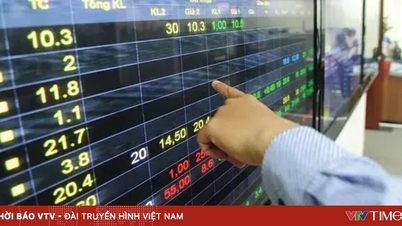
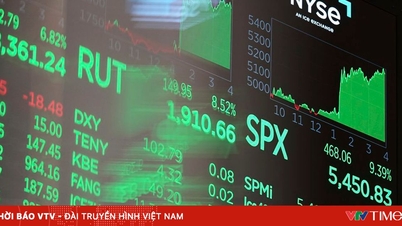
Many experts believe that the Vietnamese stock market is lacking institutional investors, especially foreign ones. - Photo: QUANG DINH
In 2023, Vietnam only raised just over $7 million through IPOs, a fraction of Indonesia's IPO value, due to a lack of companies going public, insufficient quality offerings, and failure to attract large institutional investors.
At the July dialogue themed "Upgrading, Raising Capital, and Developing Institutional Investors," organized by the Securities Journalists Club, experts acknowledged that the Vietnamese stock market is like a "restaurant"—lacking food, poor service, etc.—so investors will go elsewhere.
Too few institutional investors
Speaking at the dialogue, Mr. Nguyen Duc Chi, Deputy Minister of Finance , stated that for a high-quality, sustainably developing stock market, institutional investors must account for a large proportion. Meanwhile, despite the number of securities accounts reaching 8 million, the proportion of institutional investors in the Vietnamese stock market remains very modest.
"We don't need a huge number of accounts; even with only 6 million accounts, having 50% of them being institutional investors would be reasonable," Mr. Chi said, adding that only when Vietnamese investors change their mindset and invest through professional organizations instead of "self-managing assets and investing in securities themselves" can the number of institutional investors increase.
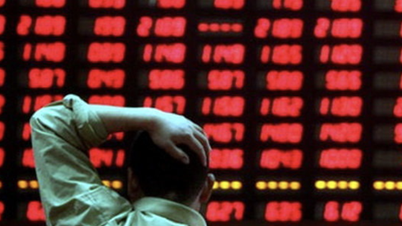
Ms. Vu Thi Chan Phuong, Chairwoman of the State Securities Commission, also stated that in developed markets, the proportion of institutional investors is at 50-60%. In contrast, in Vietnam, individuals account for over 90%, and investment is often driven by psychology. "Many times the market fluctuates unpredictably, ultimately mainly due to psychological factors and a lack of stability," Ms. Phuong said.
According to Ms. Phuong, the Vietnamese market is like "a person wearing tight clothes," needing to move forward. "The State Securities Commission will soon announce the final draft for public consultation on amending four circulars related to the securities market, with many new points proposed by the regulatory body after consulting and incorporating feedback from relevant parties," Ms. Phuong said.
"We need to remove overly strict conditions and create more favorable conditions for institutional investors to participate more in the stock market," Mr. Chi said, adding that the Ministry of Finance will facilitate and open up operations for various types of investment funds. For example, the State Securities Commission has sought opinions on whether foreign investors need to deposit 100% of the funds in order to upgrade the stock market.
The quality of goods has not improved.
The market needs to be upgraded to have a chance to attract foreign capital. But once investors are there, what will they buy if the market lacks quality products? To attract more institutional investors, especially foreign institutional investors, experts agree that the quality of available products needs to be improved.
Mr. Nguyen Son, chairman of the Vietnam Securities Depository and Clearing Corporation (VSDC), acknowledged that the stock market lacks innovation, especially in terms of commodities. "The public offering phase is limited, lacking promising new businesses and corporations...", Mr. Son said.
While there is significant potential for the sale and privatization of state-owned enterprises, Mr. Le Thanh Tuan, Deputy General Director of the State Capital Investment and Business Corporation (SCIC), stated that it is not easy for domestic and foreign institutional investors to participate in the purchase and sale of state-owned shares.
"Many foreign institutional investors want to conduct transactions through negotiated agreements, while the divestment and equitization of state-owned enterprises must be carried out through auctions and information disclosure as required by regulations...", Mr. Tuan said.
According to Mr. Bui Hoang Hai, Vice Chairman of the State Securities Commission, Vietnam's stock market liquidity is the second highest in Southeast Asia. "However, like a restaurant, if the food is scarce or the service is poor, investors will go elsewhere," Mr. Hai said, adding that pre-funding should be removed soon and conditions should be created to give foreign investors equal access to information.
Citing information that only about 3 Vietnamese stocks were in the MCSI index in 2017, financial expert Nguyen Duc Hung Linh believes that the Vietnamese stock market is severely lacking in options. However, even after an upgrade, there is still a possibility of "downgrading." "We are trying very hard to get in, but what is important is the assessment of the Vietnamese market by foreign investors," Mr. Linh said.
The market lacks new elements.
Also at the dialogue, Dominic Scriven, chairman of Dragon Capital, said that over the past four years, foreign investors have sold a net $4 billion worth of shares in the Vietnamese stock market. Of that amount, approximately $2 billion was sold in the first half of this year alone.
Aside from objective factors such as the increase in US interest rates, Dominic Scriven believes that the Vietnamese market lacks many new and interesting elements to attract the attention of foreign investors.
The fact that the Vietnamese market has not yet been upgraded also impacts the decisions of many foreign investors, not to mention a number of events in the last two years that have affected their perception of risk.
Source: https://tuoitre.vn/them-hang-chat-luong-chung-khoan-moi-hap-dan-20240720084436306.htm






















































































Comment (0)