

Unusual natural disasters
According to data from the Department of Dike Management and Disaster Prevention and Control, the total damage caused by natural disasters from the beginning of 2025 to date is estimated at over 85,099 billion VND.
The pattern of typhoons has also been reversed, with the first typhoon of the season heading straight towards central Vietnam, while the last one hits northern Vietnam – a rare occurrence in Vietnam's history.
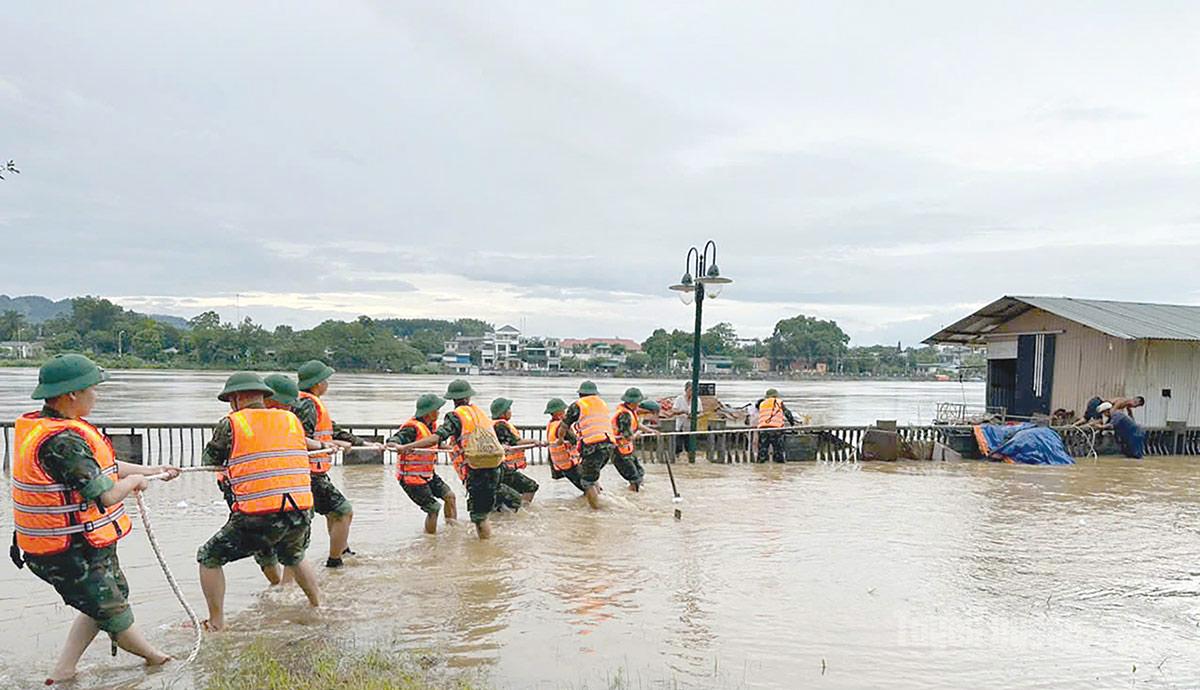 |
| Officers and soldiers of Regiment 247, under the Provincial Military Command, actively assisted owners of floating houses in Minh Xuan ward in relocating and securing their houses to ensure safety. |
More significantly, recent storms have caused extreme heavy rainfall, leading to historically high flood levels on many rivers, such as the Lo River exceeding the 1969 level by 0.90 m, causing severe flooding.
In addition, many areas have been hit by successive natural disasters, creating a situation of "storm after storm, flood after flood," flash floods, and landslides, especially in the mountainous and midland provinces of Northern and South Central Vietnam, which have seriously threatened traffic safety, dikes, and dams; many people, houses, and properties have been swept away by floods.
In Tuyen Quang, the heavy rains and floods caused by typhoons No. 10 and No. 11 resulted in damages exceeding 4,300 billion VND. Thousands of houses were submerged, transportation infrastructure was severely affected, the lives and production of people and businesses were paralyzed, and tourism also suffered the same fate…
According to the Ministry of Agriculture and Environment , preliminary figures show that this year's natural disasters have reduced Vietnam's growth by 0.2 percentage points. The damage caused by successive storms and floods represents not only significant losses of life, property, and the economy, but also disruptions to livelihoods, deep emotional pain for the people, and a stagnant state of the local economy.
This clear lesson further confirms that proactively responding to climate change is no longer an option, but the only path to sustainable development. Only by translating proactiveness into consistent action can we escape the vicious cycle of "damage - remediation - further damage".
It's not just about proactively forecasting and warning about weather patterns and natural disasters using easily understandable illustrations that show the impact on each target group; increasing the capacity of the political system early and from afar, especially for local governments at the commune and ward levels, but responding to climate change is also a sustainable development challenge.
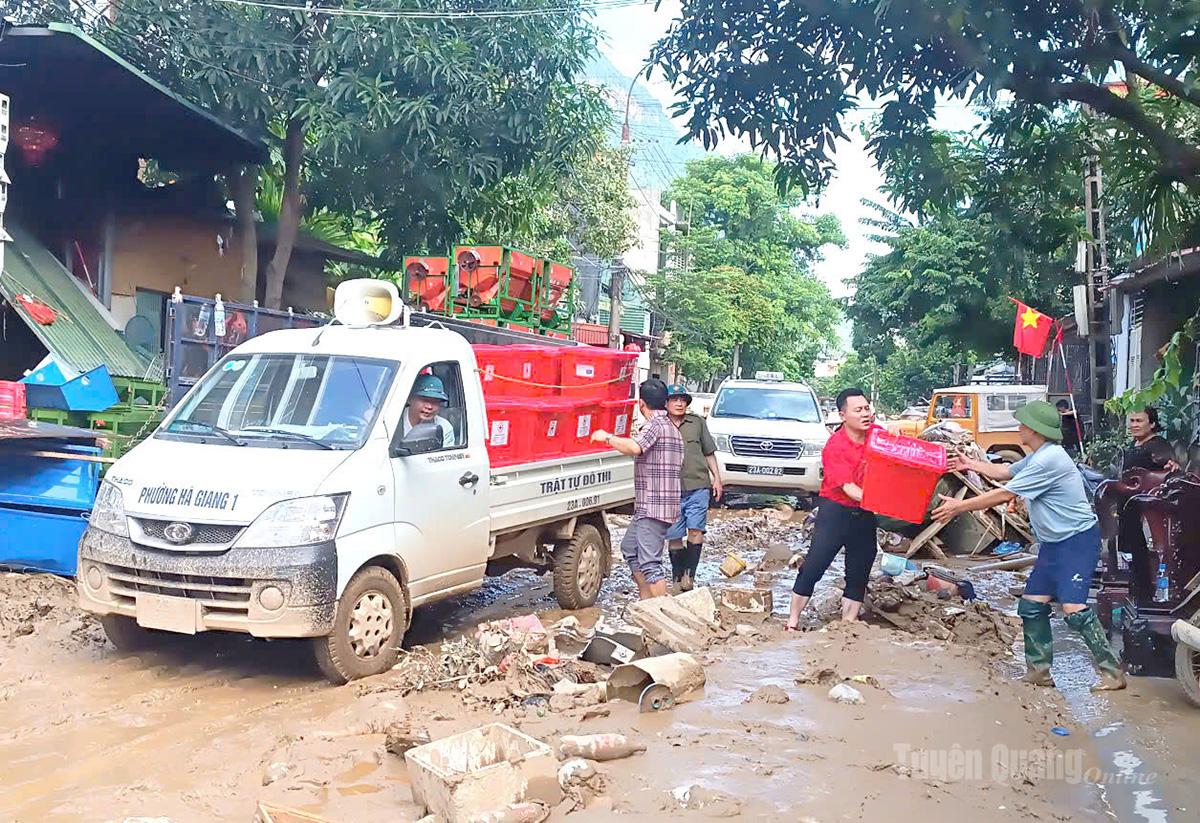 |
| The relief supplies from the Central Committee of the Red Cross Society were delivered directly to the people affected by Typhoon No. 10. |
Ms. Vu Thi Thu, Director of the Provincial Meteorological and Hydrological Station, stated: In the context of increasingly severe climate change and unpredictable weather patterns, the work of forecasting impacts and warning of natural disaster risks at the Provincial Meteorological and Hydrological Station plays a crucial role in minimizing damage. With state investment, forecasting and warning equipment for natural disasters is being upgraded and modernized; the development of the meteorological and hydrological station network helps to make forecasting impacts and warning of natural disaster risks faster, more effective, and more accurate. In addition to cooperating with network operators and mass media channels to provide comprehensive weather reports and flood warnings via telephone, television, and radio, the Provincial Meteorological and Hydrological Station has worked with local authorities to broadcast bulletins on wireless radio systems in case of power outages or loss of telephone signal during major floods.
Comrade Bui Chi Thanh, Deputy Head of the Irrigation Sub-Department, said: People in many flood-affected areas have shifted to a proactive response, using forecasts as a "guiding principle" for their actions. This is a positive change in the culture of disaster response. People have proactively monitored warning bulletins through various information channels, instead of relying solely on word-of-mouth announcements. Continuous interaction and information updates help them make timely decisions about moving their assets.
Proactiveness is not only an individual action but also strongly demonstrated through community spirit. Currently, each commune and ward has at least one disaster prevention and response task force. This is a crucial link in transmitting forecast information to every household, assisting the elderly and disabled in relocation, and participating in on-site rescue and relief efforts. The "four on-site" principle, applied by the people of Tuyen Quang after two years of responding to extreme storms and floods, is not just a slogan but has become a practical action, with the community as the core.
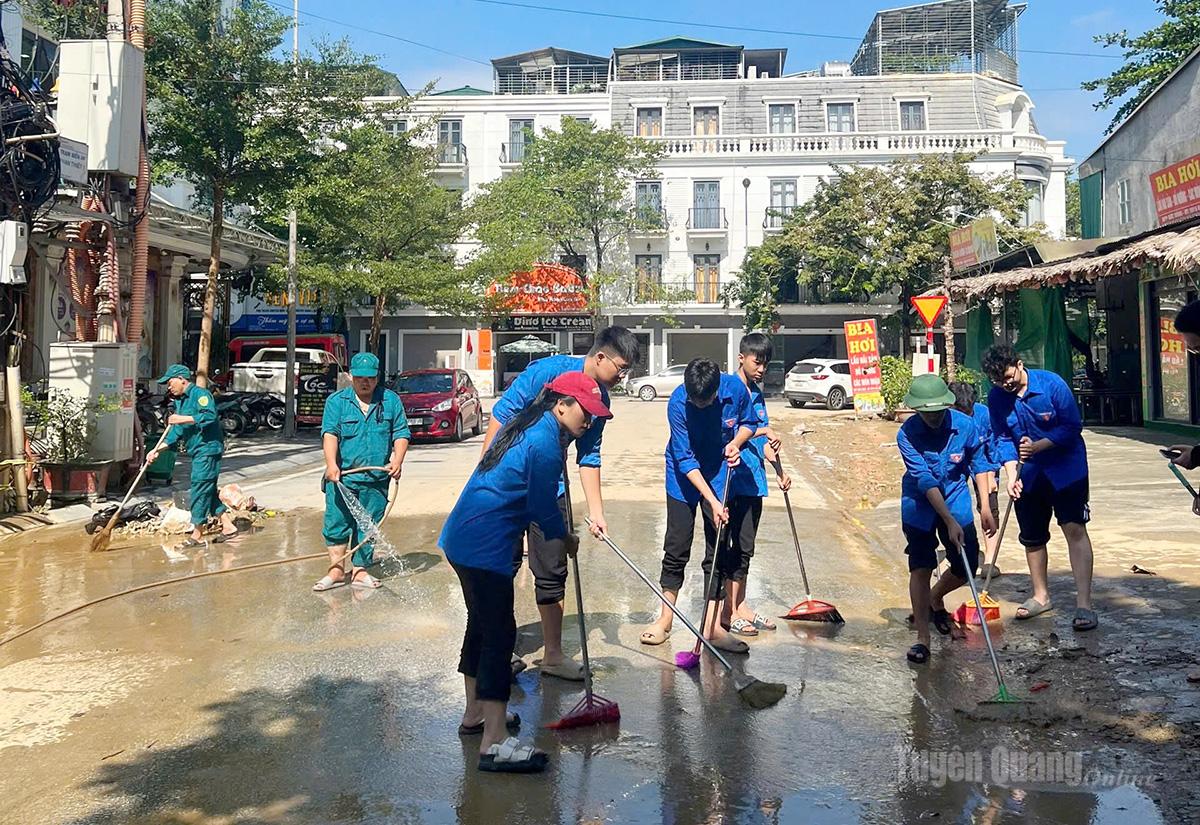 |
| Youth union members and young people in Minh Xuan ward participated in cleaning up the environment after the floodwaters receded following the impact of typhoon No. 10. |
Integration into the national development strategy
According to experts, adapting to extreme weather requires rational regional planning based on natural conditions and soil types. Infrastructure development must be linked to disaster prevention and control; a thorough assessment and forecasting of the impacts of geological factors and water flow during the construction of infrastructure systems that do not adequately handle drainage is a problem that requires a rational, synchronized, and long-term solution to ensure that the recurring issue of "flooding whenever it rains" no longer exists.
More importantly, climate adaptation must be integrated into national development strategies. In this context, green growth, circular economy, renewable energy, and the protection of water, land, and especially forest resources are no longer options, but conditions for development.
As Comrade Pham Manh Duyet, Member of the Provincial Party Committee, Director of the Department of Agriculture and Environment - and member of the Provincial Civil Defense Command, said: We cannot prevent floods, but we can certainly minimize the disaster by strengthening faith in scientific forecasting and building proactiveness and solidarity within the community. Doing this will create a stronger, more proactive "immune system" against the harshness of nature, ensuring a safe and sustainable life.
Tran Lien
Source: https://baotuyenquang.com.vn/xa-hoi/202602/thich-ung-de-vuot-qua-4a21737/
![[Photo] General Secretary and President To Lam presides over the meeting to approve the draft report on the results of the second inspection by the Politburo of the Standing Committee of the Hanoi City Party Committee.](https://vphoto.vietnam.vn/thumb/1200x675/vietnam/resource/IMAGE/2026/05/26/1779789811432_a2-bnd-4430-9620-jpg.webp)











![[INFOGRAPHICS] Content of political and ideological work within the Party](https://vphoto.vietnam.vn/thumb/402x226/vietnam/resource/IMAGE/2026/05/27/1779866344311_1779866293.webp)


























































Comment (0)