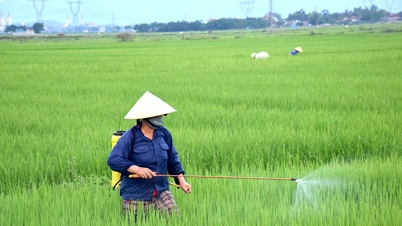
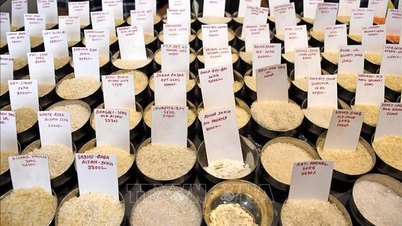
Vietnam in general, and Thanh Hoa province in particular, is an agricultural society closely linked to the rice-based civilization. Rice is considered the "jewel" that sustains people. Having enough rice and sufficient food is always a cherished wish: "When will October come? A bowl of rice overflowing, a fish caught by the net." The rice grain and the bowl of rice reflect the fruits of labor, expressing the simple, sincere love and happiness of working people: "When will the rice ripen and turn golden? So I can go harvest it for you to bring rice."
 Rice cooking competition during the spring festival in Thanh Hoa province. (Illustrative image)
Giving thanks to heaven and earth, and expressing gratitude to the ancestors who pioneered and cleared the land to create lush green rice paddies and cornfields, ensuring bountiful harvests and a prosperous life, is a moral principle and a beautiful aspect of life, becoming a spiritual culture of the working people. Every year, after the harvest, the people offer the first bowls of rice, still fragrant with the scent of new rice, to the gods and ancestors, and pray for a bountiful harvest in the next season. Gratitude to heaven and earth, and the wish for a prosperous and fulfilling life are intertwined with the beautiful custom of rice-cooking competitions among agricultural communities.
Rice cooking competitions in Thanh Hoa province take many forms. For example, in Quy Chu village, Hoang Quy commune (Hoang Hoa district), a "Rice Cooking Competition with Fish" is held on boats, where people cook rice while rowing and fishing. In some villages in Phu Loc commune (Hau Loc district), rice cooking is done using a rotating stove. In Mom village, Quang Nham commune (Quang Xuong district); Trinh Ha village, Hoang Trung commune (Hoang Hoa district); Thuong Bac village, Khanh Van village, Hai Nhan commune (Nghi Son town)... rice cooking competitions are held by carrying rice on their shoulders while lighting a fire to cook it. The actions of pounding rice, sifting rice, cooking rice, and serving rice... are all performed to the sound of drums and accompanied by singing.
The rice-cooking competition vividly reflects the ecological environment and daily life of rice-farming people in Thanh Hoa province. This beautiful custom demonstrates reverence for the deities and the skill and resourcefulness of the working people.
Compared to some other localities in Thanh Hoa province that have a rice-cooking competition, the unique custom of holding a rice-cooking competition during the spring days in Trung Duc village, Nga Trung commune, Nga Son district (formerly part of So village, Trung Nghia Doai, Thach Gian commune) is quite distinctive. The old So village worshipped its tutelary deity at the communal house, who had contributed to protecting the coastal area of Nga Son.
Legend has it that an old man, holding a large sword, gazed thoughtfully at the vast sea, contemplating the fate of the nation and the ways of the world. Passersby questioned him, but he remained silent. When enemy troops invaded the land, the king and his soldiers, on their march, encountered him and asked for his strategy to defeat the invaders. The old man, holding his sword, wrote a line of text that appeared in the sand: “If you wish to bring peace to the world, turn to my sacred shrine.”
Following the old man's guidance, the king gathered his generals and went into battle. Sure enough, the enemy suffered a great defeat. When the king returned, the old man was nowhere to be seen. Remembering his service, the king and the people erected a shrine to worship him. Inside the shrine were two couplets: "The pacification of the Wu dynasty is so great that heaven descends upon the old man / The meritorious deeds of supporting the Le dynasty are so humble and modest." Later, whenever there was a major event, the court would come to him for prayers, and they were always answered. In gratitude to the old man and the sacred shrine, the king had it expanded and beautified, adding two more couplets commemorating the deity's achievements: "The pacification of the Wu dynasty is so powerful that it permeates the universe / The meritorious deeds of supporting the Le dynasty are so humble and modest." Every year, the village holds a spring festival on the 15th day of the first lunar month. Along with the rituals, the festival includes a rice-cooking competition to offer as a tribute to the old man who assisted the king, helped the country, and is the guardian deity protecting the lives of the people and villagers.


In the vibrant atmosphere of spring, villagers gathered before the ancient communal house to participate in a rice-cooking competition. The rice-cooking competition in So village was conducted in pairs. When the drum sounded, the young men and women participating in the competition stepped out into the courtyard one by one to present themselves to the village. Three drumbeats signaled the start of the competition. Each pair moved in rhythm with the drums. In the middle of the courtyard appeared four young men dressed as boatmen, wearing brown shirts and loose trousers, each holding an oar. Simultaneously, four young women, gracefully dressed in pink bodices and silk skirts, appeared, carrying rice and circling the courtyard three times. Seeing the girls carrying rice, the four young men bent down, mimicking rowing, and sang: “My boatman, I trade from Nghe An province / Seeing the village girls as beautiful as daylilies / Elegant men, beautiful women / Near and far, who wouldn’t fall in love?”...
When the four girls heard the driver's flirtatious remarks, they smiled and replied, "This rice is as precious as pure gold / Our parents haven't sold it to someone from the celestial realm / This rice won't be sold for money / Let's consider it a destined union, a vow to be made..."
To cook rice, since they only had paddy, the contestants were forced to pound and sift it to obtain fragrant white rice grains. Young men and women each took on their assigned tasks: some pounded and sifted the rice, others lit fires and fetched water... and cooked the rice. Village girls, while scooping water from the village well into copper pots to use as firewood for cooking, sang: “You go home and pound rice for three days / So I can carry water from Cao Bang to soak / The water is clear, the rice grains are pure white / Like pearls to offer to the gods”...
After pounding the rice, the boys began to sing: "My dear, the rice is now white/ Quickly pour water into the pot to cook the rice"...
The rice-cooking competition was divided into four sections, each man and woman taking charge. The four rice pots were labeled with the four characters: Giáp, ất, bính, and đinh to distinguish the competing groups. While the young men and women competed, the villagers watched the contest and sang along: “…Quick, quick, four young men of the Giáp group / Competing in skill, regardless of distance / Men compete strongly, women are gentle / Using scissors to cut the fire and cook the rice…”
Before lighting the fire, they sang a fire-starting song, and the young man rubbed two bamboo sticks together to create a spark that ignited the tinder, then lit the bundle of tinder to cook the rice. The girl wore a betel nut box on her head, held a fan in her hand, and carried a rice-cooking pole made of bent bamboo on her shoulder. The pole was slung diagonally over her shoulder, with a rod (a dragon's head) attached to the end of the pole holding a copper pot. As they worked, they sang along with the chorus of onlookers standing in circles: "Four pots placed on four poles / Dragons fly, water swirls, the people are prosperous / Fragrant rice fills the air with its intoxicating aroma..."
While cooking rice, both participants must coordinate perfectly. The young man skillfully maintains the fire to ensure it burns evenly, without being extinguished or blown out by the wind. The young woman balances the rice pot while simultaneously fanning and distributing the fire precisely to ensure the rice is cooked perfectly and on time. When the rice is almost gone, the young man reduces the fire to prevent burning by turning the torch or stepping forward and backward. While cooking, they must move according to the instructions of the person waving the red flag, remaining within the pre-drawn "longevity" character in the temple courtyard. According to experience, before cooking rice, the contestants carry a piece of agarwood to prevent urination or defecation from affecting the process.
The competition lasted for a week. After each pair of contestants cooked rice to the tune of "longevity," and the drum signaled the end of the competition, the four competing pairs, still holding their rice pots, danced around the courtyard before presenting their freshly cooked rice to the elders for judging. The team with the best rice would receive high marks from the judges and a prize from the village. The winning pot of rice was a great honor for that group, as it was offered to the village guardian deity and other saints, so that "spring passes, summer returns, autumn arrives / The saints protect our people, bringing prosperity / Prosperity, health, and longevity." The prize was 3 quan of money and 3 meters of silk fabric.


Along with the rice-cooking competition, the festival also features many other exciting games such as wrestling, chess, and demonstrations of traditional crafts... all very entertaining. Each activity includes an introductory speech. In the demonstration of traditional crafts, the talk about carpentry often incorporates humorous elements to make the festival even more enjoyable: “...We chisel, forge saws / Ten years of carpentry but have never built a house / We've made a hut before / A few strips of wood and some bamboo sticks / If we say it, people will say we're showing off / Cutting rafters, choosing posts, we're afraid... we'll have to pay for it.”
The rice-cooking competition held at the beginning of spring in the old So village, now Trung Duc village, Nga Trung commune, Nga Son district, reflects the occupation and spiritual life of the agricultural inhabitants of Thanh Hoa province. It demonstrates their respect for rice, their appreciation for farming, their respect for farmers, and their dedication to refining agricultural product processing techniques. The rice-cooking competition also highlights skill, diligence, creativity, and a strong sense of community and neighborly solidarity. This traditional rice-cooking competition is a beautiful custom in Thanh Hoa's villages, an intangible cultural heritage closely linked to the Vietnamese rice civilization. Today, it needs to be restored, preserved, and promoted in conjunction with tourism development.
Hoang Minh Tuong
Source


































































![[Photo Gallery] Exciting Cosplay Festival at Vincom Plaza Bien Hoa](https://vphoto.vietnam.vn/thumb/402x226/vietnam/resource/IMAGE/2026/07/05/1783255268158_img_1441_20260705161627_20260705193040.jpeg)