

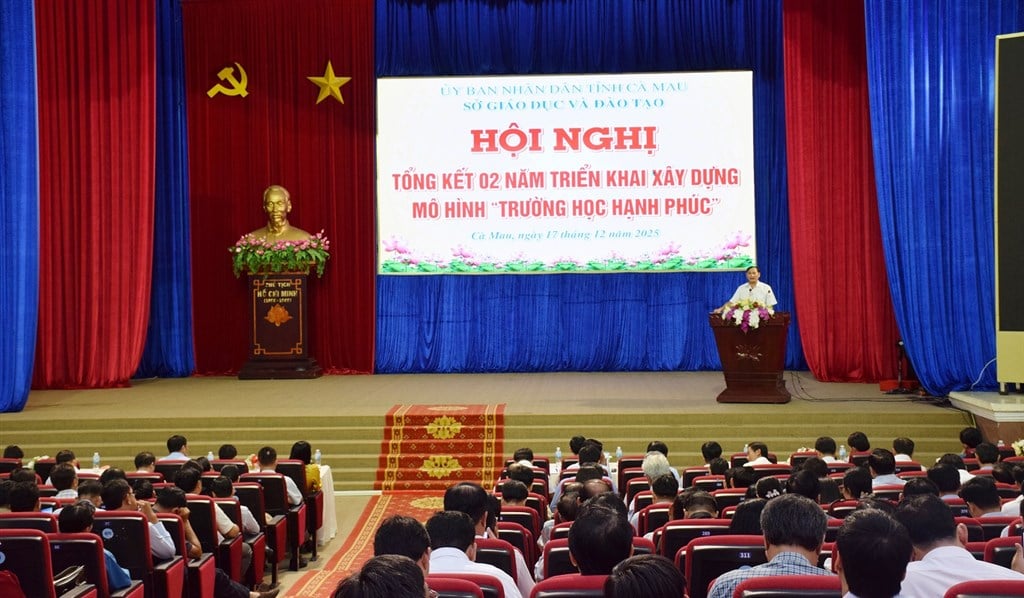
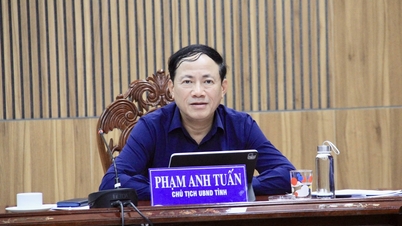
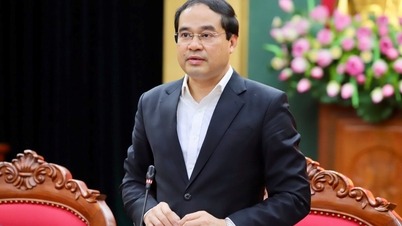
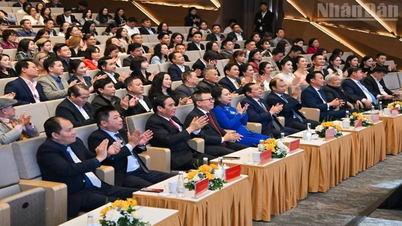
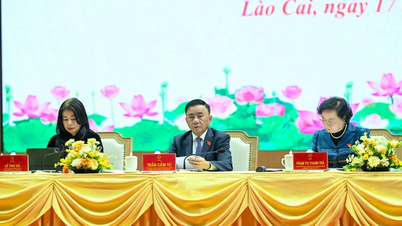
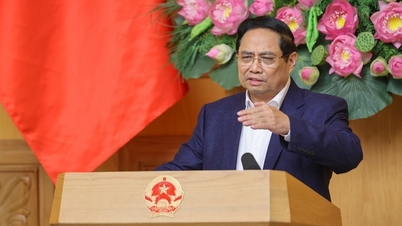
The scene at the conference.
According to the report presented at the conference, after two years of implementation, the "Happy School" model has gradually spread widely, contributing to building a safe, friendly, and healthy educational environment; creating positive changes in the awareness and actions of administrators, teachers, staff, students, and parents.
Guidance and propaganda work is regularly carried out by the units through various flexible forms. The content of building a "Happy School" is effectively integrated into professional activities, flag-raising ceremonies, emulation movements, and extracurricular activities.
The model's three pillars include: happiness in the educational environment; happiness in teaching and educational activities; and happiness in relationships inside and outside the school, implemented in conjunction with movements such as "Democracy - Discipline - Compassion - Responsibility" and "Every teacher is a role model of morality, self-learning, and creativity".
The assessment shows that most educational institutions achieved good results according to the "Happy School" criteria. The pedagogical environment has undergone many positive changes; school grounds are increasingly green, clean, and beautiful; and the relationships between teachers and students, and between the school, family, and society, have been strengthened. Students feel safe, respected, and loved; their learning spirit is more positive, contributing to reducing school violence. The teaching staff is gradually improving their pedagogical skills, professional ethics, and sense of responsibility.
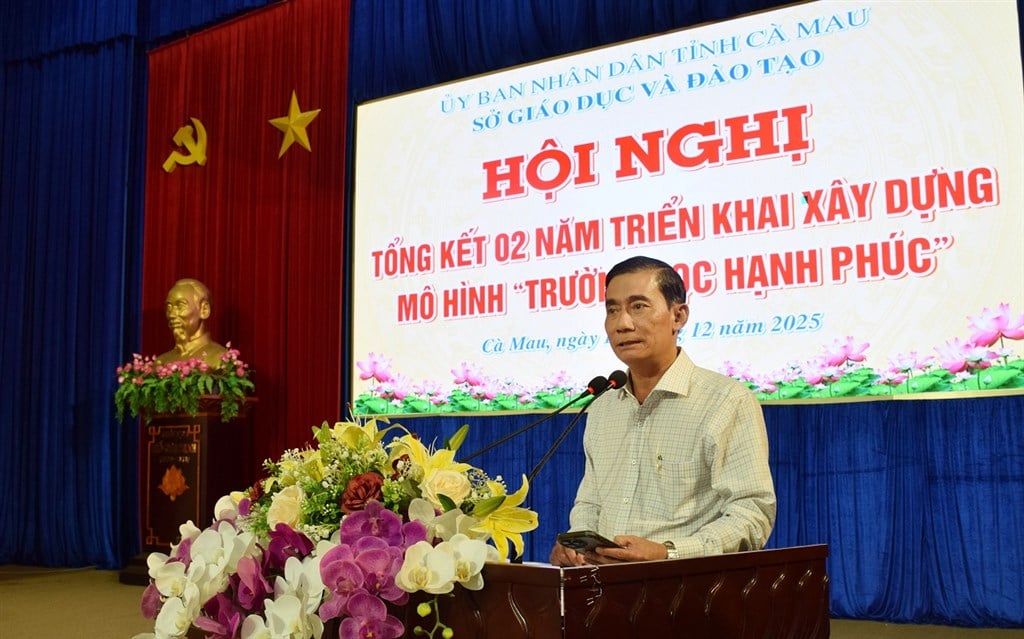
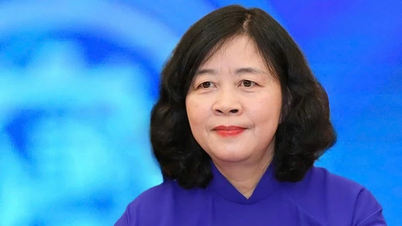
Deputy Director of the Department of Education and Training, Le Hoang Du, delivered a speech at the conference.
Building on the achievements already made, the Department of Education and Training has determined to continue implementing a comprehensive set of tasks and solutions to enhance the effectiveness of the "Happy School" model in the coming period. The focus will be on strengthening communication efforts, encouraging teachers, students, and parents to participate in forums and clubs for sharing emotions; organizing extracurricular activities and creative experiences linked to life skills and values education; and simultaneously strengthening the role of homeroom teachers and school organizations in setting a good example and inspiring others. Furthermore, close coordination between schools, families, and society is essential for holistic education.
Source: https://www.camau.gov.vn/van-hoa-xa-hoi/tong-ket-02-nam-trien-khai-mo-hinh-truong-hoc-hanh-phuc-292547

![[Live] 2025 Community Action Awards Gala](/_next/image?url=https%3A%2F%2Fvphoto.vietnam.vn%2Fthumb%2F1200x675%2Fvietnam%2Fresource%2FIMAGE%2F2025%2F12%2F16%2F1765899631650_ndo_tr_z7334013144784-9f9fe10a6d63584c85aff40f2957c250-jpg.webp&w=3840&q=75)
![[Image] Leaked images ahead of the 2025 Community Action Awards gala.](/_next/image?url=https%3A%2F%2Fvphoto.vietnam.vn%2Fthumb%2F1200x675%2Fvietnam%2Fresource%2FIMAGE%2F2025%2F12%2F16%2F1765882828720_ndo_br_thiet-ke-chua-co-ten-45-png.webp&w=3840&q=75)
![[Photo] Prime Minister Pham Minh Chinh receives Lao Minister of Education and Sports Thongsalith Mangnormek](/_next/image?url=https%3A%2F%2Fvphoto.vietnam.vn%2Fthumb%2F1200x675%2Fvietnam%2Fresource%2FIMAGE%2F2025%2F12%2F16%2F1765876834721_dsc-7519-jpg.webp&w=3840&q=75)

![[Photo] Prime Minister Pham Minh Chinh receives the Governor of Tochigi Province (Japan)](/_next/image?url=https%3A%2F%2Fvphoto.vietnam.vn%2Fthumb%2F1200x675%2Fvietnam%2Fresource%2FIMAGE%2F2025%2F12%2F16%2F1765892133176_dsc-8082-6425-jpg.webp&w=3840&q=75)






























![[Live] Closing Ceremony and Award Presentation for the "Impressive Vietnam Tourism" Video/Clip Creation Contest 2025](https://vphoto.vietnam.vn/thumb/402x226/vietnam/resource/IMAGE/2025/12/17/1765974650260_z7273498850699-00d2fd6b0972cb39494cfa2559bf85ac-1765959338756946072104-627-0-1338-1138-crop-1765959347256801551121.jpeg)



















Comment (0)