

(NLĐO) - The formation and destruction of the "monster continent" Pangaea has split apart the thickest layer of the Earth.
A study recently published in the scientific journal Nature Geoscience reveals that beneath our feet, the mantle – the thickest layer of the Earth – has actually long since separated the African and Pacific regions.
The boundary between these two mantle regions is the Pacific Ring of Fire, while Pangaea – also known in Vietnamese as the Entire Continent – is the culprit.
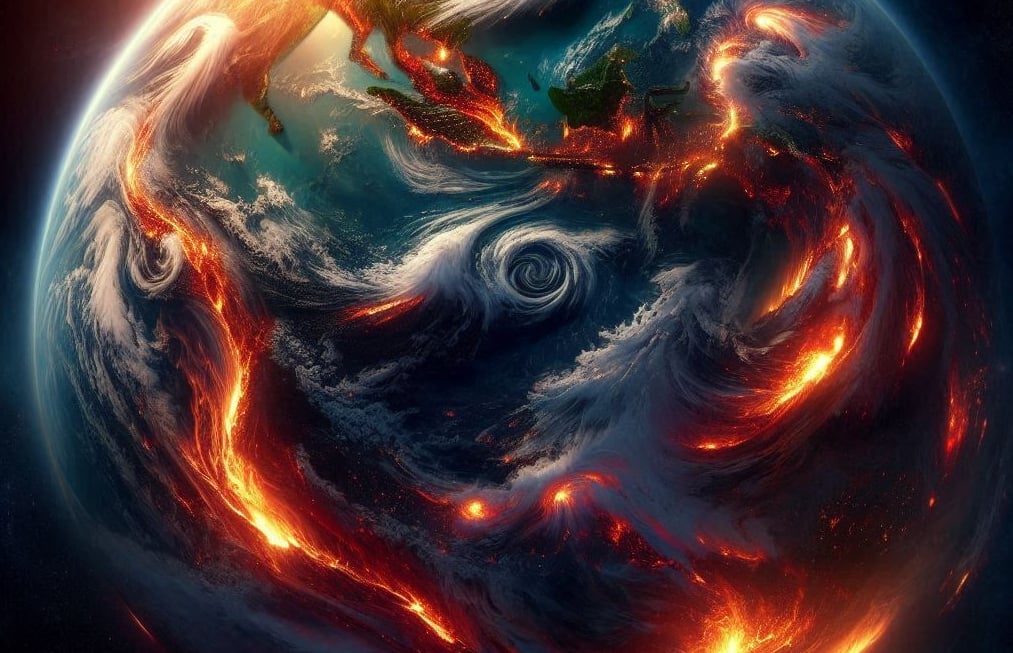
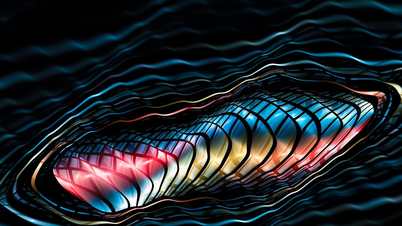
Plate tectonics hundreds of millions of years ago split the Earth's mantle - Illustration by AI: ANH THU
Of these two regions, Africa carries most of the Earth's current landmass, stretching from the eastern coasts of Asia and Australia, across Europe, Africa, and the Atlantic, to the western coast of North America.
The Pacific region, on the other hand, only covers the ocean of the same name.
According to the new research, the mantle beneath Africa contains a much greater variety of elements and their isotopes than the Pacific Ocean.
Dr. Luc Doucet from Curtin University (Australia), a co-author, told Live Science that the differences in composition between the two mantle regions reflect the last two supercontinental cycles over the past billion years.
First was the supercontinent Rodinia, which formed about 1.2 billion years ago and broke apart about 750 million years ago.
Next came Pangaea, which formed about 335 million years ago and broke apart around 200 million years ago.
"What we observe today is essentially what happened during the transition from Rodinia to Pangaea and then the disintegration of Pangaea," said Dr. Doucet.
These supercontinents came together on the landmass that is now Africa.
As oceans close in between them, the oceanic crust slides beneath the continents—a process called subduction—sometimes dragging continental rocks down with it.
This pulled elements and their isotopes from the continental crust down to the mantle beneath the developing supercontinent.
This "geological conveyor belt" continued in a slightly different form after the supercontinents were assembled: The oceanic crust at the edge of Rodinia, and later Pangaea, sank beneath the continental crust, again eroding some continental rocks as the tectonic plates crushed together.
The events created a "funnel effect," concentrating all the geological richness beneath the supercontinent.
Even after Pangaea disintegrated, these traces persisted in both the deep and shallow mangrove layers, as evidenced by samples the research team collected from underwater ridges as well as machine learning models.
The composition of each mangrove domain reflects what is happening on the surface, as well as deep geological processes.
Therefore, this discovery could help geologists pinpoint exactly where useful mantle materials, such as rare earth elements, might be concentrated.
Furthermore, this will also serve research into the origins of life, as plate tectonics is one of the crucial processes that helps Earth maintain a chemical environment suitable for us and all living things.
Source: https://nld.com.vn/trai-dat-tach-thanh-2-phan-o-vanh-dai-lua-thai-binh-duong-196241028101614523.htm





















































































Comment (0)