Research objectives
From the rice varieties and lines of Vietseed Company Limited that meet two main criteria: the presence of genetic material from upland rice, drought-tolerant rice, or good drought tolerance; and meeting the requirements of the Vietnamese Standard (TCVN) on cultivation value and use testing (VCU) or having been approved for circulation, the research team aims to select promising varieties. These varieties are collectively called upland rice and must ensure dual-purpose nature, growing well in both paddy fields and dry land while maintaining yield.
Under controlled conditions, two experiments were designed and conducted to evaluate: the ability to withstand severe drought and the ability to recover during the vegetative growth stage; and the response of plants to severe drought during the heading-flowering stage, which is the most sensitive to drought. In the field, in addition to the wet rice VCU trial based on TCVN standards, the selected varieties will have to undergo dry rice VCU trials to find the varieties that meet the requirements.
Initial results
- Experiment 1. Evaluating the ability to withstand severe drought and recover during the vegetative growth stage.
The drought induction process was carried out by completely stopping water supply when the rice plants reached 8-10 leaves, maintaining this until at least one variety had its entire plant die. During the drought induction period, every 7-10 days, drought tolerance was assessed using the IRRI Standard Evaluation System (SES) scale (2002) based on the percentage of dead leaves and the degree of wilting.

Differences in drought tolerance levels exist between varieties.
The experiment was re-watered and maintained until most of the surviving branches produced at least one complete new leaf. At that point, recovery was assessed using the SES scale (IRRI, 2002) based on the percentage of recovered branches and the regrowth of leaves.
Results after 25 days of water supply interruption, followed by 12 days of water supply restoration: Three varieties, NTS004, CH777, and KH789, showed fairly good to good drought tolerance (scores 1-3) and good recovery (score 3). Two varieties, NTS102 and N97 (control), showed average drought tolerance (score 5) and average recovery (score 5). Two varieties, T47 and CH141, showed average drought tolerance (score 5) and weak recovery (score 7). The remaining three varieties, NTS003, LY2099 (control), and glutinous rice NTS246, showed sensitivity to very high sensitivity to drought (scores 7-9) and weak to very weak recovery (scores 7-9), with two varieties dying completely.
Another rapid drought experiment was conducted by drilling drainage holes in the experimental pots to increase the rate of soil moisture loss. The results showed that the TGMS maternal line named DR1S exhibited good drought tolerance (score 1), and is considered a potential source of material for drought-tolerant hybrid rice breeding programs.
- Experiment 2: Evaluating drought tolerance and grain setting during the heading and flowering stages.
The drought tolerance process was carried out by completely stopping water supply when the rice plants were in the 6th-7th panicle stage and resuming water supply when any rice variety had 50-80% of its panicles emerging. Drought tolerance was assessed using the IRRI Standard Evaluation System (SES) scale (2002) based on the percentage of fertilized and set grains when the rice entered the grain-filling stage.

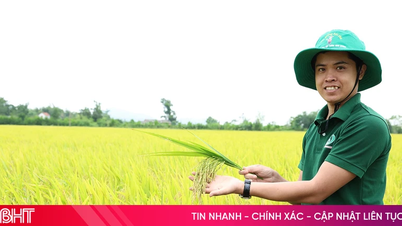
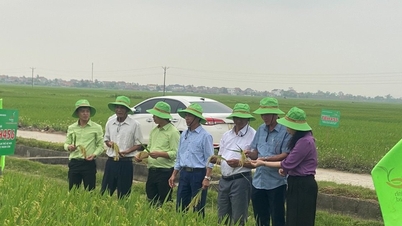
NTS004 - an excellent drought-tolerant rice variety.
The results showed that 4 varieties had average grain setting rates, including NTS102 (54.6%), CH777 (45.3%), KH789 (42.1%), and NTS004 (41%). The remaining 5 varieties had poor grain setting rates. Most of the experimental varieties had poor heading rates (score 9), while NTS102 and KH789 had average heading rates (score 5).
Initial findings have identified four promising rice varieties: NTS004, CH777, KH789, and NTS102; and one TGMS mother line: DR1S. Of these, CH777 – a water-saving and drought-tolerant (WDR) three-line hybrid rice – has already been recognized in China, while NTS102 is currently undergoing testing for regulatory approval. The NTS004 and KH789 varieties will soon participate in the national VCU trial in 2026.
Expectations for a new farming technique.
By referencing traditional wet rice cultivation practices and alternating wet-dry (AWD) farming techniques, the research team proposed and designed a hypothetical cultivation process to optimize aerobic conditions for wet-dry rice, called the AWD Technique.
In this process, the flooding period is maintained only from land preparation until the rice plants reach about 3 leaves. This creates favorable conditions for seedling germination and initial growth, helps control weeds, limits fungal diseases, facilitates fertilization, aligns with current farming practices, and contributes to reducing land preparation costs compared to dry farming conditions.

CH777 - a three-line hybrid rice variety that is water-saving and drought-tolerant (AWD).
After this stage, the entire remaining growth period, from tillering to harvest, is designed to take place entirely under aerobic conditions (the field is not flooded).
The dual-purpose nature of wet-dry rice cultivation gives the LNC technique high flexibility: In areas with poor irrigation, water can be drained at any stage during the aerobic period when conditions permit, and it can be applied to most current rice production conditions. However, the scope of application of the technique is limited to wet-dry rice varieties. Although this is a major challenge in research and production, if proven effective, the LNC technique is expected to bring about a breakthrough in wet-dry rice cultivation, reducing methane emissions and saving irrigation water.
According to MSc. Do Thanh Tung - Director of Vietnam Seed Company Limited, and project leader, the drought tolerance of rice plants is a complex agronomic characteristic, influenced by many vegetative organs (leaves, stems, roots, etc.) and various physiological and biochemical mechanisms.

Simulation of the LNC Engineering Hypothesis Process.
Experiments conducted under controlled conditions such as laboratories or greenhouses often do not fully reflect the drought tolerance of rice plants in real-world production. Therefore, promising rice varieties with drought tolerance will continue to be evaluated in VCU trials following upland rice cultivation procedures. The goal is to verify the resistance, growth potential, and yield of the varieties under upland cultivation conditions, thereby selecting the most superior rice varieties.
Controlled experiments will continue to be designed to closely simulate real-world farming conditions to support the development and implementation of hypothetical wet-dry rice cultivation techniques. The project aims to develop technology packages of "Rice Varieties and Cultivation Techniques" that are simple, easy to apply, and widely adaptable to various ecological regions.
Source: https://nongnghiepmoitruong.vn/trien-vong-nghien-cuu-giong-lua-nuoc--can-d785248.html


![[Photo] General Secretary and President To Lam presides over a working session with the Central Policy and Strategy Committee on the development of the materials industry.](https://vphoto.vietnam.vn/thumb/1200x675/vietnam/resource/IMAGE/2026/05/21/1779359935432_a3-bnd-3129-1412-jpg.webp)
![[Photo] National Assembly Chairman Tran Thanh Man working with the Standing Committee of the Law and Justice Committee](https://vphoto.vietnam.vn/thumb/1200x675/vietnam/resource/IMAGE/2026/05/21/1779378929214_ndo_br_1-4610-jpg.webp)

























































Comment (0)