

According to the KCNA news agency, Sunday's missile launch posed no security threat to neighboring countries. The launch was aimed at testing the reliability of the new multi-stage, high-thrust solid-fuel engine of a medium-range hypersonic missile.
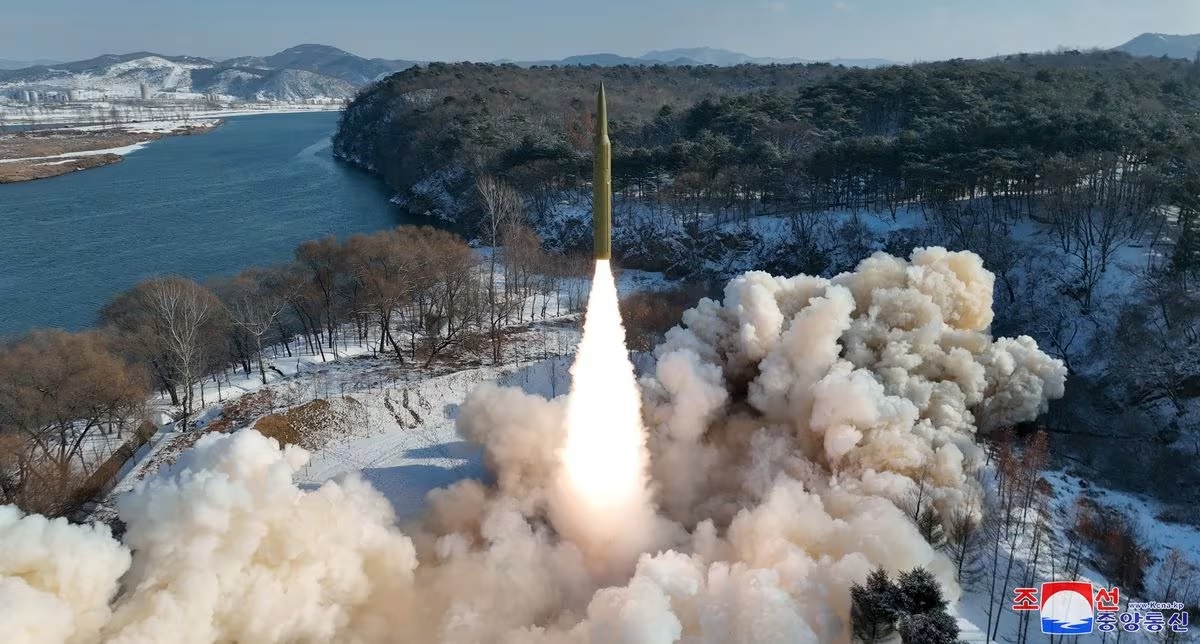
North Korea launched a solid-fuel, hypersonic ballistic missile from an unspecified location on January 14, 2024. Photo: KCNA
The South Korean military previously stated that the missile, launched from the Pyongyang area on Sunday at approximately 2:55 p.m., flew about 1,000 kilometers off the country's eastern coast. Meanwhile, Japan's Ministry of Defense said its maximum altitude was at least 50 kilometers.
Pyongyang had previously announced that it had tested a new solid-fuel engine for an intermediate-range ballistic missile (IRBM) on November 11 and 14.
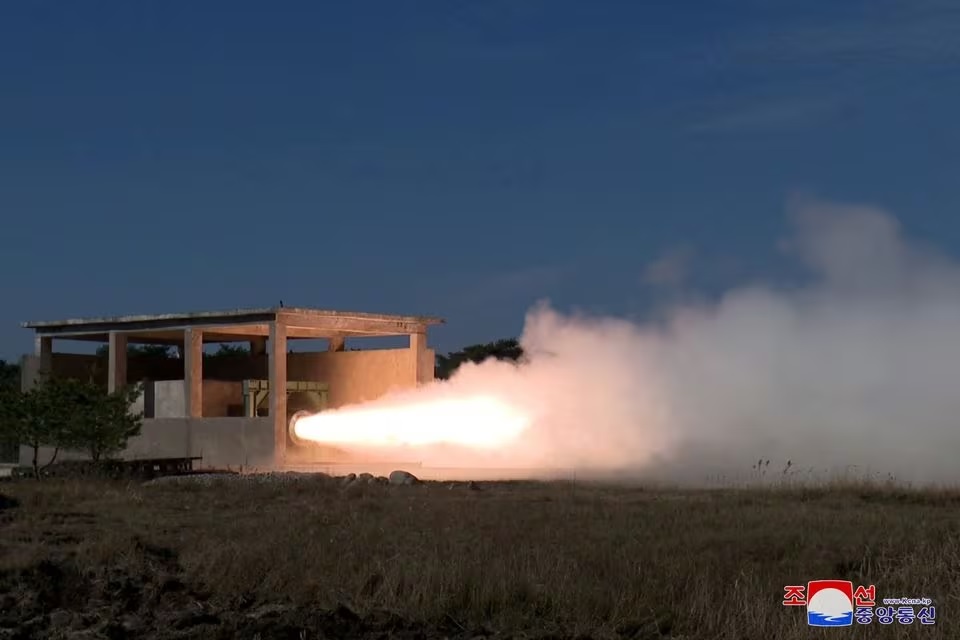
North Korea's test of a new solid-fuel engine on November 14, 2023. Photo: KCNA
South Korean officials believe that the solid-fuel IRBMs being developed by North Korea are capable of striking U.S. military bases in Japan and Guam. IRBMs have a range of up to 5,500 km.
Solid-fuel rockets are known to be more difficult to detect before launch than liquid-fuel rockets, which require more preparation, such as fuel injection.

Leader Kim Jong Un visits and directs operations at a North Korean weapons production facility. Photo: KCNA
Recent North Korean missile launches and South Korea's joint military exercises with the US and Japan have heightened tensions in the region. On January 7, North Korea conducted artillery firing exercises near the maritime border between the two countries.
This incident prompted South Korea to conduct live-fire exercises from the northwestern border islands of Baengnyeong and Yeonpyeong for the first time in over six years.
Hoang Anh (according to KCNA, Yonhap, Reuters)
Source


![[Image] Central Party Office summarizes work in 2025](/_next/image?url=https%3A%2F%2Fvphoto.vietnam.vn%2Fthumb%2F1200x675%2Fvietnam%2Fresource%2FIMAGE%2F2025%2F12%2F18%2F1766065572073_vptw-hoi-nghi-tong-ket-89-1204-jpg.webp&w=3840&q=75)































































































Comment (0)