

Thenceforth...
In the early days following the General Election (January 6, 1946), amidst widespread and fierce warfare, the Standing Committee of the National Assembly was a regularly working body alongside the Government under the leadership of the Central Committee of the Party. At that time, the supporting agency was called the Office of the Standing Committee of the National Assembly. According to archive file No. 276 at the National Archives Center III, the Office then had only about 18 cadres and staff members. These were comrades selected from central agencies and all possessed revolutionary qualities, good character and ethics, and were dedicated and committed to fulfilling their duties.
Despite having a small workforce and limited expertise, from the very beginning, the staff of the Office have assisted and advised on issues of great significance:
On April 16, 1946, the Office advised the Standing Committee of the National Assembly to organize a delegation of 10 National Assembly delegates, led by Comrade Pham Van Dong, Deputy Head of the Standing Committee of the National Assembly, to work in France from April 25 to May 16, 1946. Their mission was to make the French people and a large number of French politicians understand the Vietnamese people's struggle for independence and to foster friendly relations between the Vietnamese and French peoples based on the recognition of Vietnam's aspirations for independence and unification...
During this same period, in Southern and South Central Vietnam, the French army continued to provoke and sabotage the Preliminary Agreement (March 6, 1946). To establish a legal basis for the struggle, the Office assisted the Standing Committee of the National Assembly in drafting the Appeal to the People, primarily aimed at opposing the French army's betrayal of the Preliminary Agreement. The appeal from the Standing Committee of the National Assembly was enthusiastically received, trusted, and respected by the people.
On May 3, 1946, the Office assisted the Standing Committee of the National Assembly in establishing a working group led by Father Pham Ba Truc, along with representatives of the Government, to go to Central Vietnam to explain to the people the national unity policy of the Ho Chi Minh Government. Following this, on August 14, 1946, the Office assisted the Standing Committee of the National Assembly in establishing a delegation of National Assembly representatives to go to South Central Vietnam to comfort the soldiers who were fighting bravely and tenaciously on the fronts. Also during this time, the Office helped the Standing Committee of the National Assembly direct the drafting of the Declaration to rally the people to unite closely and crush all enemy schemes to divide the ethnic groups...
In just eight months (the period between the two sessions of the First National Assembly, from March to November 1946), the Office of the Standing Committee of the National Assembly advised and assisted the three Subcommittees of the National Assembly in reviewing and giving opinions on 98 draft decrees submitted by the Government. The vast majority of the opinions of the Standing Committee of the National Assembly on the draft decrees were accepted by the Government, with the most frequently accepted being the draft decrees on labor and education ...
From the very beginning, with a fervent revolutionary spirit, the staff worked with utmost dedication and high responsibility, helping the Standing Committee of the National Assembly to thoroughly resolve many important issues. This also served as a foundation for the National Assembly Office in subsequent periods to learn from, draw experience from, and improve the quality of advice and service to the National Assembly in each term...
... up to the present day
Currently, in addition to activities related to improving the working conditions of the National Assembly, strategic planning, in accordance with the National Assembly's functions, remains a massive workload for the National Assembly Office.
First, regarding legislative advisory work : In terms of quantity alone, if the first 7 terms of the National Assembly (from 1946 to 1987) only provided advisory support for the drafting of 29 laws and 3 Constitutions (the Constitutions of 1946, 1959, and 1980), then in the 8 subsequent terms of the National Assembly, starting from the 8th term (the first term of the reform process) to the present (February 2024), with the effective advisory support of the National Assembly Office, the National Assembly has drafted and passed 461 laws and 2 Constitutions (the 1992 Constitution, amended and supplemented in 2001, and the 2013 Constitution). In particular, from the beginning of the 21st century to the present, across 5 National Assembly terms (from the 11th to the middle of the 15th term), the National Assembly has drafted and promulgated 338 laws, averaging more than 80 laws per term.
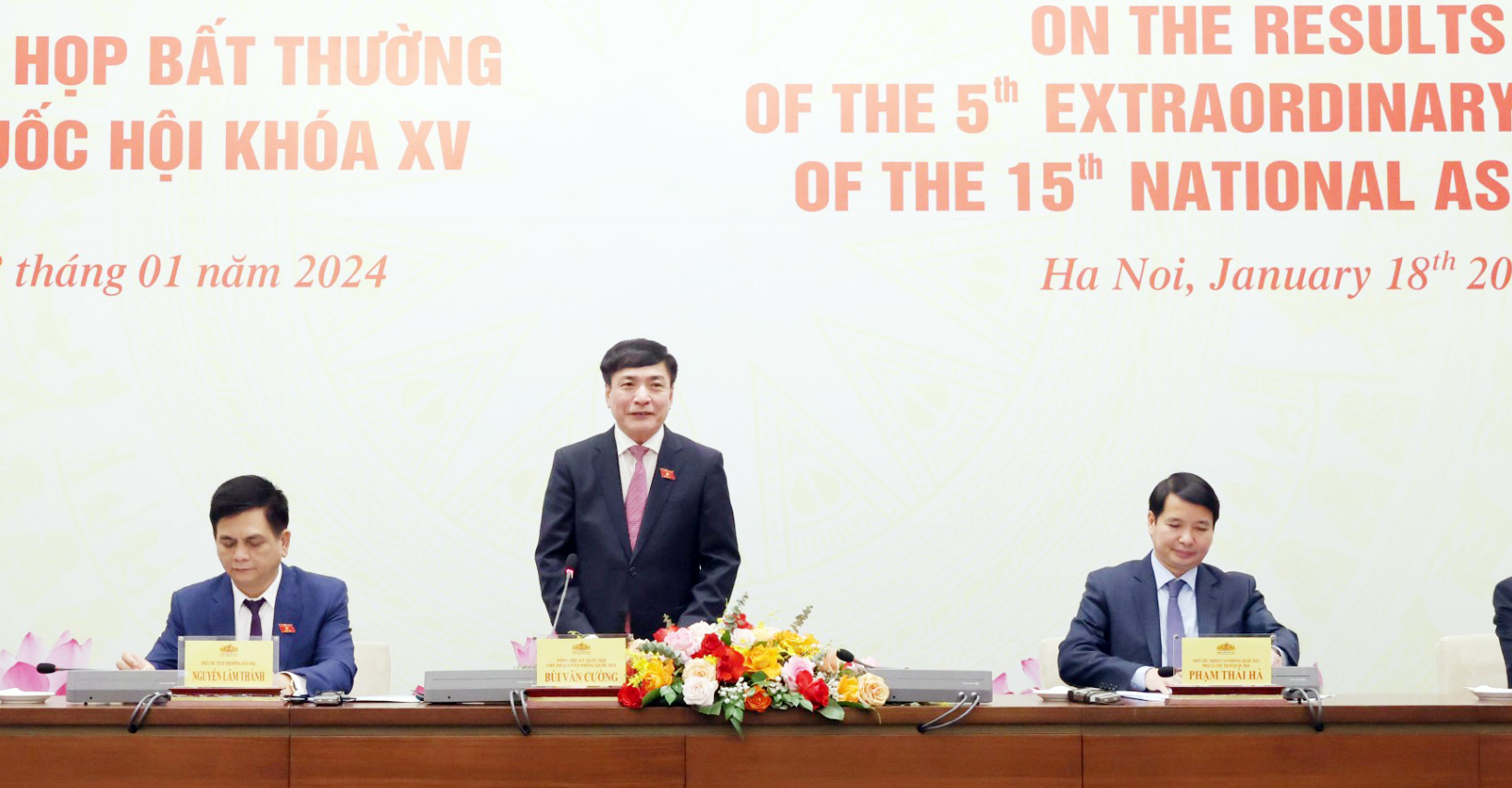
Specifically for the current 15th National Assembly, up to the end of the Fifth Extraordinary Session (January 2024), according to our records, the National Assembly has drafted and passed 30 laws, 70 resolutions, and provided opinions on 45 other draft laws... In the six-stage process of lawmaking, the National Assembly Office has advised and supported four very important stages: the program for drafting laws and ordinances; the review of draft laws and ordinances; assisting the Standing Committee of the National Assembly in providing opinions on drafts to be submitted to the National Assembly; and assisting the National Assembly in receiving, revising, and passing laws.
Similarly, in providing advisory support for oversight activities, the National Assembly Office has completed quite a lot of specific tasks, including three very important types of work.
Firstly, to advise the National Assembly and the Standing Committee of the National Assembly on effectively implementing all six forms of supreme oversight by the National Assembly at its sessions as stipulated by law (except for the form of establishing temporary committees), with particularly high effectiveness being the forms of oversight involving votes of confidence and questioning and answering questions.
Secondly, we advised the National Assembly to accept the thematic supervision form (a form of supervision with multifaceted effects), thus this form has been legally stipulated as one of the seven supreme forms of supervision of the National Assembly.
Thirdly , the forms of supervision and questioning activities are constantly being innovated, including re-questioning and comprehensive questioning. Re-supervision, combining various forms of supervision, and comprehensive supervision are implemented to control power in the operation of the socialist rule of law state. As a result, almost all members of the Government and all heads of state agencies have appeared to answer questions during each supervision session through the questioning format. Therefore, many issues have achieved the principle of "getting to the bottom" of each issue...
With its third function – deciding on major national issues – the National Assembly Office has advised on the implementation of the Party and State's strategic guidelines to achieve the highest effectiveness and efficiency. Accordingly, during the war, all decisions of the National Assembly aimed at providing the greatest human and material resources to the great southern front and firmly protecting the North – the great rear base of the great front; liberating the South and unifying the country. Since the completion of national reunification, the National Assembly's decisions have focused on the industrialization and modernization of the country, fulfilling President Ho Chi Minh's sacred testament, and building a peaceful, unified, independent, democratic, and prosperous Vietnam . And currently, the National Assembly Office continues to advise the National Assembly on solutions to work with the whole country to achieve the goals set by the 13th National Congress of the Party, namely: By 2025, Vietnam will be a developing country with a modern industrial sector, surpassing the lower-middle income level; By 2030, the country aims to be a developing country with modern industry and a high-middle income; by 2045, it aims to become a developed country with a high income.
Strategic planning is a demanding, complex, time-consuming, and intellectually exhaustive task, but the National Assembly Office has been striving and making every effort to fulfill its responsibilities to the National Assembly.
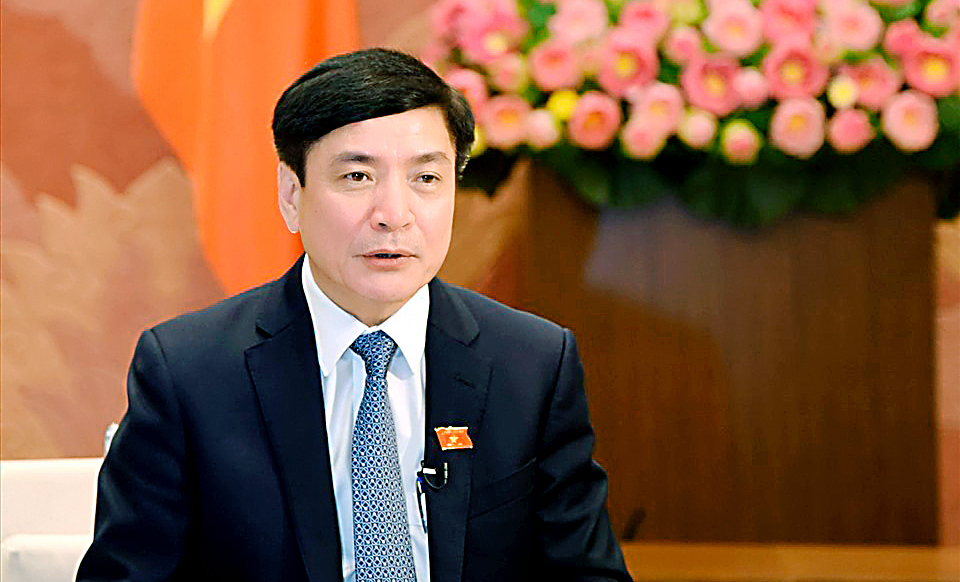
Speaking about the efforts of officials, civil servants, and employees of the National Assembly Office, at the work review conference on December 28, 2023, the Secretary General of the National Assembly and Head of the National Assembly Office presented some "telling" figures: providing advice and support for the organization of more than 3,000 meetings, working sessions, conferences, and seminars, including 5 National Assembly sessions, 15 sessions of the National Assembly Standing Committee, 8 important conferences of the National Assembly Standing Committee, 25 meetings and conferences of the National Assembly Party Caucus, 4 specialized supervision delegations of the National Assembly and the National Assembly Standing Committee, 12 delegations going abroad by the Speaker and Vice-Speakers of the National Assembly, and 8 high-level delegations going in - at the level of the Speaker of the National Assembly; providing advice and support for the successful organization of the 9th Global Young Parliamentarians Conference; the Vietnam Socio-Economic Forum 2023, the Mock Session of the Children's Parliament, and the First Workers' Forum. The process involved consolidating 50 legal documents, updating 2 codified legal topics; issuing 27 documents containing conclusions and reports on the work results of National Assembly leaders, and issuing 34 notices containing conclusions from the leaders of the National Assembly Office...
Indeed, the National Assembly Office has a mountain of work, difficult to fully quantify with its level of "year-round urgency, four seasons of intense activity." All we know is that from leaders to officials, civil servants, and employees, everyone is aware of their responsibilities, diligently and devotedly working (completing all tasks, not just working until the end of the workday)...
To practically commemorate its 78th anniversary, and alongside fulfilling its statutory duties, the National Assembly Office is urgently conducting research on more than 20 projects to advise the National Assembly and the entire country on preparing for the 80th anniversary of the formation and development of the Vietnamese National Assembly (January 6, 1946 - January 6, 2026) and preparing (with fundamental reforms) for the election of deputies to the 16th National Assembly and deputies to People's Councils at all levels for the 2026-2031 term.
Source


![[Image] Nearly 125,000 Hanoi students completed the Literature exam for the 10th grade entrance exam.](https://vphoto.vietnam.vn/thumb/1200x675/vietnam/resource/IMAGE/2026/05/30/1780117233041_ndo_br_thiet-ke-chua-co-ten-2-png.webp)


















































































Comment (0)