

Preserving the quintessence of traditional linen village
Nam Cao village linen (Le Loi commune, Hung Yen province) has a history of more than 400 years, formed in 1584. According to the investigation of the People's Representative Newspaper reporter, the founders of the profession were Mrs. Tu Tien and Mrs. Tu An (originally from Van Xa village (old Ha Tay) moved back to open the profession of growing mulberry, raising silkworms, spinning linen and weaving, and teaching weaving techniques to women in the village to take advantage of their free time after the agricultural season.
Nam Cao linen products are woven from the cored silk, creating a rustic, rough but soft, light and airy material, so it is favored by the market. People respectfully call linen "golden and silver threads" because it is produced from natural yellow and white silk.
All linen yarn is made from 100% silk, the production process requires meticulousness and elaborateness, only 70 - 100 grams of linen can be drawn per day. According to the Director of Nam Cao Silk Cooperative, Luong Thanh Hanh, to produce a beautiful linen sheet, it must go through many stages such as cutting the cocoons, the worker will put the cocoons in a pot of water and then heat it to melt the glue in the silk cocoons, making the cocoons softer and easier to draw. In this stage, the worker in Nam Cao will put a type of leaf in the pot to cut the cocoons. After that, the worker will draw the silk linen yarn - this is the most important stage because it determines the quality of the silk linen yarn. The worker will put the cocoons after cutting them into a basin of water and then use his hands to roll them into rough silk linen yarn and requires meticulousness of the worker.
Next, the worker will put the bundle of linen into a large pot of water to boil for about 1 hour to bleach and remove any remaining impurities. The linen is then spun and used to make the finished product. The woven linen fabric will be sent to the dyer.
Ms. Luong Thanh Hanh, Director of Nam Cao Silk Cooperative, said that Nam Cao villagers still preserve natural fabric dyeing methods such as using Indian almond leaves, purple sticky rice, gac fruit, etc. Once dyed, the linen fabric will be dried under natural sunlight and will be checked one last time before being measured into large and small rolls to be brought to market.
Nam Cao linen products are highly appreciated for their good absorbent quality, and are currently widely used to produce a variety of items such as fabrics, ao dai, skirts, scarves, bags, blankets and pillows, bringing a simple, sophisticated beauty to users.
Efforts to preserve and develop craft villages
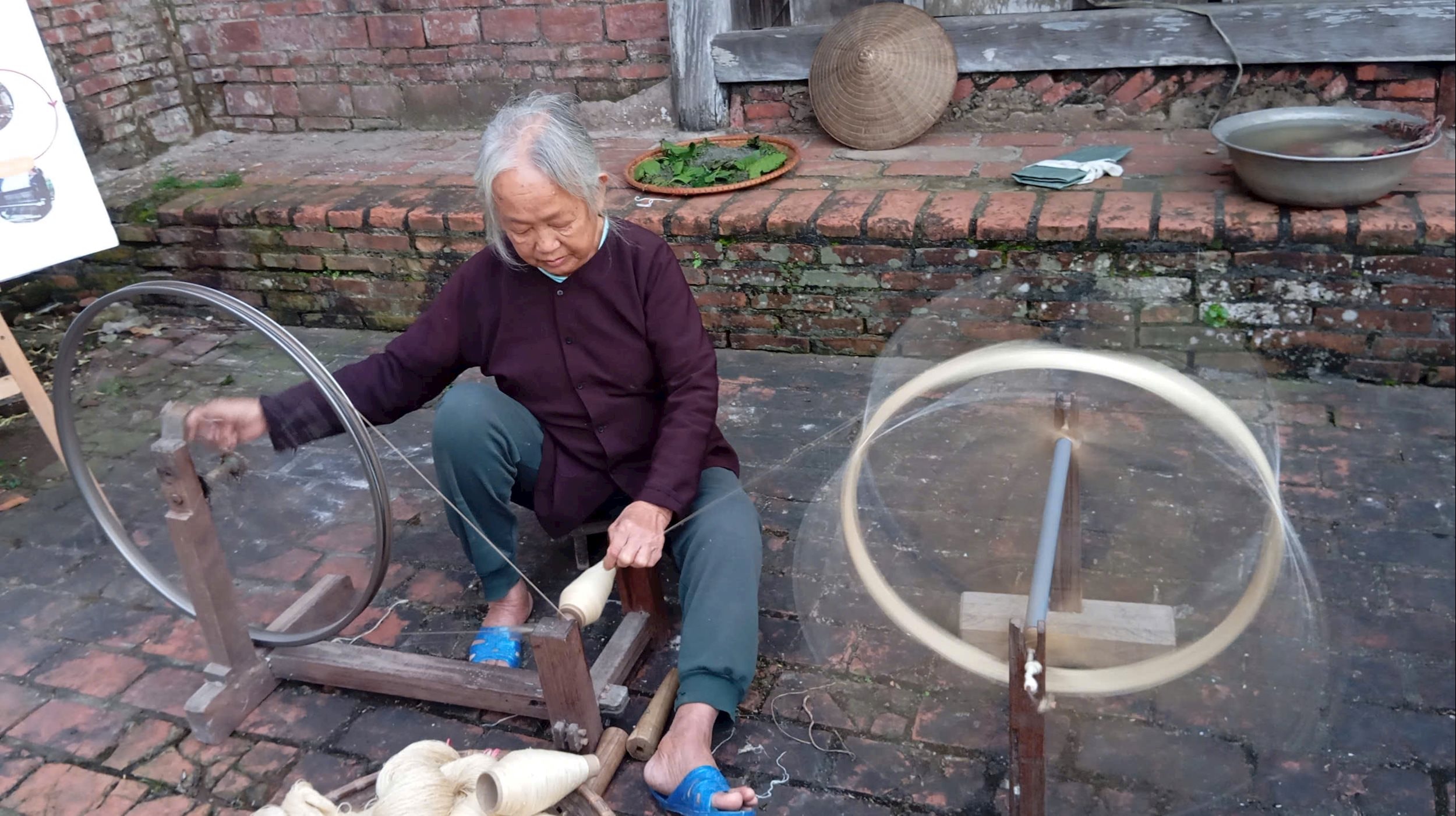
Through many historical ups and downs, there were times when the village had nearly 1,600 weaving looms operating every day, but today there are only about 500 households still practicing the craft.
According to the people in Nam Cao, in the past, every household had someone who worked in the linen weaving profession, especially women. Mrs. Nguyen Thi Bon (81 years old) said that since she was 5-6 years old, she was instructed by adults on how to choose mulberry leaves to raise silkworms. And every day, she stood by the loom watching adults perform production operations. For nearly ten years now, more and more households have restored production. Currently, there are still many elderly people participating in production. However, to preserve the craft village, it is necessary to have the cooperation of businesses and state support. Especially the step of finding young people with passion and enthusiasm to contribute - Mrs. Bon wishes.
There are currently two large-scale production enterprises in Nam Cao, of which the Nam Cao linen silk cooperative has nearly 200 employees and is known as the enterprise with the most activities supporting people in preserving, producing and developing craft villages in the locality. In 2016, the Nam Cao linen weaving cooperative was established with 30 members, chaired by Ms. Luong Thanh Hanh. To support the villagers, Ms. Hanh has established a mulberry growing and silkworm raising area of about 700 hectares to meet the input needs of members as well as households associated with the unit. At the same time, Ms. Hanh also supports nearly 90 weaving households. In 2025, the Nam Cao linen silk bedding set of the Cooperative will be recognized as a 4-star OCOP and will become a timely encouragement for the villagers.
Coming to Nam Cao linen craft village, tourists will also be told about the production stages and the value of the products by the locals. Experiencing the peaceful space of the village and spinning, weaving silk and dyeing scarves by themselves, the villagers were very excited to hear that Hung Yen province had approved the project to build a homestay and bring tourists to the locality, with Nam Cao linen silk cooperative as the investor.
Deputy Director of the Department of Culture, Sports and Tourism of Hung Yen province, Pham Van Hieu, affirmed: each craft village has its own strengths and potentials, which are favorable conditions to both preserve the cultural values and unique characteristics of each locality, and develop in the direction of linking with craft village tourism and eco-tourism.
In the coming time, the Department of Culture, Sports and Tourism will actively coordinate with functional units, local authorities and craft villages to support training of local human resources in skills to welcome domestic and international tourists. At the same time, it will develop criteria for developing rural tourism and craft village tourism; support connecting tours and routes, and form destinations for rural tourism and craft village tourism in the locality.
Source: https://daibieunhandan.vn/ve-nam-cao-trai-nghiem-nghe-det-dui-co-lich-su-hon-400-nam-10397696.html


![[Photo] Prime Minister Pham Minh Chinh receives President of Cuba's Latin American News Agency](/_next/image?url=https%3A%2F%2Fvphoto.vietnam.vn%2Fthumb%2F1200x675%2Fvietnam%2Fresource%2FIMAGE%2F2025%2F12%2F01%2F1764569497815_dsc-2890-jpg.webp&w=3840&q=75)









































![[Photo] President Luong Cuong holds talks with Sultan of Brunei Darussalam Haji Hassanal Bolkiah](https://vphoto.vietnam.vn/thumb/402x226/vietnam/resource/IMAGE/2025/12/01/1764574719668_image.jpeg)





















Comment (0)