

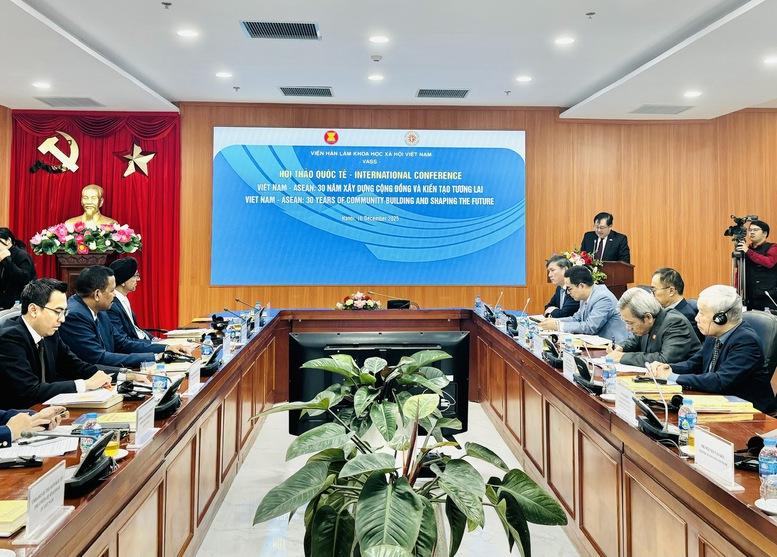
The seminar took place in a special context, commemorating the 30th anniversary of Vietnam's official accession to the Association of Southeast Asian Nations (ASEAN), marking a period of deep, proactive, and significant integration of Vietnam into the regional community.
A historical milestone that opens up new avenues for development.
In his opening remarks at the seminar, Professor Dr. Le Van Loi, President of the Vietnam Academy of Social Sciences , emphasized that July 28, 1995 – the date when Vietnam officially became the 7th member of ASEAN – was a significant historical milestone, opening a new chapter in the country's development and international integration process.
This event is significant not only for Vietnam but also contributes to strengthening peace , stability, and promoting cooperation in Southeast Asia.
According to Professor Dr. Le Van Loi, the most overarching benefit of Vietnam joining ASEAN is the formation of a peaceful and stable regional environment – an essential foundation for ensuring security and socio- economic development.
ASEAN membership has helped Vietnam and other countries in the region reshape their relations towards friendship, cooperation, stability, and sustainability, based on comprehensive cooperation at the bilateral, regional, and multilateral levels.
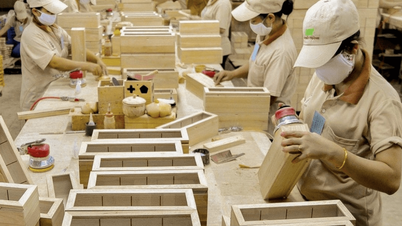
In the economic field, joining ASEAN has opened up a vast market for Vietnam, creating favorable conditions to boost exports, attract investment, and accelerate the process of international economic integration. Participation in the ASEAN Economic Community (AEC) helps Vietnam attract FDI, access modern technology and techniques, create more jobs, and promote economic growth.
Beyond its commercial benefits, ASEAN also serves as an important "launching pad" for Vietnam to expand its global integration through the signing of free trade agreements with many major partners.
At the same time, the ASEAN integration process has strongly promoted domestic economic institutional reforms, improved the system of policies and laws, enhanced the competitiveness of businesses, and helped Vietnam participate more deeply in regional and global value chains.
In the socio-cultural pillar, ASEAN creates a broad space for Vietnam to enhance exchanges, interactions, and the promotion of its national cultural identity. Through cooperation within the framework of the ASEAN Socio-Cultural Community (ASCC), Vietnam has actively participated in addressing common regional issues such as the environment, social welfare, health, education, and human development.
In particular, the people of Vietnam are the direct beneficiaries of the ASEAN integration process, enjoying a more peaceful, secure, and stable environment, greater access to a wider variety of goods and services, and more opportunities for employment, education, and mobility within the region.
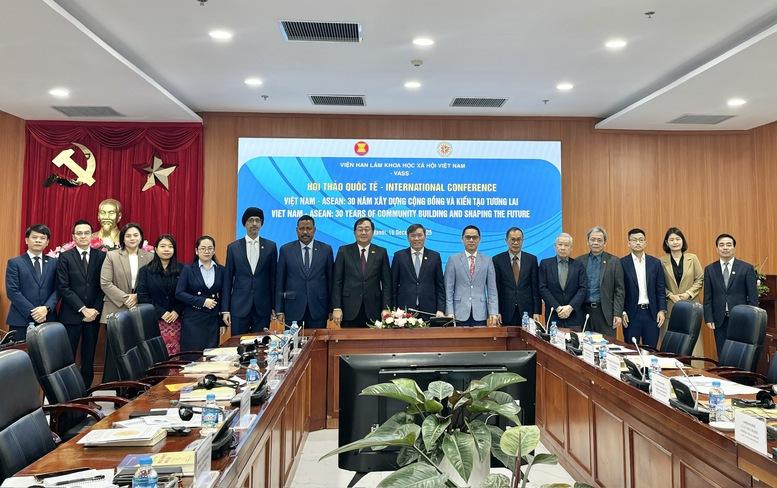
Vietnam – an active, proactive, and responsible member.
Looking back at 30 years of partnership with ASEAN, Vietnam has left many outstanding marks, gradually affirming its role as an active, proactive, and responsible member of the ASEAN Community. Vietnam's position and prestige have been increasingly enhanced through its substantive and effective contributions in many fields.
Vietnam is committed to promoting intra-ASEAN solidarity and the central role of ASEAN in the evolving regional architecture, actively participating in and proposing numerous initiatives to enhance ASEAN's capacity to respond to regional and global challenges. Vietnam also actively participates in building the three pillars of the ASEAN Community, contributing to the formation and implementation of the ASEAN Community Vision 2025.
Notably, Vietnam has successfully held the ASEAN chairmanship three times (1998, 2010, 2020), leaving a distinct mark, especially in the context of the COVID-19 pandemic, demonstrating a high sense of responsibility and contributing to maintaining regional solidarity and promoting cooperation.
Within the framework of the Conference, delegates focused on discussing two main topics: evaluating Vietnam's 30-year journey of participation in ASEAN and exchanging views on the ASEAN Vision 2045, thereby clarifying the prospects and direction of Vietnam's contributions in the coming period.
Professor Ngeow Chow Bing, Director of the Institute of Chinese Studies, University of Malaya, Malaysia, believes that since joining ASEAN in 1995, Vietnam has demonstrated a strong commitment to the norms of the Association of Southeast Asian Nations, pursuing a proactive diplomatic approach and maintaining a firm stance on maritime security, thereby contributing to enhancing the cohesion and prestige of the ASEAN Political-Security Community.
Malaysia views Vietnam as a constructive and increasingly influential partner, supporting ASEAN in effectively responding to political, security, and non-traditional challenges.
Against the backdrop of increasing geopolitical competition in the broader region, Vietnam's continued active participation will remain crucial in ensuring ASEAN's unity, strategic autonomy, and role. For Malaysia, Vietnam is not only an ASEAN member state but also a vital partner in building a resilient, peaceful, and stable Southeast Asia.
Alongside achievements, delegates also frankly pointed out the major challenges ASEAN is facing, from strategic competition among major powers and internal issues to non-traditional security challenges such as climate change, cybersecurity, natural disasters, epidemics, and rising protectionism. This is coupled with the need to innovate development models and enhance competitiveness in the context of the Fourth Industrial Revolution.
In this context, ASEAN has adopted the ASEAN Vision 2045, aiming for a resilient, dynamic, innovative, people-centered, and inclusive community. Vietnam is actively implementing major policies such as Resolution 57-NQ/TW on the development of science and technology, innovation, and digital transformation, and Resolution 59-NQ/TW on international integration in the new context, demonstrating its determination to proactively contribute to the overall development of the region.
Updated December 16, 2025
Source: https://laichau.gov.vn/tin-tuc-su-kien/chuyen-de/tin-trong-nuoc/viet-nam-asean-30-nam-dong-hanh-kien-tao-cong-dong-va-huong-toi-tuong-lai-tu-cuong.html
![[Photo] Prime Minister Pham Minh Chinh receives the Governor of Tochigi Province (Japan)](/_next/image?url=https%3A%2F%2Fvphoto.vietnam.vn%2Fthumb%2F1200x675%2Fvietnam%2Fresource%2FIMAGE%2F2025%2F12%2F16%2F1765892133176_dsc-8082-6425-jpg.webp&w=3840&q=75)
![[Photo] Prime Minister Pham Minh Chinh receives Lao Minister of Education and Sports Thongsalith Mangnormek](/_next/image?url=https%3A%2F%2Fvphoto.vietnam.vn%2Fthumb%2F1200x675%2Fvietnam%2Fresource%2FIMAGE%2F2025%2F12%2F16%2F1765876834721_dsc-7519-jpg.webp&w=3840&q=75)
![[Image] Leaked images ahead of the 2025 Community Action Awards gala.](/_next/image?url=https%3A%2F%2Fvphoto.vietnam.vn%2Fthumb%2F1200x675%2Fvietnam%2Fresource%2FIMAGE%2F2025%2F12%2F16%2F1765882828720_ndo_br_thiet-ke-chua-co-ten-45-png.webp&w=3840&q=75)
![[Live] 2025 Community Action Awards Gala](/_next/image?url=https%3A%2F%2Fvphoto.vietnam.vn%2Fthumb%2F1200x675%2Fvietnam%2Fresource%2FIMAGE%2F2025%2F12%2F16%2F1765899631650_ndo_tr_z7334013144784-9f9fe10a6d63584c85aff40f2957c250-jpg.webp&w=3840&q=75)




































![[Live] Closing Ceremony and Award Presentation for the "Impressive Vietnam Tourism" Video/Clip Creation Contest 2025](https://vphoto.vietnam.vn/thumb/402x226/vietnam/resource/IMAGE/2025/12/17/1765974650260_z7273498850699-00d2fd6b0972cb39494cfa2559bf85ac-1765959338756946072104-627-0-1338-1138-crop-1765959347256801551121.jpeg)
















Comment (0)