

NDO - According to information from Bach Mai Hospital, 11 children who were poisoned by accidentally ingesting rat poison in Tuyen Quang are still hospitalized for treatment, while 23 cases have been discharged.
According to doctors at Bach Mai Hospital, among the 34 pediatric patients (24 at the Pediatric Center and 10 at the Poison Control Center), the extent of damage due to poisoning included: 4 children with brain damage, 9 children at risk of seizures on electroencephalograms, and 13 children showing signs of impaired heart function on laboratory tests.
On January 26th, the two units discharged 23 children and instructed them to return for follow-up examinations. The remaining 11 children, who had abnormalities on their electroencephalograms or brain damage, will continue treatment and be re-evaluated soon for possible discharge consideration.
The Pediatric Center and the Poison Control Center are coordinating with the neurology department to thoroughly evaluate the electroencephalogram (EEG) and consider treatment for some children at risk of seizures; if there are no seizures, they can be discharged. For children with brain damage, a follow-up MRI scan will be performed on the 28th-29th of the lunar month. If stable, they can be transferred to another hospital or discharged with a prescription and a follow-up appointment.
Sharing their feelings before discharge, a parent expressed gratitude for the support and kindness of the doctors and medical staff throughout the past period: “When we found out our child had ingested rat poison, our family was extremely worried. We couldn't hold back our tears when we arrived at Bach Mai Hospital to meet the doctors. Now that he's discharged and can go home to celebrate Tet (Lunar New Year), we are truly overjoyed. The doctors also gave thorough and detailed instructions on monitoring any abnormalities in our child and on follow-up appointments.”
Earlier, on the evening of January 22nd, the Pediatric Center and the Poison Control Center of Bach Mai Hospital received 32 child patients, mostly students from grades 1 to 5 of Phu Binh Primary School in Tuyen Quang City, who had accidentally ingested fluoroacetate, a rat poison.
On January 23rd, the Poison Control Center admitted two more child patients, bringing the total number of children who ingested "red syrup" used to kill rats and are being treated at Bach Mai Hospital to 34.
Upon admission, the pediatric patients were promptly examined, assessed, and tested for damage caused by poisoning, toxins in urine, magnetic resonance imaging (MRI) for those indicated, echocardiogram, etc.
Even when the children are awake and playing, they are closely monitored and treated according to protocol. Doctors continuously review the cases, trying not to miss any other potential causes of poisoning.
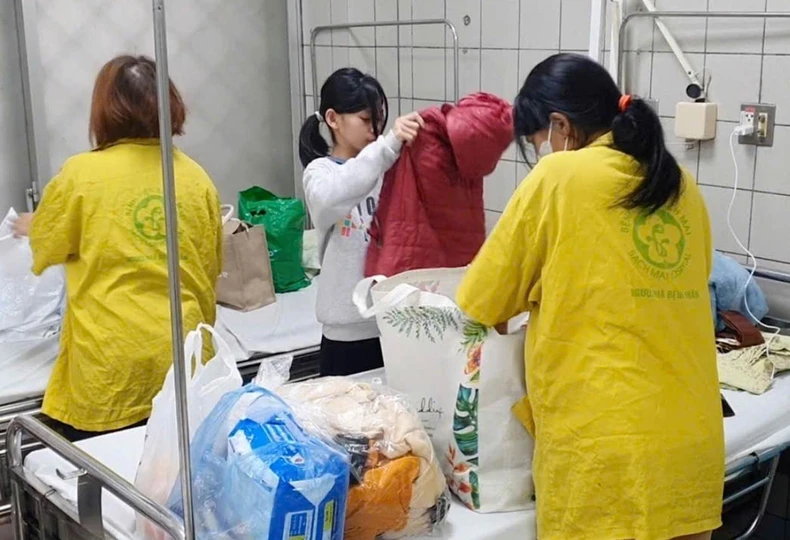 |
The family of the young patient, along with the children, are preparing their belongings for discharge from the hospital. |
According to Dr. Nguyen Trung Nguyen, Director of the Poison Control Center, the characteristics of the red liquid in the tube, the children's symptoms, and the results of the toxicology tests indicate that this was a case of poisoning from the rat poison fluoroacetate/fluoroacetamide.
Furthermore, doctors carefully monitored and assessed whether other substances were causing simultaneous poisoning, as the first child to discover the bag containing the rat poison also had a blue tube inside. Fluoroacetate/fluoroacetamide is a rat poison originating from China, usually in the form of: small plastic or glass tubes containing a pink, colorless, or brown solution, or pink rice-grain-shaped packets, all without labels or with labels entirely in Chinese.
This is a highly toxic rodenticide with neurotoxic effects, causing seizures, coma, severe brain damage, heart damage, acute myocarditis, acute heart failure, arrhythmias, cardiogenic shock, and characteristic hypocalcemia. Severe poisoning can lead to multiple organ damage and failure.
Source: https://nhandan.vn/vu-34-chau-ngo-doc-thuoc-diet-chuot-23-chau-duoc-ra-vien-post857954.html
![[Photo] Tran Cam Tu, Standing Member of the Secretariat of the Central Committee, presides over the first meeting of the Central Steering Committee on the Development of Vietnamese Culture.](https://vphoto.vietnam.vn/thumb/1200x675/vietnam/resource/IMAGE/2026/03/19/1773895004549_ndo-br-bnd-1195-2-jpg.webp)


![[Photo] The General Secretary and the Prime Minister attend the groundbreaking ceremony for multiple-level boarding schools in border areas.](https://vphoto.vietnam.vn/thumb/1200x675/vietnam/resource/IMAGE/2026/03/19/1773888999705_vna-potal-tong-bi-thu-va-thu-tuong-du-le-khoi-cong-dong-tho-dong-loat-cac-truong-noi-tru-lien-cap-bien-gioi-8649904-3885-jpg.webp)








![[Photo] Tran Cam Tu, Standing Member of the Secretariat of the Central Committee, presides over the first meeting of the Central Steering Committee on the Development of Vietnamese Culture.](https://vphoto.vietnam.vn/thumb/402x226/vietnam/resource/IMAGE/2026/03/19/1773895004549_ndo-br-bnd-1195-2-jpg.webp)

























































Comment (0)