

The US is increasing investment in nuclear energy for AI.
Commands for AI chatbots have become familiar operations for most users of technology devices, for various purposes. But behind each of those commands lies the operation of data center systems.
As the AI race accelerates, technology corporations are also entering another race: the race to find energy for artificial intelligence. Energy for AI has become a difficult problem for the global energy industry and leading technology nations.
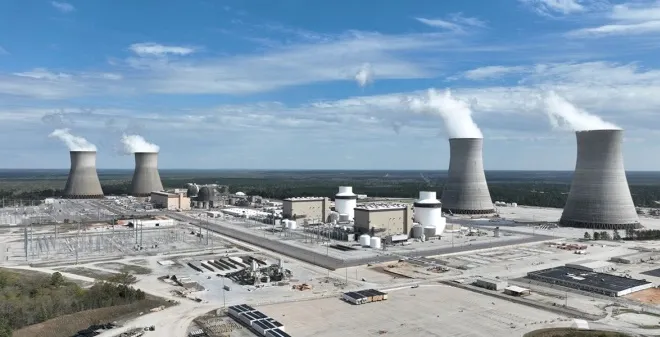
A Georgia Power nuclear power plant in the United States. Photo: Energy.gov
Against this backdrop, the US government recently announced new investments to develop nuclear energy specifically for the AI industry. The administration of US President Donald Trump has just signed an executive order allocating $80 billion to a "strategic partnership" to boost nuclear power production for the artificial intelligence (AI) industry.
US officials believe this move will help realize President Trump's vision of ensuring sufficient domestic energy supply and positioning the US as a leader in the global AI race. Many technology companies also support the new energy policies for technology.
Jensen Huang, CEO of Nvidia, said: "From day one, President Trump has been very supportive of energy growth. We need more energy to sustain the growth of American industries like chip manufacturing and AI, which are energy-intensive."
Earlier in May, President Donald Trump also signed an executive order requiring the completion of 10 large nuclear reactors in the United States by 2030. Meanwhile, many American technology companies have also proactively explored nuclear energy to address their energy needs for AI.
Microsoft has invested approximately $1.6 billion to restart the Three Mile Island nuclear power plant, purchasing its entire electricity output for 20 years to meet the energy needs of its data center.
Google also buys electricity from small-scale nuclear reactors. Amazon has signed numerous agreements to develop nuclear power for its data center systems and has invested billions of dollars in wind and solar farms around the world .
Most recently, Google and the American energy giant NextEra Energy announced a partnership agreement to restart Iowa's only nuclear power plant.
The demand for electricity from AI data centers is growing ever larger.
Energy is a crucial and indispensable resource in the AI industry, especially for the operation of data centers.
According to the International Energy Agency (IEA), electricity consumption from data centers is estimated at around 415 terawatt-hours (TWh), equivalent to about 1.5% of total global electricity consumption last year. This figure has grown by 12% annually over the past five years and is expected to double by 2030.
By 2030, the total electricity consumption of data centers could account for approximately 3% of global electricity. In the US alone, it is estimated that by 2028, data centers could consume up to 12% of the US's total electricity, which is three times the current figure.
By 2030, in the US alone, the electricity used for data processing is projected to far exceed the amount of electricity used in the production of steel, cement, and chemicals combined.
However, according to the IEA, the majority of power for data centers still does not come from renewable energy, despite ambitious claims from businesses.
Furthermore, the AI industry's electricity demand also raises concerns about increased greenhouse gas emissions. The growing number of data centers will cause CO2 emissions from electricity consumption to increase from the current 180 million tons to approximately 300 million tons by 2035.
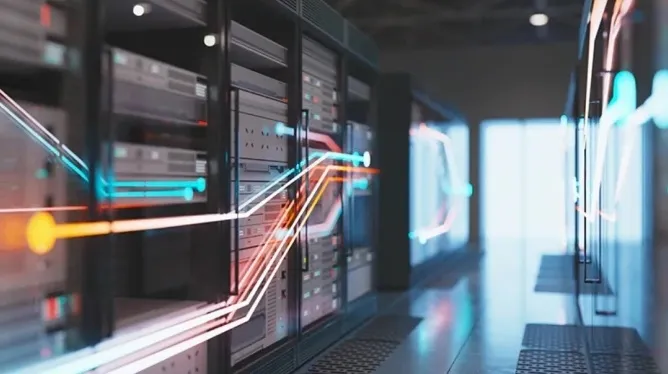
According to the International Energy Agency (IEA), electricity consumption from data centers is estimated at around 415 terawatt-hours (TWh), equivalent to about 1.5% of total global electricity consumption last year. Photo: Goldman Sachs
Challenges in the effort to solve the energy problem for AI
According to Professor Benjamin Lee of the University of Pennsylvania: "Given the scale of the data centers we are building, we cannot rely solely on renewable energy. Discussions have shifted to natural gas, which is abundant in the U.S., or nuclear power. Much of the investment by technology companies has gone into these power generation sources. The question is who will pay for all that infrastructure. And there is a risk that data center operators will disproportionately benefit from these investments, but then those costs will be passed on to local consumers."
Amanda Smith of Project Drawdown Research stated: "AI is taking an increasing share of data center energy consumption. And data centers are also taking an increasing share of electricity consumption in the U.S. We have to think about how we're going to meet that demand whenever we see increased demand in a particular area, because electricity production always has an environmental impact."
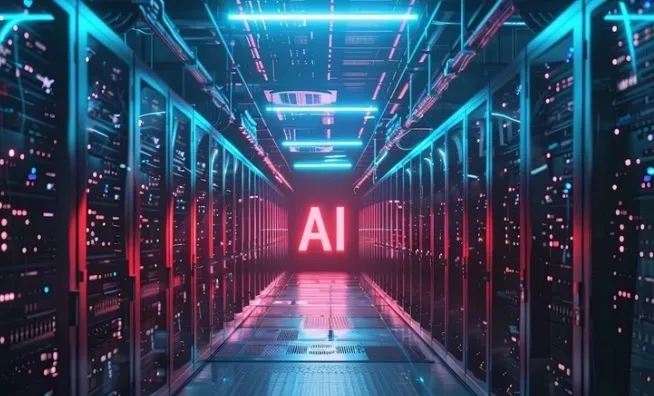
But the "thirst for electricity" for AI is not just a technical problem, but a challenge of balance: balancing development and sustainability, technology and climate, the needs of today and responsibility for tomorrow. Photo: Bloom Energy
Meanwhile, Seamus Corcoran, a local activist in Ireland, said: "We oppose data centers because they consume enough electricity to power the economy . Data centers are commercial; they don't provide any benefits in terms of jobs or the environment."
UN Secretary-General Antonio Guterres stated: "Artificial intelligence (AI) can boost efficiency, innovation, and resilience in energy systems, and we must leverage that. But it also consumes a lot of energy. A typical AI data center consumes the same amount of electricity as 100,000 households, and the largest centers will use 20 times that amount. By 2030, data centers could consume the same amount of electricity as all of Japan today. This is unsustainable unless we change."
AI – a symbol of the new technological era – demands a more robust energy foundation than ever before, as the CEO of the International Energy Agency emphasized – without sufficient energy, AI intelligence cannot develop.
But the "thirst for electricity" for AI is not just a technical problem, but a challenge of balance: balancing development and sustainability, technology and climate, the needs of today and responsibility for tomorrow.
Ensuring sufficient energy for AI while simultaneously making it a tool to help humanity use energy more efficiently is considered a major test for nations and technology corporations.
Source: https://vtv.vn/bai-toan-nang-luong-cho-cong-nghe-ai-100251030060830238.htm

![[Image] Leaked images ahead of the 2025 Community Action Awards gala.](/_next/image?url=https%3A%2F%2Fvphoto.vietnam.vn%2Fthumb%2F1200x675%2Fvietnam%2Fresource%2FIMAGE%2F2025%2F12%2F16%2F1765882828720_ndo_br_thiet-ke-chua-co-ten-45-png.webp&w=3840&q=75)
![[Photo] Prime Minister Pham Minh Chinh receives the Governor of Tochigi Province (Japan)](/_next/image?url=https%3A%2F%2Fvphoto.vietnam.vn%2Fthumb%2F1200x675%2Fvietnam%2Fresource%2FIMAGE%2F2025%2F12%2F16%2F1765892133176_dsc-8082-6425-jpg.webp&w=3840&q=75)
![[Photo] Prime Minister Pham Minh Chinh receives Lao Minister of Education and Sports Thongsalith Mangnormek](/_next/image?url=https%3A%2F%2Fvphoto.vietnam.vn%2Fthumb%2F1200x675%2Fvietnam%2Fresource%2FIMAGE%2F2025%2F12%2F16%2F1765876834721_dsc-7519-jpg.webp&w=3840&q=75)
![[Live] 2025 Community Action Awards Gala](/_next/image?url=https%3A%2F%2Fvphoto.vietnam.vn%2Fthumb%2F1200x675%2Fvietnam%2Fresource%2FIMAGE%2F2025%2F12%2F16%2F1765899631650_ndo_tr_z7334013144784-9f9fe10a6d63584c85aff40f2957c250-jpg.webp&w=3840&q=75)

































































![[Live] Closing Ceremony and Award Presentation for the "Impressive Vietnam Tourism" Video/Clip Creation Contest 2025](https://vphoto.vietnam.vn/thumb/402x226/vietnam/resource/IMAGE/2025/12/17/1765974650260_z7273498850699-00d2fd6b0972cb39494cfa2559bf85ac-1765959338756946072104-627-0-1338-1138-crop-1765959347256801551121.jpeg)



























Comment (0)