

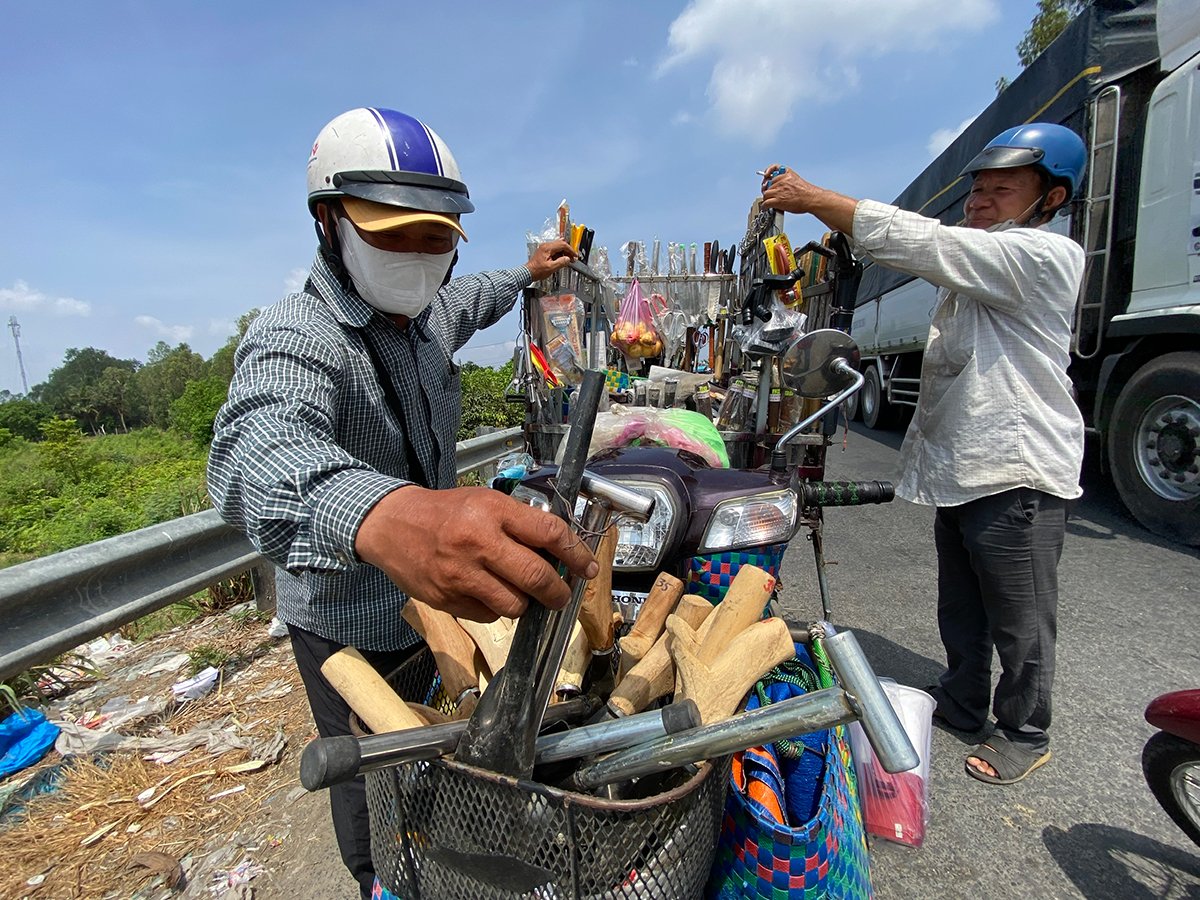
Rearrange the blacksmith's tools that are being sold everywhere.
Quality products
The midday sun beat down on the sweltering countryside, and the cries of the blacksmiths selling their wares grew fainter. This trade involved traveling far and wide; often, exhausted, they would stop somewhere under the shade of a tree by the roadside to rest. One weekend, I saw them huddled under a tree, chatting animatedly about their trade. In the past, the blacksmithing products of Phu My (Phu Tan district) were closely linked to the rice- farming agriculture of the Mekong Delta. The blacksmiths here were diligent and skillful, creating high-quality products that they sold door-to-door. Today, with the inevitable trend of development, traditional Phu My blacksmithing faces competition from many industrial products and has been somewhat affected. To keep up with market tastes and demands, the villagers have boldly changed their designs to be more attractive and of higher quality.
Whenever Phú Mỹ forged products are mentioned, villagers prioritize them. As a result, the blacksmithing craft continues to thrive to this day. Sitting by the roadside enjoying the cool breeze, Mr. Nguyen Hoang Son (54 years old) happily chatted with us. He is very proud of the Phú Mỹ forged goods business passed down from his ancestors. Today, the products are forged from very strong steel pieces, resulting in superior quality. He is the third generation to keep the craft alive. The products are frequently purchased by farmers for use as agricultural tools.
Every day, on his old motorbike, Mr. Hoang Son leisurely rides around selling knives, scissors, saws, sickles, hoes, shovels, axes, machetes, sickles, fruit picking cages, and other tools... all hanging haphazardly on his vehicle. Farmer Nguyen Van Chat was hunched over, digging ditches in his rice field. When he saw Mr. Hoang Son park his motorbike to rest by the roadside, Mr. Chat immediately bought a shovel for 120,000 dong. Mr. Chat said that farmers often use this type of shovel because the blacksmiths in Phu My make them of such high quality.
Typically, those who sell blacksmithing tools follow the seasonal needs of farmers. Hoes, sickles, and scythes are the best-selling items. In the past, during the rice harvest season, sickles from the Phu My blacksmiths' workshops were in high demand. During the rice harvest, families with agricultural land would buy dozens of sickles. Families who worked as hired rice harvesters would equip each member with one. “Back then, I would load hundreds of sickles and sell them throughout the countryside. As soon as I parked my cart, people would scramble to buy them; there weren't enough to sell. The blacksmiths in Phu My had to constantly blow on their fires to meet market demand,” recalled Mr. Hoang Son.
Continuing to uphold the ancestral craft.
With years of experience in the blacksmithing trade, Mr. Pham Ngoc Son (57 years old) recounts that the Phu My blacksmithing village has boldly invested in equipment and machinery such as motors, grinding stones, cutting machines, and steel stamping machines. As a result, the products are of high quality and have beautiful designs that suit consumer tastes. Rearranging the items on his cart to continue his journey to earn a living, Mr. Ngoc Son explains that modern industrially produced forged products tend to bend and break after a short period of use. This is because the steel is "undercooked" and the forging process lacks advanced techniques. Currently, Phu My blacksmithing products are very durable and meet the needs of rural communities.
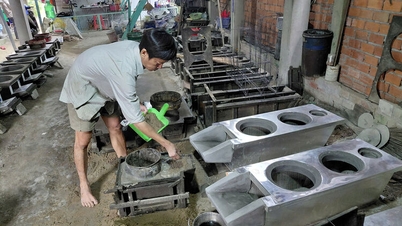
To create exquisitely crafted forged products requires great skill and dedication from the craftsman. Steel is selected from car springs, heated in a red-hot furnace, and then flattened using a stamping machine. The final step is to grind the product on a whetstone until it is perfectly sharp. “This profession is very arduous; you have to work tirelessly under high heat. Therefore, anyone who wants to learn must observe very carefully; it’s impossible to teach them step by step. Some people learn in about a day. Many people keep learning but haven’t succeeded yet,” Uncle Son said with a smile.
Every harvest season, on his motorbike, Mr. Ngoc Son travels throughout the countryside, both within and outside the province, selling his products. When the rice ripens to a golden yellow, he goes to Giang Thanh and Hon Dat (Kien Giang province) to sell hoes and shovels to farmers preparing for the next rice planting season. After the harvest, he travels back to Dong Thap and then down to Vinh Long to sell pruning shears to gardeners. Time flies, and 30 years have passed since he started this traditional blacksmithing trade. Thanks to this, his family has a steady income, raising his children well. As long as people still use Phu My blacksmithing products, he will continue selling them everywhere.
After finishing his conversation with us, he got back in his vehicle and continued his journey, traveling along every road in the countryside. That's the life of a blacksmith selling his wares; although it's hard work, they are very happy when the products they made with their own hands are eagerly bought and used by the farmers.
| The Phu My blacksmith village still has about 30 households maintaining stable operations. Their forged products are supplied throughout the region, providing the villagers with a fairly stable income. Each forge employs four people, producing approximately 50 products daily, which are sold throughout the Mekong Delta and Central Vietnam. |
Source: https://baoangiang.com.vn/ban-dao-do-ren-a420845.html
![[Photo] Delegates attending the opening session of the 14th National Congress of the Party](/_next/image?url=https%3A%2F%2Fvphoto.vietnam.vn%2Fthumb%2F1200x675%2Fvietnam%2Fresource%2FIMAGE%2F2026%2F01%2F20%2F1768881998853_ndo_br_1-jpg.webp&w=3840&q=75)















































![[Image] Ho Chi Minh City simultaneously commences construction and breaks ground on 4 key projects.](https://vphoto.vietnam.vn/thumb/1200x675/vietnam/resource/IMAGE/2026/01/15/1768472922847_image.jpeg)































Comment (0)