

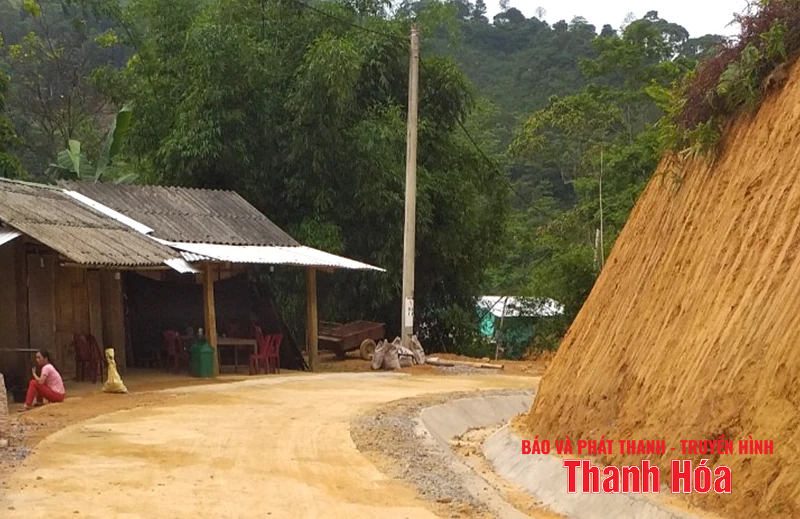
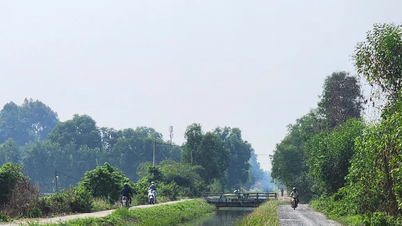
The road leading to Che Lau village (Na Meo commune) has been newly constructed.
From the administrative center of Na Meo commune, the road leading to Che Lau village is only 10 kilometers, but it used to be a harsh journey. More than 10 years ago, I remember a reporting trip with some journalists; to reach the village, it took almost half a day of pushing a cart and walking to cross steep rocky slopes, streams, and slippery roads. Goods and construction materials were almost impossible to transport by motorized vehicles. Patients wanting to go to the commune for treatment had to be carried or stretchered in hammocks, sometimes dying prematurely because they couldn't make it in time.
Now, the road from the commune center to Son village and up to Che Lau village has been 100% paved thanks to funding from the Government 's Program 30a. These first meters of concrete road have opened a door of hope for the 66 households with over 300 Mong people living here. Travel time has been reduced to about half an hour. Motorbikes and cars can now reach the villages and people's homes.
The transformation of the road not only facilitates trade and transportation but also serves as a driving force for economic development and the building of a new life. Comrade Ngan Van Nghia, Vice Chairman of the Fatherland Front Committee of Na Meo commune, pointed to the peach trees along the roadside, their height reaching eye level, and said hopefully: “After the road was completed, the commune's Youth Union, along with several volunteer groups from the lowlands, planted an additional 200 peach trees along the village roads and in the courtyard of the cultural center. Planting peach and plum trees is not just for decoration but also to nurture dreams, so that one day Che Lau will become a community tourism destination with its own unique Mong identity in this border region.”
As for Mr. Thao Van Lau from Che Lau village, he enthusiastically mentions how improved roads, electricity, and mobile phone coverage have helped the Mong people here overcome isolation during rainy and windy weather. The makeshift classrooms of the past have now been replaced by sturdy school buildings. 100% of children attend school; people can travel to the town center more easily, and agricultural products can be exchanged more conveniently.
From Ché Lầu village, I continued along winding concrete roads to Mùa Xuân and Xía Nọi villages (two Hmong villages in Sơn Thủy commune). Previously, the road connecting these villages was just a dirt path, almost impassable by motorbike during the rainy season. Now, instead of children and adults walking and carrying supplies, we see motorbikes, and even trucks carrying household goods and food from the town center. With the road, many households are paying more attention to building gates and entrances to their homes. The old wooden houses of yesteryear have been replaced by sturdy ones. Families are also more concerned about their children's education. After finishing school, they can go to the commune or province to learn a trade, have a better future, and may even work abroad.
Not only are roads improving, but the Hmong villages here are also undergoing a transformation thanks to access to the national power grid. Models of cattle breeding and forest development are becoming increasingly common. For example, the family of Mr. Thao Van The in Che Lau village now owns 10 cows, 2 hectares of bamboo, 1 hectare of sweet potatoes, and 2 hectares of cassava. Thanks to careful planning and hard work, he earns tens of millions of dong in profit each year. Meanwhile, Ms. Thao Van Nhia in Mua Xuan village, who used to only know how to clear land for farming, has now learned how to garden and grow off-season vegetables to sell at Na Meo market. “Thanks to the new road, I can now transport chickens, corn, and cassava to the town center to sell without the hardship of carrying them on my back. I’m also learning how to brew rice wine with herbal yeast, selling it to dealers near the border; they say tourists like it,” Ms. Nhia said with a smile.
Mr. Mac Van Toi, Chairman of the People's Committee of Son Thuy commune, affirmed: In recent years, thanks to special attention from the Central and provincial governments, the locality has received investment in a series of key transportation projects to connect the disadvantaged Mong ethnic minority villages. Among them, the road from Son village to Che Lau (Na Meo commune), over 5km long, has been paved with concrete under Program 30a, opening up trade routes for more than 300 residents. Along with that, the internal village roads in Che Lau and Mu Xuan have also been upgraded, helping people travel conveniently year-round, no longer isolated during the rainy season. Especially, in 2024, the locality will continue to receive funding for a new road, over 12km long, from Thuy Thanh village to Mu Xuan village. The road, nearing completion, will contribute to the completion of the highland transportation system, creating a foundation for sustainable development.
The Hmong villages are no longer as remote and difficult to access as before. New roads have been built, connecting villages and communes alike, and pointing towards the future. With new roads, electric lights, the sound of children's laughter in classrooms, and people carrying vegetables to the market... All of this has been and is illuminating a new life in these remote Hmong villages in the highlands.
Text and photos: Dinh Giang
Source: https://baothanhhoa.vn/ban-mong-khong-con-xa-ngai-255474.htm
![[Photo] General Secretary and President To Lam presides over a working session with the Central Policy and Strategy Committee on the development of the materials industry.](https://vphoto.vietnam.vn/thumb/1200x675/vietnam/resource/IMAGE/2026/05/21/1779359935432_a3-bnd-3129-1412-jpg.webp)
![[Photo] National Assembly Chairman Tran Thanh Man working with the Standing Committee of the Law and Justice Committee](https://vphoto.vietnam.vn/thumb/1200x675/vietnam/resource/IMAGE/2026/05/21/1779378929214_ndo_br_1-4610-jpg.webp)
































































Comment (0)