

- Could you tell us what the highlights of the 2024 PCI Report are?
- The 2024 PCI report marks 20 years of continuous monitoring and evaluation of the provincial-level business environment in Vietnam.
One of the most notable highlights this year is the national PCI average score reaching 67.67 points, a slight increase compared to 2023 and exceeding the 60-point mark for the eighth consecutive time, a positive sign indicating that the business environment continues to improve.
In particular, the core PCI index – reflecting the quality of core economic governance – reached 68.18 points, continuing its steady improvement trend since 2016.
Furthermore, 2024 is also the last year that the PCI has sufficient data to rank all 63 provinces and cities before the provincial-level administrative system is reorganized according to the Central Committee's Resolution. This makes this year's report particularly significant, concluding a cycle of provincial-level administrative reform and opening up expectations for a new phase of development.

- How would you rate the top 10 and bottom 10 localities in the ranking?
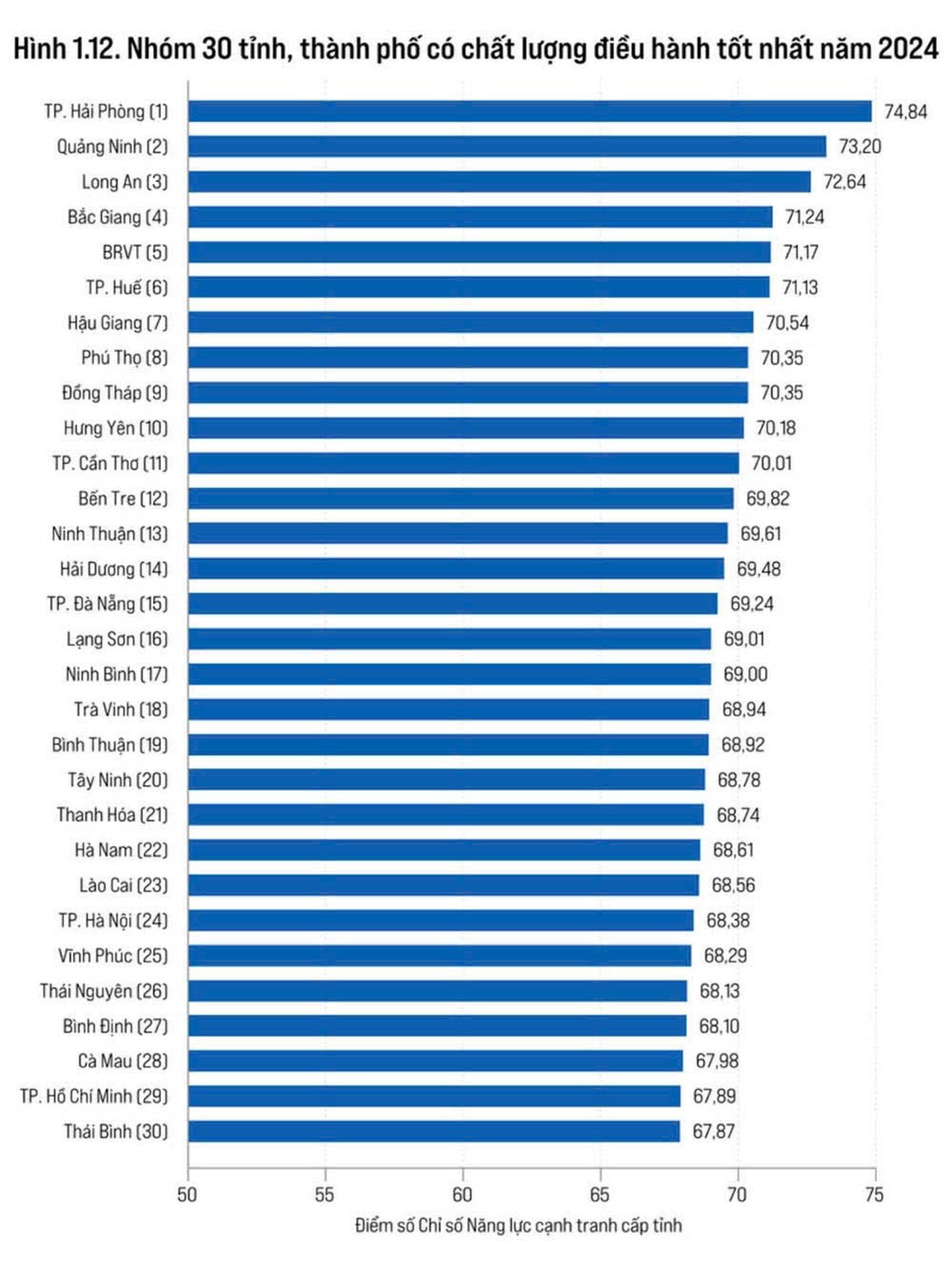
- Leading the PCI 2024 ranking is Hai Phong city with 74.84 points, a very impressive achievement, affirming the locality's strong efforts in improving infrastructure, attracting investment and reforming administration.
The next positions belong to Quang Ninh (73.20 points), Long An (72.64 points), and Bac Giang (71.24 points). These provinces have maintained high rankings for many years thanks to their open investment environment, effective governance, and strong support for the business community.
Other localities in the top 10 include Ba Ria - Vung Tau, Hue, Hau Giang, Phu Tho, Dong Thap, and especially Hung Yen, which is making its first appearance in the leading group.
Conversely, the 10 provinces and cities at the bottom of the ranking still exhibit many shortcomings, such as complicated administrative procedures, high unofficial costs, and a lack of transparency and dynamism in the local government apparatus.
These localities need to undergo strong and coordinated changes to keep pace with the overall reform trend of the country.
- Hanoi ranks 24th on the PCI 2024 ranking. What recommendations do you have for Hanoi to improve its ranking in the coming years, sir?
- Hanoi ranked 24th on the PCI ranking this year, an increase of 4 places compared to the previous year, a fairly good position, but personally, I think it is not commensurate with its potential and role as the economic locomotive of the whole country.
It must be acknowledged that the country's largest economic centers, such as Hanoi, always face greater challenges than other localities in terms of the volume of activity, the complexity of operations, and the higher expectations and demands of businesses and citizens.
Hanoi is accelerating administrative reforms, enhancing information transparency, and reducing informal costs. In particular, Hanoi is striving to play a leading role in innovation, digital transformation, and creating a favorable, dynamic, and competitive investment environment.
One challenge Hanoi must address in the coming period is the synchronized improvement of economic governance capacity at both the departmental and local levels to create substantial transformation. These are all important directions for Hanoi to further accelerate the improvement of its investment and business environment in the coming period.
- Based on the 2024 PCI Report, what is your overall assessment of the current investment and business environment?
- The PCI 2024 survey shows that the investment and business environment in Vietnam continues to experience many positive changes. Businesses note significant improvements in labor quality, information transparency, market entry procedures, and legal institutions.
However, several issues remain to be addressed, such as difficult access to land, the resurgence of informal costs, and a slight decline in the dynamism of local governments.
Progress has been made in the collaboration between the government and businesses, but further efforts are needed to create a transparent, fair, and stable investment environment. This is especially important given Vietnam's goal of rapid and sustainable economic growth, as improving the business environment is a crucial foundation for achieving those goals.
- In your opinion, what role does the PCI Report play in policy planning to achieve the 2030 targets set out in Resolution No. 68-NQ/TƯ dated May 4, 2025, of the Politburo on the development of the private economy?
- The PCI report is not only a tool for measuring the quality of provincial-level economic governance, but also an important "policy radar" that helps identify bottlenecks, thereby guiding appropriate reforms. In the context of the Politburo's recent issuance of Resolution No. 68-NQ/TƯ on the development of the private economy, the PCI will be a valuable source of practical data to support policy planning, promote administrative reforms, support businesses, and enhance national competitiveness.
In particular, with the goal of having 2 million businesses by 2030, a private sector growth rate of 10-12% per year, and contributing 55-58% of GDP, creating a favorable, transparent, and efficient business environment is a prerequisite.
The PCI will continue to be a tool for objective reflection and a powerful inspiration for reform at all levels of government, contributing to the realization of the goal of developing the private sector into the most important driving force of the Vietnamese economy.
Thank you very much, sir.
Source: https://hanoimoi.vn/bao-cao-pci-giup-hoach-dinh-chinh-sach-phat-trien-kinh-te-tu-nhan-701572.html

![[Photo] Prime Minister Pham Minh Chinh receives Lao Minister of Education and Sports Thongsalith Mangnormek](/_next/image?url=https%3A%2F%2Fvphoto.vietnam.vn%2Fthumb%2F1200x675%2Fvietnam%2Fresource%2FIMAGE%2F2025%2F12%2F16%2F1765876834721_dsc-7519-jpg.webp&w=3840&q=75)

![[Photo] Prime Minister Pham Minh Chinh receives the Governor of Tochigi Province (Japan)](/_next/image?url=https%3A%2F%2Fvphoto.vietnam.vn%2Fthumb%2F1200x675%2Fvietnam%2Fresource%2FIMAGE%2F2025%2F12%2F16%2F1765892133176_dsc-8082-6425-jpg.webp&w=3840&q=75)
![[Live] 2025 Community Action Awards Gala](/_next/image?url=https%3A%2F%2Fvphoto.vietnam.vn%2Fthumb%2F1200x675%2Fvietnam%2Fresource%2FIMAGE%2F2025%2F12%2F16%2F1765899631650_ndo_tr_z7334013144784-9f9fe10a6d63584c85aff40f2957c250-jpg.webp&w=3840&q=75)
![[Image] Leaked images ahead of the 2025 Community Action Awards gala.](/_next/image?url=https%3A%2F%2Fvphoto.vietnam.vn%2Fthumb%2F1200x675%2Fvietnam%2Fresource%2FIMAGE%2F2025%2F12%2F16%2F1765882828720_ndo_br_thiet-ke-chua-co-ten-45-png.webp&w=3840&q=75)


























































![[Live] Closing Ceremony and Award Presentation for the "Impressive Vietnam Tourism" Video/Clip Creation Contest 2025](https://vphoto.vietnam.vn/thumb/402x226/vietnam/resource/IMAGE/2025/12/17/1765974650260_z7273498850699-00d2fd6b0972cb39494cfa2559bf85ac-1765959338756946072104-627-0-1338-1138-crop-1765959347256801551121.jpeg)





















Comment (0)