

However, after nearly 10 years of implementation, the application of the Penal Code has also encountered some difficulties and shortcomings that require amendments and additions to suit practical realities and protect fundamental human rights.
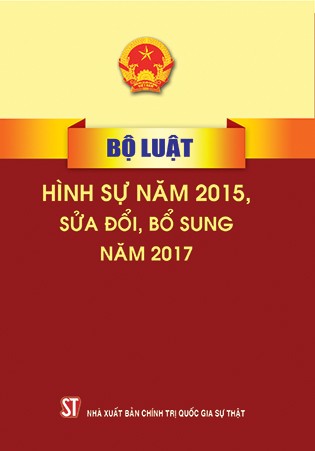 |
| The Penal Code of 2015 (amended and supplemented in 2017). |
Problems arise in practice.
With the rapid changes in socio-economic conditions and legal documents, criminals are constantly seeking new ways to evade the law. The 2015 Penal Code (amended and supplemented in 2017) has presented some difficulties and shortcomings compared to reality, requiring appropriate adjustments and synchronization with other related laws.
Firstly, the grounds for exemption from criminal liability are not consistent and can still be interpreted in different ways.
Clause 3 of Article 29 of the 2015 Penal Code stipulates that "A person who commits a minor offense or a serious offense unintentionally causing damage to the life, health, honor, dignity, or property of another person, and is voluntarily reconciled with the victim or the victim's representative and requests exemption from criminal liability, may be exempted from criminal liability."
Therefore, it can be understood that a person who commits a less serious crime, if it is due to "negligence" causing damage to the life, health, honor, dignity, or property of another person, and the victim or the victim's representative voluntarily agrees to a settlement and requests exemption from criminal liability, may be exempted from criminal liability.
Alternatively, it can be understood that a person who commits a less serious crime due to intentional or unintentional fault, causing harm to the life, health, honor, dignity, or property of another person, and is voluntarily reconciled with the victim or the victim's representative who requests exemption from criminal liability, may be exempted from criminal liability.
Due to the lack of clarity in the law, both interpretations above are reasonable. However, this leads to inconsistent application of the Criminal Code, affecting the legitimate rights and interests of suspects and defendants.
Secondly, the basis for determining the punishment in practice is not commensurate with the nature and degree of danger to society and is not appropriate to the personal background of the offender.
According to Clause 1, Article 50 of the 2015 Penal Code, when deciding on a punishment, the Trial Panel bases its decision on the following grounds: i) Provisions of the 2015 Penal Code; ii) The nature and degree of social danger of the criminal act; iii) The personal background of the offender; iv) Mitigating circumstances; v) Aggravating circumstances.
Research shows that the current Penal Code lacks specific provisions regarding the "nature and degree of social danger of the criminal act" and the "personal characteristics of the offender." Assessing the nature and degree of social danger of an act relies on the nature of the social relationship violated; the nature of the objective act, including the nature of the methods, tactics, tools, and means used in committing the crime; the extent to which the violated social relationship is caused or threatened; the nature and degree of culpability; the motives and purposes of the offender; and the socio- political context and location where the crime occurred.
In reality, recent experience has shown that courts have decided on penalties that are either too low or too high, disproportionate to the nature and degree of danger to society posed by the crime, and inconsistent with the offender's personal circumstances.
Therefore, clearly explaining the two grounds for determining punishment – “the nature and degree of social danger of the criminal act”; and “the personal characteristics of the offender” – in Article 50 of the 2015 Penal Code will ensure the legitimate rights of the accused and limit the subjective determination of punishment by the prosecuting authorities.
Thirdly, the regulations regarding fixed-term imprisonment for individuals under 18 years of age are subject to multiple interpretations and result in different penalties being applied to the same offense.
Studying the content of Article 101 of the 2015 Penal Code, the phrase "the prison sentence prescribed by law" in clauses 1 and 2 leads to various interpretations and the application of different penalties for the same criminal act. Specifically:
Option one: If it is a fixed-term prison sentence, the maximum penalty applied shall not exceed three-quarters (for those aged 16 to under 18) and not exceed one-half (for those aged 14 to under 16) of the prison sentence that the law intends to apply to those aged 18 and over.
The second interpretation is that if it is a fixed-term prison sentence, the maximum penalty applied shall not exceed three-quarters (for those aged 16 to under 18) and not exceed one-half (for those aged 14 to under 16) of the maximum prison sentence prescribed by the law.
Third interpretation: if it is a fixed-term prison sentence, the maximum penalty applied shall not exceed three-quarters (for those aged 16 to under 18) and not exceed one-half (for those aged 14 to under 16) of the maximum prison sentence stipulated in the law's penalty framework.
Fourth, the provisions regarding aggravating circumstances in some articles of the law are unreasonable.
In the group of crimes against property, the 2015 Penal Code (amended and supplemented in 2017) stipulates the basic aggravating circumstances in Clause 1 of Articles 172, 173, 174, and 175 of the 2015 Penal Code: “ Having been administratively penalized for the act of appropriating property and still committing the violation; Having been convicted of this crime or one of the crimes stipulated in Articles 168, 169, 170, 171, 172, 173, 174, 175, and 290 of the Code, and not yet having the criminal record expunged, and still committing the violation.”
However, Clause 2 (aggravating circumstances) of all four of these articles (Articles 172, 173, 174, and 175 of the current Penal Code) stipulates the grounds for "dangerous recidivism," leading to overlap with Clause 1 (basic circumstances).
Fifth, there are no regulations for handling criminal liability for acts of disruption and intimidation against others to collect debts.
Currently, the practice of throwing waste and dirt at people's homes, residences, and property is occurring in many localities, causing public outrage. Most of the incidents discovered are for the purpose of debt collection.
However, these acts do not cause damage to people's property, health, or lives, do not infringe on people's homes, and do not take place in public places. The acts are repeated and aimed at psychologically terrorizing people to collect debts; currently, there is no criminal mechanism to handle them, only administrative penalties as stipulated in Government Decree No. 144/2021/ND-CP.
Therefore, this behavior should be added to Section 4 of Chapter XXI - Other crimes against public order - in order to severely punish these dangerous acts and protect the legitimate rights and interests of citizens.
Sixth, the provision exempting relatives from criminal liability for concealing crimes and failing to report crimes is not truly equitable.
According to Articles 18 and 19, in certain cases, a person who conceals or fails to report a crime, if that person is the grandparent, parent, child, grandchild, sibling, spouse, or partner of the perpetrator, is not criminally liable.
Therefore, if the person concealing or failing to report is a foster father, foster mother, stepfather, stepmother, adopted child, son-in-law, daughter-in-law, stepchild of the wife, stepchild of the husband, niece (niece of the paternal uncle, niece of the maternal aunt, etc.), they are not subject to the provisions of Articles 18 and 19, even though they have a close emotional relationship similar to those listed in Articles 18 and 19.
Therefore, to ensure equality in the handling of criminal responsibility, it is necessary to add the above-mentioned individuals to the list of those exempt from criminal responsibility as stipulated in Article 18 (Crime of concealing a crime) and Article 19 (Crime of failing to report a crime).
Seventh, there is a lack of uniformity in the application and handling of drunk driving offenses.
Point b, Clause 2, Article 260 of the current Penal Code increases the level of criminal liability if a person violating regulations on road traffic participation "has consumed alcohol and the blood or breath alcohol concentration exceeds the prescribed level".
However, Clause 6, Article 5 of the Law on Prevention and Control of the Harmful Effects of Alcohol and Beer 2019 stipulates that the prohibited act is "driving a vehicle while having alcohol in the blood or breath." Thus, there is a lack of consistency between the two laws in their regulations, leading to inconsistent application and handling of legal responsibility; Article 260 of the Penal Code needs to be amended to align with the Law on Prevention and Control of the Harmful Effects of Alcohol and Beer 2019 and other relevant legal documents.
 |
| Illustrative image. |
Some proposed amendments
To ensure the legitimate rights and interests of individuals, as well as to align with the Vietnamese legal system and adapt to changing realities, within the framework of research aimed at contributing to the overall review, evaluation, amendment, and improvement of the 2015 Penal Code (amended and supplemented in 2017), several proposed amendments are as follows:
Regarding grounds for exemption from criminal liability, Clause 3 of Article 29 is amended as follows: “3. A person who commits a minor crime due to negligence or a serious crime due to negligence that causes harm to the life, health, honor, dignity, or property of another person, and is voluntarily reconciled with the victim or the victim's representative and requests exemption from criminal liability, may be exempted from criminal liability.”
Regarding the grounds for determining punishment , it is necessary to add provisions in Clause 1 of Article 50 to more clearly explain the two grounds for determining punishment: "The nature and degree of danger to society of the criminal act"; and "the personal characteristics of the offender," so that prosecuting authorities can apply them consistently when determining punishment for defendants.
Regarding regulations on fixed-term imprisonment for persons under 18 years of age , it is proposed to amend Article 101 of the Penal Code by removing the phrase "the prison sentence prescribed by law" and replacing it with "the maximum prison sentence prescribed within the penalty range prescribed by law".
Regarding Articles 172, 173, 174, and 175, remove the phrase in Clause 1: "Having been convicted of this crime or one of the crimes stipulated in Articles 168, 169, 170, 171, 172, 173, 174, 175, and 290 of the Penal Code, and not yet having had the conviction expunged, and committing the offense again," to avoid duplication with the aggravating circumstance of "dangerous recidivism" in Clause 2 of the aforementioned Articles.
Adding the act of "throwing waste and dirt at the houses, residences, and property of others" to the crime of disturbing public order (Article 318 of the current Penal Code) would effectively prevent individuals from engaging in such acts to collect debts, exert pressure, and psychologically terrorize citizens, causing public outrage in recent times.
Adding the group of relatives including "foster father, foster mother, stepfather, stepmother, adopted child, son-in-law, daughter-in-law, stepchild of wife, stepchild of husband, nephew/niece (nephew/niece of paternal uncle, nephew/niece of maternal aunt, etc.)" to Clause 2 of Article 18 (Crime of concealing a crime) and Clause 2 of Article 19 (Crime of failing to report a crime) of the current Penal Code to ensure consistency in resolving the kinship of the offender.
Regarding the crime of violating regulations on road traffic participation , it is proposed to remove the phrase "exceeding the prescribed limit" in point b, clause 2, Article 260 to align with Clause 6, Article 5 of the Law on Prevention and Control of Harmful Effects of Alcohol and Beer 2019 (which strictly prohibits traffic participants from having alcohol in their blood or breath).
Source: https://baoquocte.vn/sua-doi-bo-luat-hinh-su-bao-dam-quyen-con-nguoi-272907.html





























![[Photo] Reception to welcome General Secretary and President To Lam and his wife on their State visit to the Philippines](https://vphoto.vietnam.vn/thumb/1200x675/vietnam/resource/IMAGE/2026/06/01/1780295488620_vna-potal-chieu-dai-chao-mung-tong-bi-thu-chu-tich-nuoc-to-lam-va-phu-nhan-tham-cap-nha-nuoc-toi-philippines-8798060-7855-jpg.webp)





























































Comment (0)