

 |
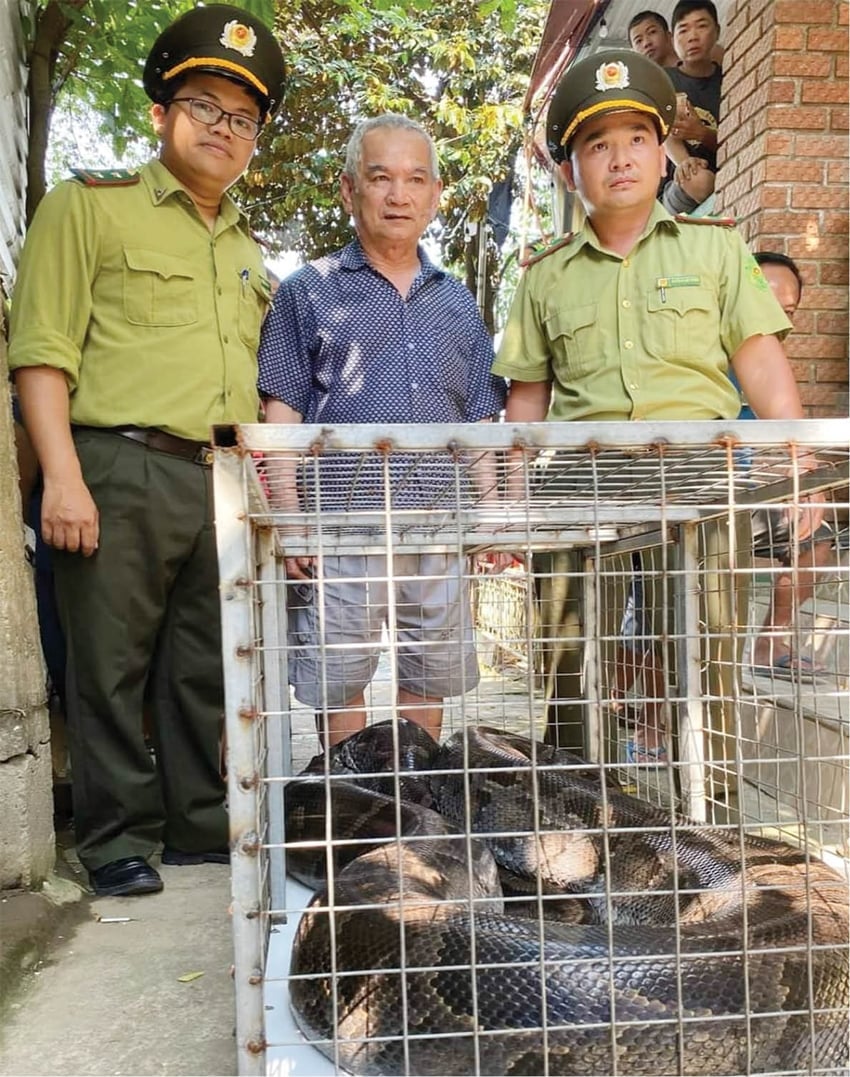
| Forest rangers receive a rare python. |
A fondness for... snakes
For Tran Xuan Hai, Deputy Director of the Phong Dien Nature Reserve Management Board, his love for the beauty of nature and wildlife began during his school years. Every time migratory birds came to nest and breed, his group of friends would buy slingshots to shoot them. On those occasions, Hai would often dissuade his friends from doing so. Perhaps that's where his love for wildlife started...
Being hired to work at Phong Dien Nature Reserve with Mr. Hai felt like fate. Deep down, his love for wildlife is the same for all species, and snakes are one of the animals he's encountered, associated with many memories from his school days.
Hai still remembers that when he was a child, he heard many people say that encountering a "student snake" was a sign of good luck and academic success. It was a coincidence, but it made students like Hai even more convinced, as after encountering the snake, they all achieved high grades. It was from this that he grew to love animals and snakes even more. Hai once wiped away tears when he saw dishes made from snakes, and bottles of liquor infused with these reptiles...
Snakes, like other wild animals, also possess maternal and marital bonds. As a child, he witnessed incredibly touching scenes of mother snakes protecting their offspring from predatory rats. The mother snake would coil herself to shield and protect her young, fiercely fighting off the rats desperate for food. Once, he even saw a pair of snakes, a "husband and wife," inseparable in a fast-flowing stream during the flood season.
Tran Xuan Hai had previously suggested to his unit and superiors that they pay more attention to the search for and conservation of snake species. During each patrol and mobile outreach trip, he and his conservation officers always carried pictures of various snake species. Upon arriving at residential areas, they showed the images of snakes, especially rare and endangered species, so that residents could recognize, understand, and cooperate with authorities in implementing effective conservation and protection measures.
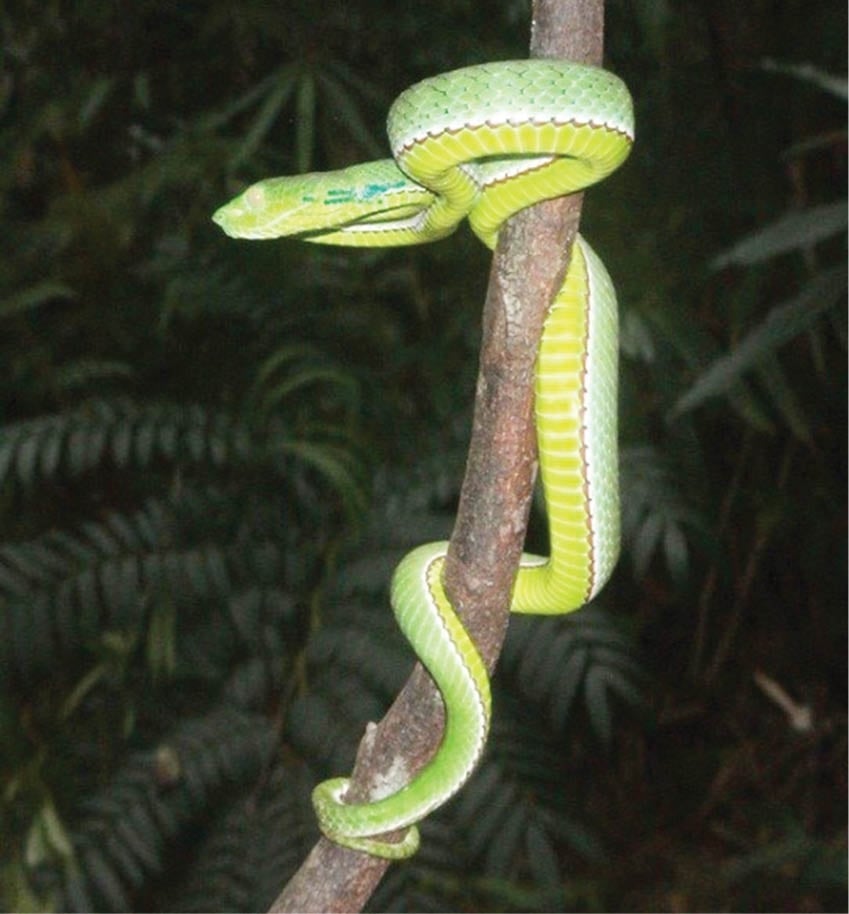 |
| White-lipped pit viper in Phong Dien Nature Reserve |
Anh Hai shared that snake conservation efforts have received more attention in recent years, with many positive changes in people's awareness. Many restaurants now display fewer jars of snake-infused liquor. However, in many places, especially among indigenous people living near forests and lagoons, there is still a clandestine practice of hunting snakes for food or selling them to restaurants. "If this harmful behavior continues, many snake species will see a decline in population and face the risk of extinction," Anh Hai warned.
Conservation efforts
Thua Thien Hue (now Hue City) boasts a rich ecosystem with approximately 50 recorded snake species, many of which are endemic. Recently, a new species of snake was discovered in the Bach Ma mountain area and named the Bach Ma green rat snake (Ptyas bachmaensis). This discovery not only confirms the biodiversity of the region but also opens up opportunities for wildlife conservation efforts there.
According to Mr. Le Ngoc Tuan, Head of the City's Forest Protection Department, the city is facing many challenges in the conservation of snake species. Many snake species are threatened, such as the pit viper (Trimeresurus spp) and cobra (Naja spp), which are in an alarming state. A study from the Institute of Ecology and Biological Resources shows that the number of pit vipers in natural forest areas has decreased by more than 40% in the past 20 years due to deforestation and urbanization. This decline causes great concern for the survival of snake species as well as the ecological balance in the area.
Habitat loss is one of the biggest challenges to snake conservation in Hue. Urban development and population growth have led to the expansion of infrastructure, putting immense pressure on natural habitats. Forests, swamps, and wetlands – considered ideal habitats for many snake species – are gradually being replaced by housing, commercial areas, and other development projects.
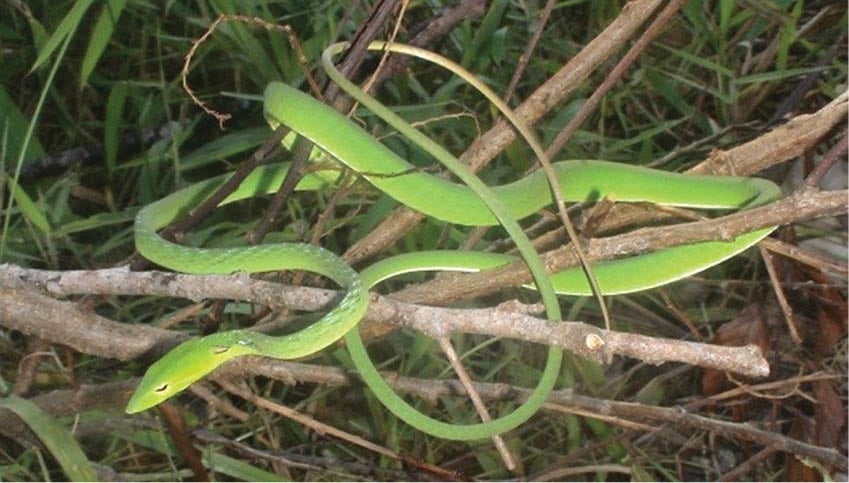 |
| Whip snakes in Phong Dien Nature Reserve |
The hunting of snakes for use in traditional medicine and as food not only puts immense pressure on snake populations but also diminishes biodiversity in the region, severely impacting the ecosystems where they live. Furthermore, climate change is adding further pressure to natural habitats. Habitat loss is not just a problem for individual snakes but affects their entire ecosystem, threatening ecological balance.
According to Mr. Le Ngoc Tuan, in this worrying context, Hue has implemented many conservation programs for snake species and their habitats. One of the outstanding efforts is maintaining and expanding natural forest habitats in Bach Ma National Park and Phong Dien Nature Reserve, and paying more attention to patrolling and enforcing laws on wildlife protection in general and snake conservation in particular.
The city's forest rangers have been very active in protecting snake species. In 2024 alone, they received two reticulated pythons (Python reticulatus) and two Burmese pythons (Morelia spilota) from residents who voluntarily surrendered them. These reptiles are classified as endangered, rare, and precious forest animals in group IIB. While not yet threatened with extinction, they are at risk if not strictly managed and their exploitation and commercial use are not restricted. Both individuals were cared for and subsequently released back into their natural environment, contributing to the recovery of the local python and snake populations. These actions not only help protect pythons and snakes but also encourage a sense of responsibility within the community for wildlife conservation.
Community education and awareness campaigns have also been actively and extensively implemented by the forestry sector, reaching every residential area and household. Non-governmental organizations and local authorities have organized numerous workshops and educational programs to raise public awareness of the importance of snakes in the ecosystem. These communication campaigns have contributed to reducing fear of snakes, thereby encouraging people to participate in their protection. Snake conservation is not only the responsibility of the government but also requires the active participation and action of each individual.
Experts have noted that out of a total of 88 amphibian and reptile species in Phong Dien Nature Reserve, 20 species are snakes belonging to 3 different families. Based on the results of species composition research in Phong Dien Nature Reserve, according to the Vietnam Red Book (2007) and Decree 84/2021/ND-CP, the results have identified 24 endangered and threatened amphibian and reptile species, including 2 amphibian species and 22 reptile species at different threat levels. |
Source: https://huengaynay.vn/kinh-te/bao-ton-ran-quy-149922.html
![[Photo] Prime Minister Pham Minh Chinh receives the Chinese Ambassador to Vietnam](https://vphoto.vietnam.vn/thumb/1200x675/vietnam/resource/IMAGE/2026/04/05/1775397481797_ndo_br_dsc-5512-jpg.webp)



































































Comment (0)