

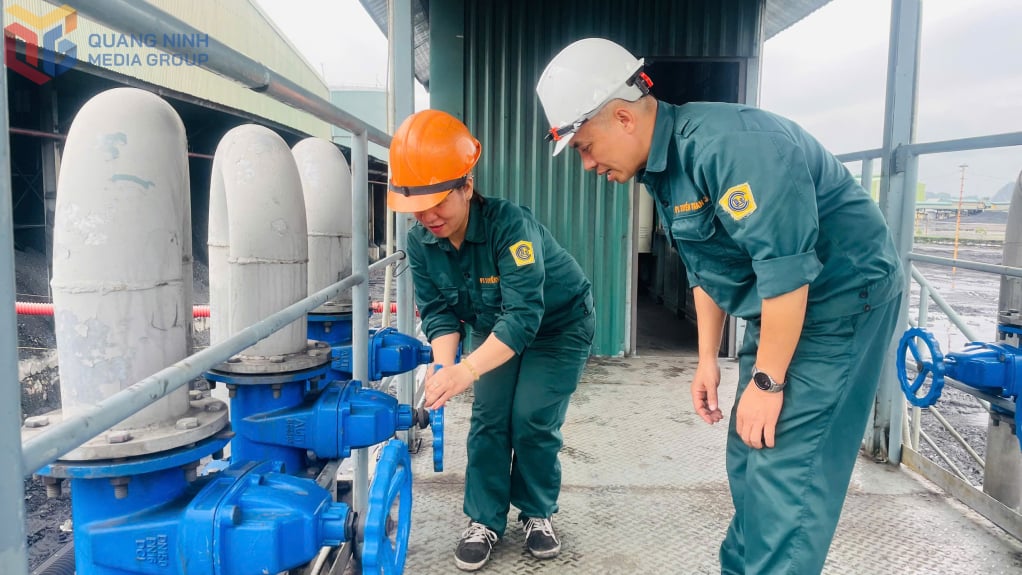
As the largest coal processing and consumption hub in the coal industry, handling over 10 million tons of coal annually, Cua Ong Coal Sorting Company faces significant pressure regarding environmental protection. In recent years, changes have been implemented from within each workshop. Coal Sorting Plant 3, one of the company's high-intensity workshops, receives and processes thousands of tons of raw coal daily. Mr. To Kim Thao, Deputy Workshop Manager, shared: "The workshop is equipped with spraying systems, dust suppression vehicles, and has concreted the entire surface; a misting and surface washing system has been installed, thereby minimizing dust emissions into the environment. In addition, we have invested in a system to wash the wagons to remove all accumulated coal, ensuring that dust is not dispersed during transportation, thus meeting environmental protection requirements."
Cua Ong Coal Sorting Company recognizes that for long-term development within an urban area, production must be clean from the source. The company has implemented a comprehensive set of solutions in each stage of production. Notably, a high-pressure misting system has been installed at dust-emitting points, such as chutes and conveyor belts; the coal conveyor belts are completely covered to minimize dust dispersion; and wastewater generated during the coal sorting process is collected in a central settling tank and treated to meet standards before being recycled. The company has also focused on improving the landscape, paving dust-proof surfaces, planting trees, and investing in noise reduction equipment. This not only helps reduce emissions and meet environmental standards but also contributes to building a cleaner, greener image for the coal sorting plant, harmonizing with the surrounding urban environment.
At Hon Gai Coal Company, the Ha Rang open-pit mine officially ceased operations in 2020 and was included in a long-term reclamation plan. In just a few years, what was once a barren, deep pit is now covered in greenery, with stable soil, a complete drainage system, and fences installed according to regulations. The appearance of the former coal area has changed dramatically; there is no more dust and no longer the risk of landslides during the rainy season.
The Hon Gai Coal Company is implementing land reclamation activities comprehensively across various waste dumps, mining pits, and old transportation routes. Each year, tens of hectares of post-mining land are rehabilitated and reforested; this includes soil treatment, drainage ditches, slope reinforcement to prevent landslides, and long-term plant maintenance. Simultaneously, the company continues to control dust, wastewater, noise, and improve the landscape in production areas, minimizing impacts on residential areas.
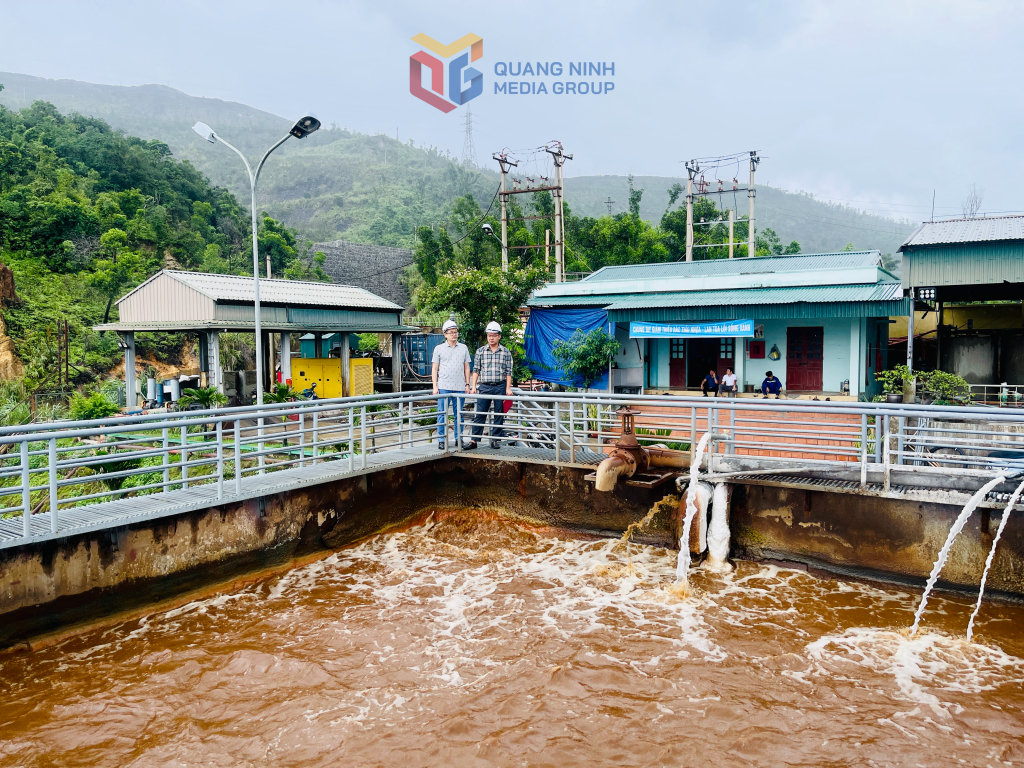
With a mining scale of tens of millions of tons of coal per year, operations spanning many localities, mostly located in urban areas or bordering residential areas, the coal industry always faces significant environmental pressure. TKV (Vietnam Coal Corporation) identifies environmental protection as a key element in its sustainable development strategy, linked to each project and each stage of production.
Mr. Nguyen Manh Chuyen, Deputy Head of the Environmental Department of TKV, said: To date, the Group has planted trees on over 2,000 hectares; built, managed, and operated 45 underground and open-pit wastewater treatment plants ensuring environmental standards; invested in over 128 high-pressure dust suppression misting machines and 167 road watering vehicles. Through these efforts, they annually treat 140-150 million m³ of mine wastewater and over 3,700 tons of hazardous waste. In the first six months of 2025, coal industry units treated more than 49 million m³ of mine wastewater, collected and treated nearly 2,000 tons of hazardous waste, and restored and planted trees on 99 hectares of land after mining.
Source: https://baoquangninh.vn/bao-ve-moi-truong-do-thi-mo-3368487.html

![[Image] Nguyen Tat Thanh Street is expected to be widened, reducing traffic congestion.](https://vphoto.vietnam.vn/thumb/1200x675/vietnam/resource/IMAGE/2026/03/24/1774326200262_ndo_br_3-6869-jpg.webp)
























































Comment (0)