

From 2025, the Ministry of Education and Training will allow secondary schools to be built with no more than 5 floors, instead of the current 3 floors, in order to address the problem of overcrowding and a shortage of classrooms.
The above content was issued by the Ministry of Education and Training in Circular 23/2024, which stipulates the standards for physical facilities in preschools, primary schools, lower secondary schools, upper secondary schools, and multi-level general schools.
Notably, the new circular from the Ministry of Education and Training adjusts regulations regarding the height of schools at all levels. Specifically, at the primary school level, the Ministry of Education and Training stipulates that: Buildings directly serving teaching and educational activities should not exceed 5 stories (the old circular stipulated a maximum of 3 stories).
At the lower secondary and upper secondary levels, the Ministry of Education and Training also adjusted the regulations on the height of buildings directly serving teaching activities from "no more than 4 stories high" to "no more than 5 stories high".
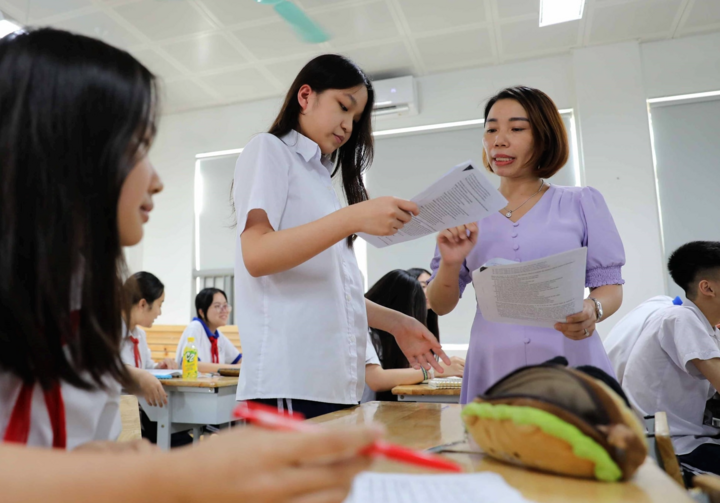
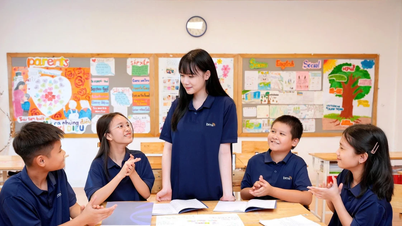
The Ministry of Education and Training 'relaxes' regulations limiting school buildings to no more than 5 stories. (Illustrative image)
A notable new point regarding the facilities of preschools is the size. According to the new regulations, preschools must have a minimum of 9 groups/classes and a maximum of 30 groups/classes (the previous regulation allowed a maximum of 20 groups/classes).
The circular also amends regulations on average area per child. Accordingly, the total land area for school construction (including school branches) is determined based on the number of groups, classes, and children, with a minimum average of 12 m2/child; for urban areas of type III and above, a minimum average of 8 m2/child is permitted.
Circular 23/2024 will take effect from January 31, 2025.
Regarding the proposal to increase the size and scale of schools to address the problem of overcrowded classrooms, a representative of the Hanoi People's Committee stated that the capital city has over 2.2 million students, the highest in the country, and is facing significant pressure from rapid population growth. Each year, Hanoi sees an increase of approximately 50,000-60,000 students, corresponding to 30-40 schools. With no more space available in the inner city, building new schools in the suburbs also requires time.
Representatives of the Hanoi People's Committee proposed to the Ministry of Education and Training that Hanoi be granted special mechanisms, including changing the evaluation criteria from land area per student to floor area per student; and allowing schools in the inner city to add floors and basements.
Similarly, representatives from the Ho Chi Minh City People's Committee also proposed that the Ministry of Education and Training consider establishing standards and classifications based on regions, taking into account special urban areas like Hanoi and Ho Chi Minh City, in order to have specific regulations.
Currently, Ho Chi Minh City sees an increase of 10,000-15,000 students per age group each year, with a 42,000 increase in 6th grade this year alone, leading to overcrowding in junior high schools.
Khanh Huyen
Source: https://vtcnews.vn/bo-gd-dt-noi-long-quy-dinh-xay-truong-khong-qua-5-tang-ar915010.html
















![[Photo] Prime Minister Pham Minh Chinh holds a phone call with the CEO of Russia's Rosatom Corporation.](/_next/image?url=https%3A%2F%2Fvphoto.vietnam.vn%2Fthumb%2F1200x675%2Fvietnam%2Fresource%2FIMAGE%2F2025%2F12%2F11%2F1765464552365_dsc-5295-jpg.webp&w=3840&q=75)











































Comment (0)