

This not only violates the regulations of the Land Law but also leaves many negative consequences for the environment, traffic safety, disrupts urban planning, and directly affects the lives of the people.

According to reports, residents have been arbitrarily digging up forest land and garden plots on both sides of the road, leaving behind steep earthen cliffs that pose a risk of landslides, especially during the rainy season. This situation not only detracts from the urban landscape but also directly threatens the safety of surrounding residents and vehicles traveling below.
Speaking to reporters, Mr. Luong Duy Tien, a resident of Luong Thinh neighborhood, Van Phu ward, expressed his frustration: "During the rainy season of 2024 and 2025, my family constantly lived in anxiety because behind our house there was a high embankment due to a household digging on the hillside to level the land, and in front of our house we worried about floodwaters overflowing because upstream there is a waste disposal site, and every time it rained, a large amount of mud and soil flowed down."
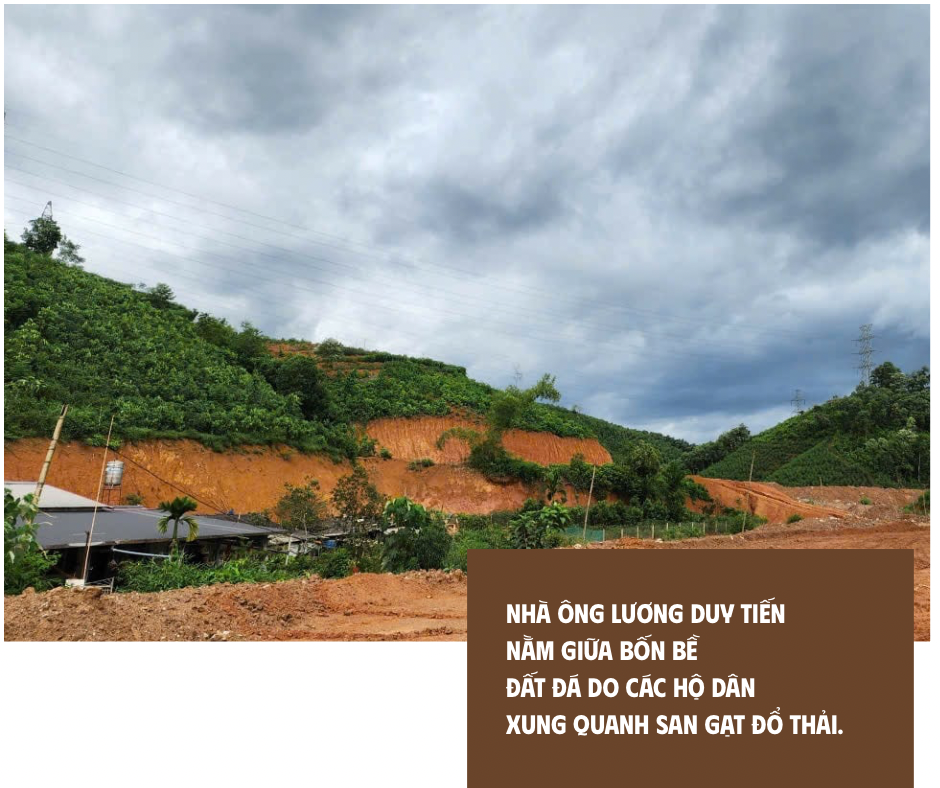
"Recently, during the heavy rains caused by Typhoon No. 3, my family's house was severely flooded. The amount of mud and soil from the landfill that flowed here was excessive, flooding my garden and house. With more heavy rain coming soon, I don't know what will happen," Mr. Tien shared worriedly.
Pointing to several spots where residents had arbitrarily dug and leveled the ground along the road connecting Nguyen Tat Thanh Street with Au Co Street in Van Phu Ward, Ms. Pham Thi Vui, a resident of Thanh Huong residential area, said: "These leveling points along both sides of the road are all done by several businesses that have the necessary equipment and machinery to hire people to excavate and level the land. Households with hillside or garden land that needs digging and leveling only need to pay to hire the businesses, which will handle the entire project. After the land is leveled, many households have divided it into plots to transfer to people who need land for housing or to build factories for production and business purposes."
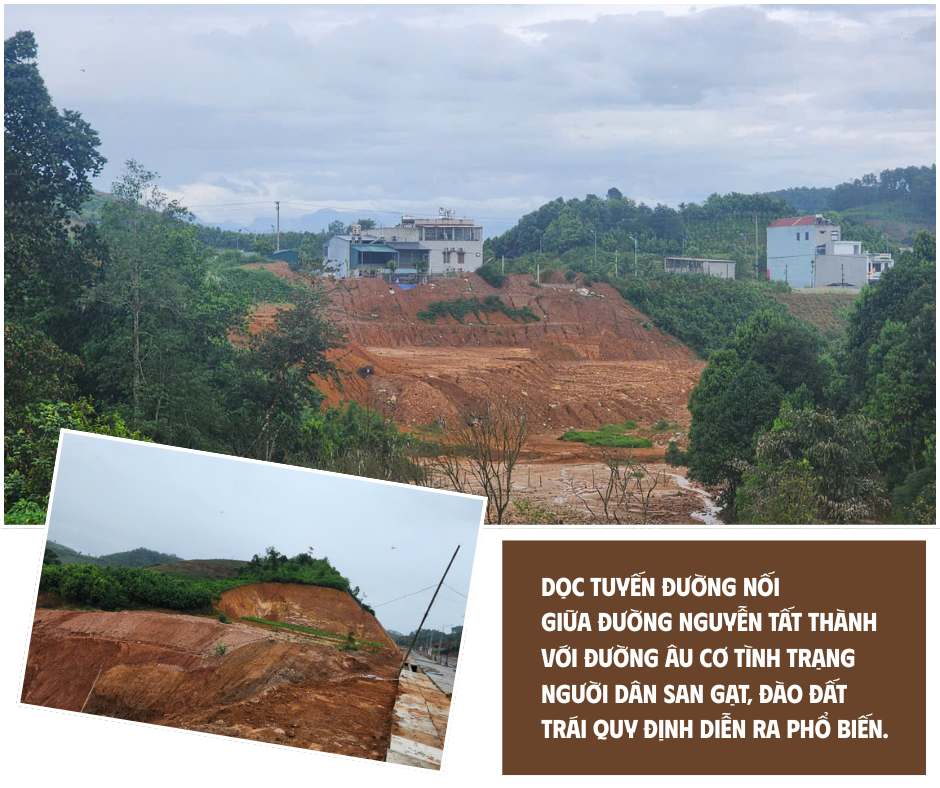
According to Ms. Pham Thi Vui, the digging of hills and dumping of soil to level the ground along this road has been going on for many months, and in some places it has only been about a month.
According to observations by reporters, the unauthorized hiring of machinery by households to excavate and level the land along both sides of the road connecting Nguyen Tat Thanh Street with Au Co Street has resulted in unevenly dug hills, damaged newly constructed road shoulders, and in some places, buried or collapsed drainage pipes, causing a loss of aesthetics, affecting traffic safety, and hindering drainage.
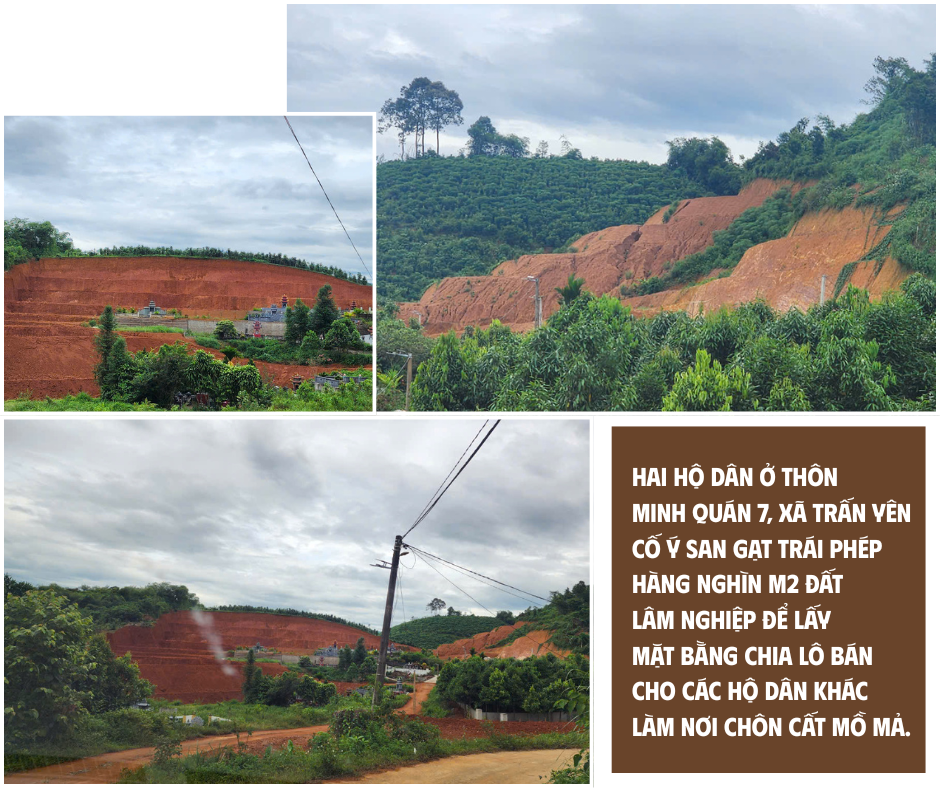
In Tran Yen commune, we observed that residents had arbitrarily leveled a hillside plot of land planted with perennial trees, covering an area of over 6,900 m², located near the Minh Quan 7 village cemetery. The leveling was done in multiple layers, with an estimated volume of tens of thousands of cubic meters of excavation and embankment, in order to divide the land into plots for sale to families in the village for burial and tomb construction.
Traveling along National Highway 279 towards Bao Yen and Xuan Hoa communes, reporters also observed people digging and leveling hillsides to create space for housing. In some locations, many households even filled in riverbeds with soil to create space for building production and business facilities. This not only seriously violates the Land Law and environmental protection regulations, but also poses a risk of landslides, traffic accidents, obstruction of water flow, and danger to the residents themselves.
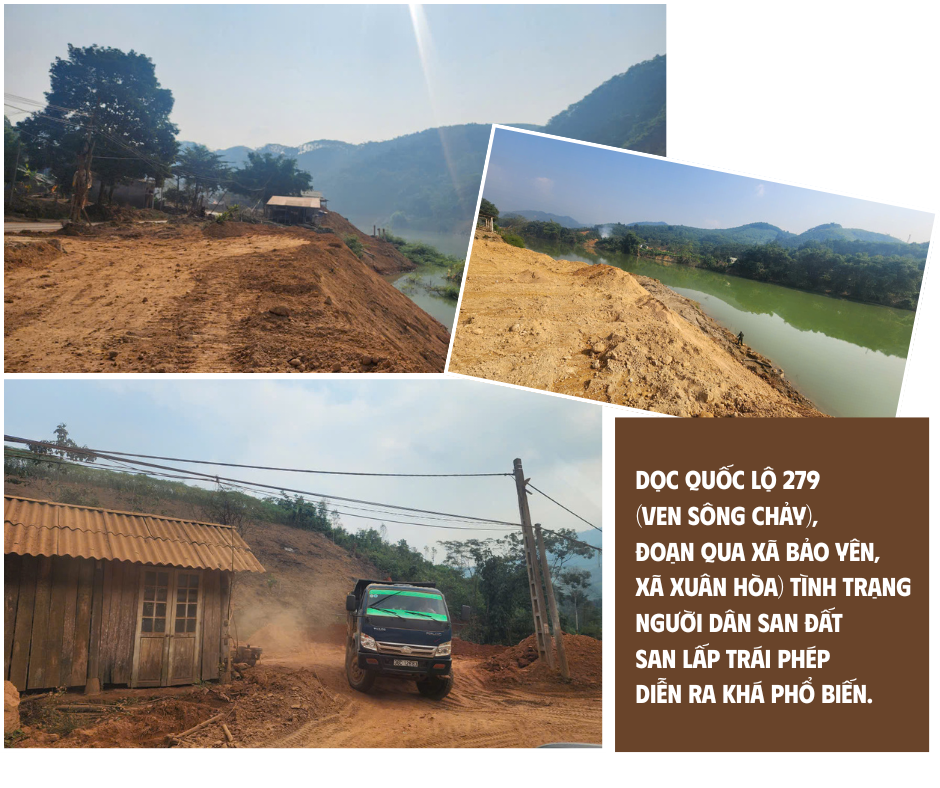
In reality, unauthorized land leveling and excavation are quite common in many localities, especially along National Highways 70, 279, 4D, 4E, and 32C, and Provincial Highways 160, 166, and 156. However, due to various reasons, the inspection and handling by the authorities in some localities and relevant agencies have not been decisive enough, leading to an increase in this activity.
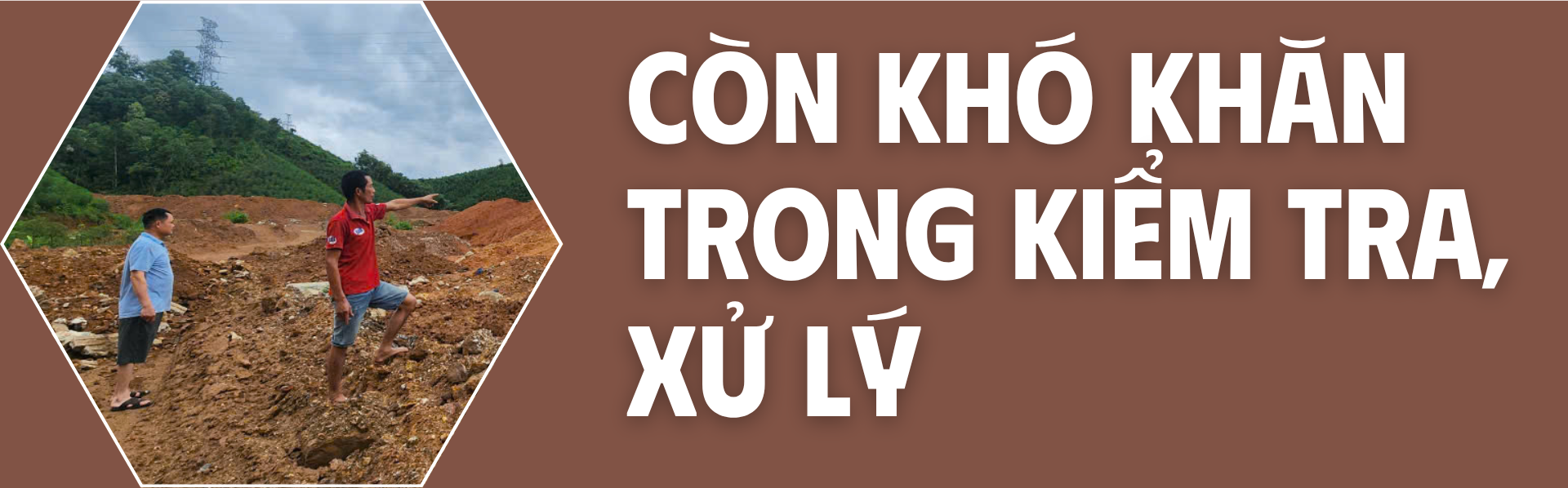
Faced with the rampant problem of excavating slopes and leveling hillsides for land preparation, which causes safety hazards, disrupts public order and security, and impacts the environment, affecting people's lives and infrastructure such as transportation, electricity, and telecommunications, the authorities of some communes and wards in the province have been taking steps to tighten management; however, organizing inspections and taking action still faces many difficulties.
Speaking with reporters, Mr. Bui Ngoc Giang, Vice Chairman of the People's Committee of Van Phu Ward, acknowledged that there have been instances of people leveling land illegally in the ward. Particularly after Typhoon Yagi in September 2024, some households arbitrarily leveled and cleared landslide areas without reporting to the authorities or completing the necessary procedures. In addition, there have been cases of people taking advantage of this to level hills and agricultural land for housing purposes. Upon detection, we dispatched forces to request a temporary halt to construction and simultaneously educated and persuaded residents about the relevant laws.
“Van Phu Ward has also established an inter-agency task force comprising police, the Fatherland Front , and specialized civil servants to strengthen oversight, promptly detect, and disseminate information to the people. For areas where the current status has been altered, we will resolutely refuse to process administrative procedures related to land, such as changing land use purposes,” Mr. Giang emphasized.
In Tran Yen commune, decisive action is demonstrated through concrete penalty decisions. Mr. Nguyen Tuan Linh, Vice Chairman of the Tran Yen Commune People's Committee, stated that the commune recently issued penalties against two households in Minh Quan 7 village, namely Mr. Mai Van Hong and Mr. Mai Thanh Son, for illegally leveling and altering the terrain on over 6,900 square meters of production forest land adjacent to the Minh Quan 7 village cemetery. Both households were fined a total of 71.5 million VND each for failing to register their land for the first time and for altering the land's topography beyond restoration.
"In practice, we have observed that many households in the commune do not fully understand the procedures and regulations when carrying out land leveling. Therefore, after handling violations, the commune has intensified propaganda through various information channels to inform the people," Mr. Linh added.
Similarly, in Tan Hop commune, upon discovering that some households were digging and leveling land, causing landslides along inter-communal roads and endangering several high-voltage power poles in the area, the local authorities coordinated with the Van Yen Regional Power Management Team and the commune police to inspect and record violations by the households. They also directed the villages to strengthen supervision to promptly prevent similar incidents from occurring.
According to Mr. Ha Trung Kien, Chairman of the Tan Hop Commune People's Committee, the commune's People's Committee has reviewed each road and area to closely monitor the work of overcoming the consequences of the floods, guiding people to level, excavate, and dispose of waste according to regulations; and at the same time, resolutely dealing with households that deliberately excavate and level land illegally. However, because the commune government is newly established, the assignment of responsibilities for inspection and handling violations in some areas is still not fully ensured.
Regarding provincial-level management, Ms. Trinh Thi Thu Huyen, Deputy Director of the Department of Agriculture and Environment of Lao Cai province, stated: The authority to grant permits for land leveling falls under the jurisdiction of the commune-level government and the Construction sector. Currently, there is no specific information from localities regarding the number of violations. To strengthen management, the Department of Agriculture and Environment has issued directives and guidelines to the commune level. In the future, the Department will strengthen coordination with relevant provincial agencies to inspect and strictly handle violations by households, organizations, and individuals.
“The Department of Agriculture and Environment recommends that the People's Committees at the commune level need to enhance their management role, promptly detect and prevent violations in their areas. For areas at risk of landslides, the department will continue to advise the Provincial People's Committee to review and develop plans for relocating and safely resettling people, avoiding allowing people to arbitrarily excavate and level the land in violation of regulations and without ensuring safety,” Ms. Huyen added.
Lao Cai is a mountainous province with steep terrain, making land leveling and improvement necessary for housing construction, land-use conversion, and disaster relief. However, land users must comply with legal regulations and ensure environmental protection during land leveling and improvement activities. According to Articles 11 and 31 of the 2024 Land Law, unauthorized leveling that alters the slope and soil structure can be considered land destruction and is strictly prohibited.
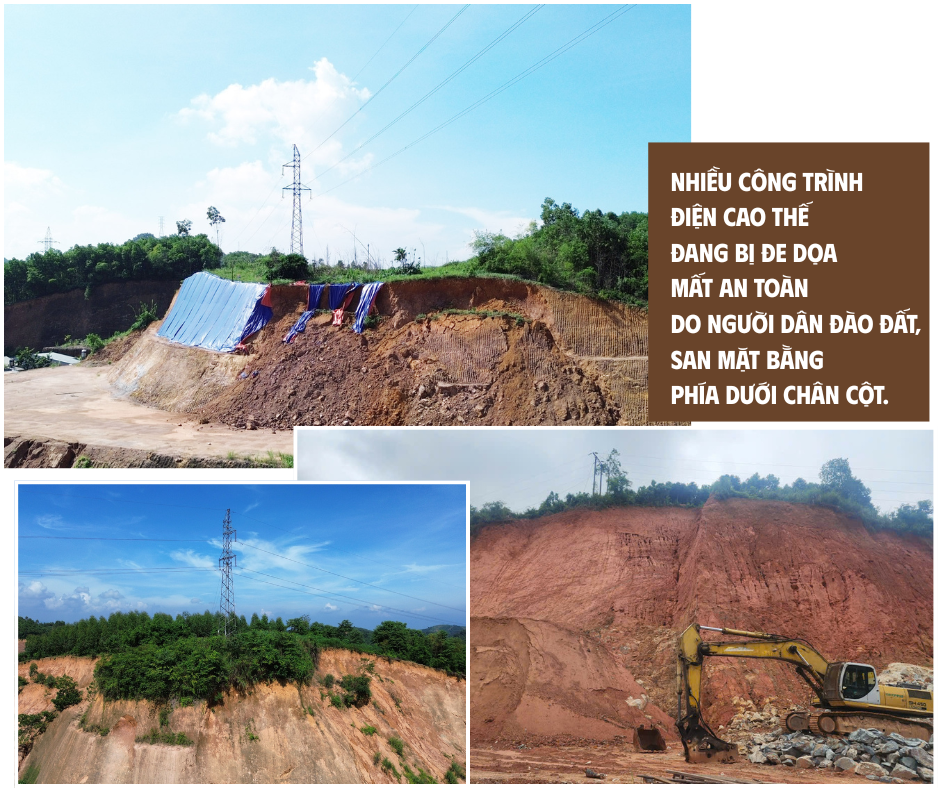
To put an end to illegal land leveling, excavation, and dumping that detracts from the aesthetics, affects transportation and power infrastructure, and jeopardizes the safety of residential areas, requires the coordinated efforts of all levels of government and relevant agencies; more importantly, it requires a change in awareness and compliance with land laws by each citizen. Leveling land for housing or production is a legitimate need, but it must comply with legal regulations and cannot be sacrificed for the safety of the community or the sustainable development of society as a whole.
Source: https://baolaocai.vn/can-siet-chat-quan-ly-hoat-dong-san-gat-dao-dat-trai-phep-post649902.html















![[Photo] Prime Minister Pham Minh Chinh attends the Conference on the Implementation of Tasks for 2026 of the Industry and Trade Sector](/_next/image?url=https%3A%2F%2Fvphoto.vietnam.vn%2Fthumb%2F1200x675%2Fvietnam%2Fresource%2FIMAGE%2F2025%2F12%2F19%2F1766159500458_ndo_br_shared31-jpg.webp&w=3840&q=75)





























































Comment (0)