The spirit of the countryside clings to traditional crafts.
Amidst the crowded rows of houses near Thanh Cong Market ( Hanoi ), it wasn't difficult for me to find Mr. Cao Ky Kinh's house. It was a pork offal porridge shop with walls covered in all kinds of traditional musical instruments.
When I arrived, Mr. Kỉnh was sitting and tuning his unfinished moon lute. His hair was as white as snow, and the wrinkles on his face were replaced by sharp, intelligent eyes. His dark, calloused hands skillfully adjusted each string and each wooden fret. Hearing my question, he smiled slightly, picked up the lute, and hummed a đoạn of "Floating Water Lilies and Drifting Clouds," as if both answering and testing whether the sound was "right."
The owner of the pork offal porridge stall, who is also a craftsman of traditional musical instruments, was born in 1958 in Khoai Chau, Hung Yen . In 2006, Mr. Cao Ky Kinh's family moved to Hanoi to make a living selling pork offal porridge in the mornings, and later selling clothes, working as a parking attendant, and grinding flour. When the stall was quiet, he would immerse himself at his small wooden table, where he "breathed life" into bamboo and wood pieces, creating the sounds of the mountain's stringed instruments. He recounted that his father was a craftsman of musical instruments, so from a young age he was familiar with the sounds of chiseling, carving, and the sounds of stringed instruments. It was these familiar sounds that led him to traditional musical instruments, a pure passion passed down from his father.
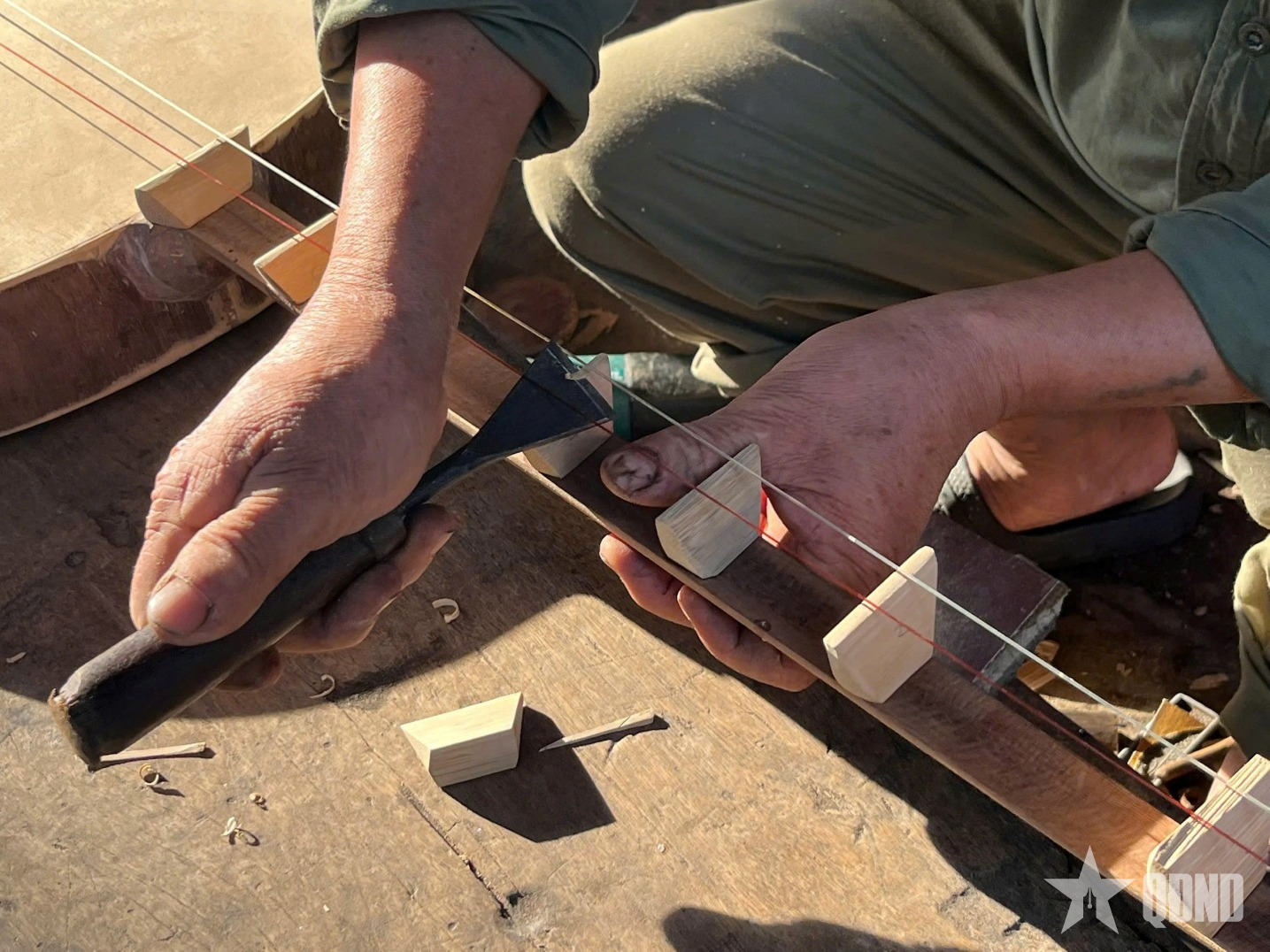
|
Mr. Kỉnh was meticulous with each piano key. |
Turning back to the moon lute he was tuning, Mr. Kỉnh said this was the most difficult part. Making a lute is not just a profession, but a meticulous process, paying attention to every detail.
“In this craft, selecting the wood, carving the details, and measuring the dimensions must be precise. But the most difficult part is tuning the strings and adjusting the pitch. In the noisy city, sometimes I have to wait until very late at night to test whether the instrument has reached the correct sound,” Mr. Kỉnh confided. Furthermore, to make a quality instrument, Mr. Cao Kỳ Kỉnh must source high-quality woods such as: Vông, Gạo, Lim, Trắc, and pine… which produce a natural and refined sound.
Entering the house, Mr. Kỉnh showed me each instrument. In the room, which was just over 10 square meters , all kinds of musical instruments with glossy brown paint hung everywhere. The instruments—moon lute, pipa, two-stringed fiddle, zither, and bass lute—were all simple, uncarved, and without elaborate decorations, covering an entire wall. "I know how to play every single one hanging here," he said, with a touch of pride in his voice.
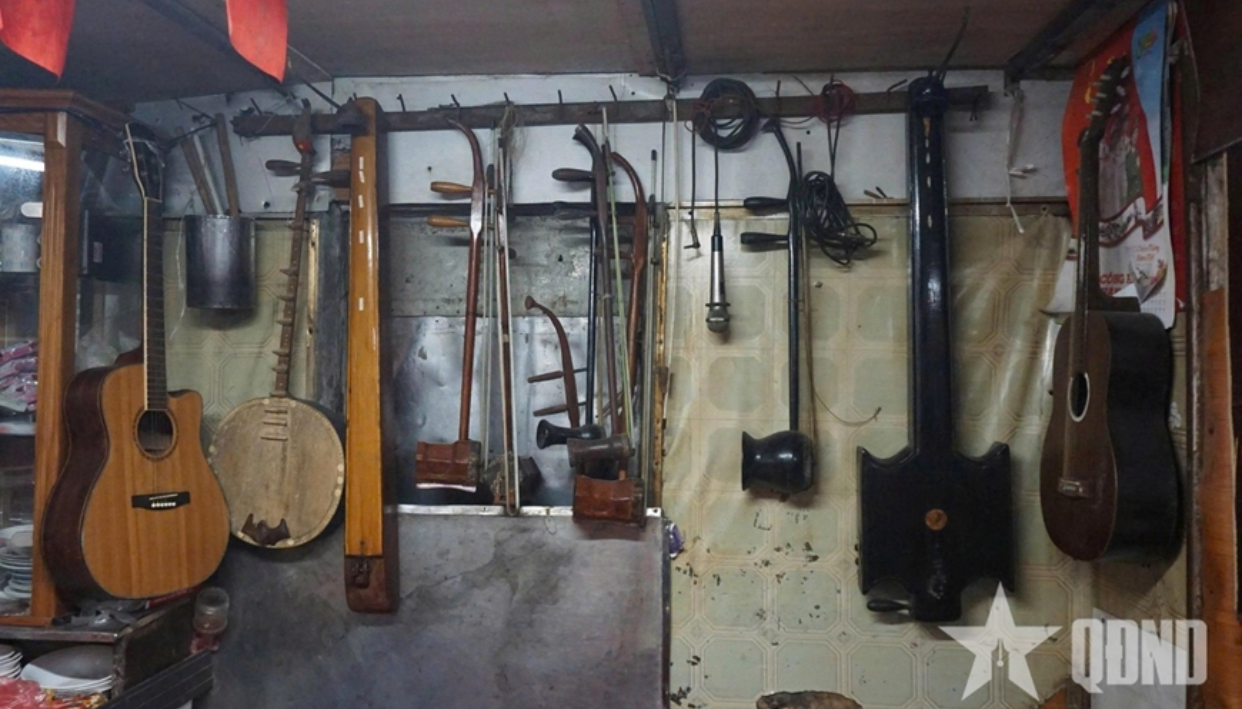
|
The "legacy" of traditional musical instruments crafted by Mr. Cao Ky Kinh. |
Besides crafting instruments, he also repairs them. According to Mr. Kỉnh: "Repairing instruments is sometimes even more difficult than making them. Making them only requires the right technique, but repairing them requires capturing the old soul of the instrument."
Someone once brought a century-old zither to him. Mr. Kỉnh could only promise to restore about 80% of it, and the sound might not be as perfect as it was originally. However, after the repairs were completed and the sound of the zither resonated, the customer was moved and said, "It's wonderful, absolutely wonderful. Please keep it and play it yourself; consider it our destiny." Since then, Mr. Kỉnh has carefully preserved the ancient zither, and despite many people offering high prices to buy it, he has always refused.
The heart of a musician
Customers eating porridge at Mr. Kỉnh's shop couldn't hide their surprise when they saw the musical instruments on the wall. Some, while eating, exclaimed in admiration, "Please bring out the instruments and play for fun!" And so, amidst the steaming hot porridge, an ancient melody resonated, gentle yet heartfelt, permeating every small corner of the old alley.
In the past, Mr. Kỉnh's shop was always bustling, but few came to eat porridge; more came to enjoy the music and watch him play the instrument. Even Western tourists came to experience it, enjoying their meal while listening to him play a few tunes. Several musicians and singers also visited the shop, lingering to socialize. Gradually, his small porridge shop became a meeting place for those who love traditional Vietnamese music .
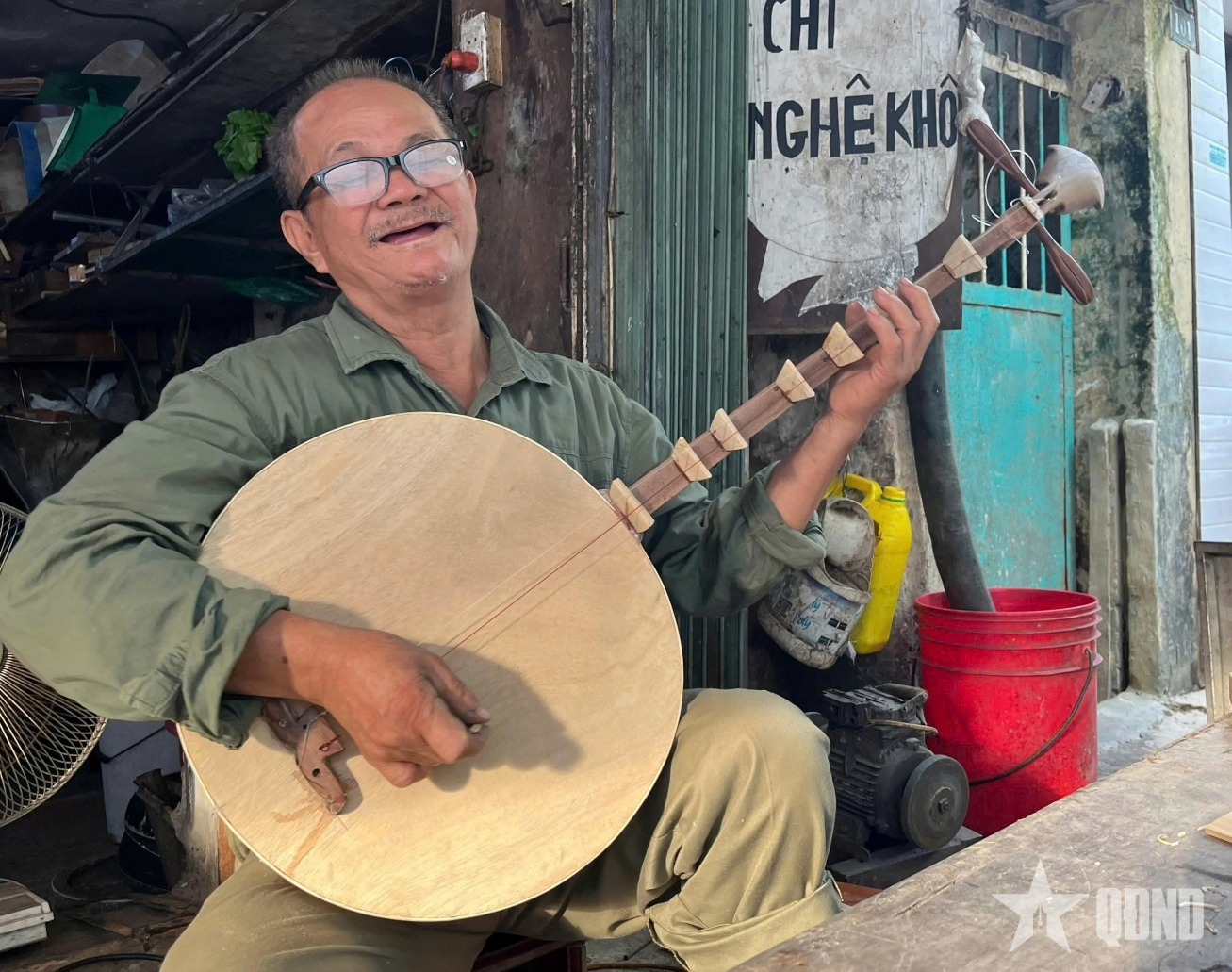
|
For Mr. Kỉnh, making and playing musical instruments gives life more meaning. |
Once so vibrant and lively, the familiar sounds of traditional instruments have gradually faded in recent years. "Now that modern music is popular, hardly anyone cares about listening to folk music anymore," he said, his voice lowering.
Occasionally, people would stop by the shop and ask, "It's been so long since I've heard your country music, I suddenly miss it." Mr. Kỉnh would then happily pull out his unique, self-created zither and play a few old melodies. He was also happy and willing to share his knowledge and experience with anyone who wanted to.
Mr. Kỉnh's instrument workshop was born from a longing for his homeland, a love for folk music, and the affection and encouragement of culture lovers near and far. Whether busy or quiet, he continues to work diligently on his instruments every day. "Making instruments doesn't make you rich, but if I quit, I'd feel completely poor," he says with a smile, his eyes sparkling.
Source: https://www.qdnd.vn/van-hoa/doi-song/nguoi-tho-gia-giu-hon-dan-gian-959288




![[Photo] General Secretary and President To Lam presides over a working session with the Central Policy and Strategy Committee on the development of the materials industry.](https://vphoto.vietnam.vn/thumb/1200x675/vietnam/resource/IMAGE/2026/05/21/1779359935432_a3-bnd-3129-1412-jpg.webp)












































































Comment (0)