

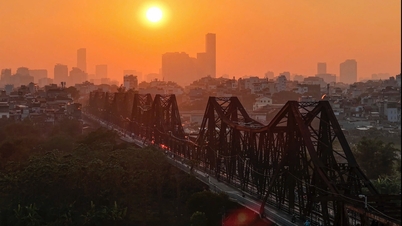
Long Bien Bridge is not only the first steel bridge connecting the two banks of the Red River, but also a cultural and historical heritage of the capital city. Through many ups and downs, the Long Bien Bridge is no longer intact, but the image of this century-old bridge remains closely associated with Hanoi and has become a sacred part of the beloved capital.
Every time I cross or stop on Long Bien Bridge, images of a peaceful, ancient Hanoi appear before my eyes. The values of culture and history seem to be imprinted on each span of the bridge, evoking countless memories of Hanoi's past.
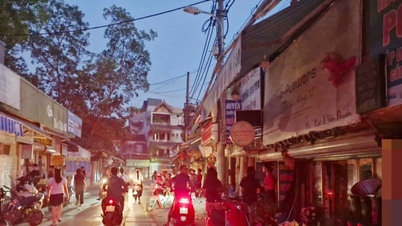
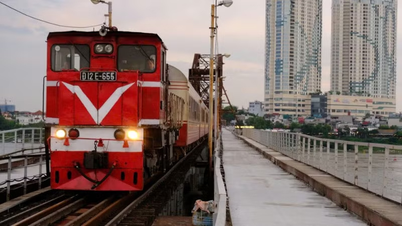
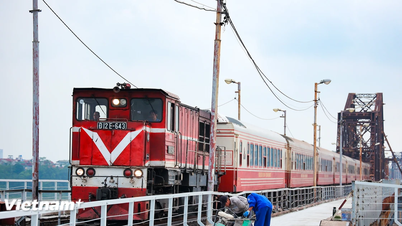
Let's admire the serene moments capturing everyday life on Long Bien Bridge through the photographs of photographer Cao Anh Tuan.
 The Long Bien Bridge is one of the most distinctive, beautiful, and unique man-made images of Hanoi's culture and history. For the people of Hanoi, the Long Bien Bridge is not only the first bridge connecting the two banks of the Red River, but also an inseparable historical landmark of the capital throughout the 20th century. This bridge was inaugurated on this day 112 years ago, February 28, 1902.
  Hanoi has the Long Bien Bridge, both long and wide, spanning the Red River. Trains and vehicles travel freely, and people bustle back and forth carrying their loads... On September 13, 1889, the first stone was officially laid by Governor-General Paul Doumer at the bridge's abutment on the left bank of the Red River.
  The Long Bien Bridge was designed using a cantilevered girder system, first applied by the Daydé & Pillé company to the Tobiac Bridge (Paris) on the Paris-Orleans railway line in France. The bridge is 1,862 meters long, consisting of 19 steel girder spans and stone-built approach roads. A single railway track runs through the middle of the bridge. Side lanes are for motor vehicles and pedestrians. After nearly three years of construction, the bridge was officially inaugurated on February 28, 1902, and named the Doumer Bridge. After the liberation of Hanoi, the bridge was renamed the Long Bien Bridge. The Long Bien Bridge, beautiful in its design and unique in its construction materials, became the second longest bridge in the world and the most prominent bridge in the Far East at that time.
  The bridge was built by the French colonialists with the intention of exploiting the colony for the first time, and to suppress the anti-colonial movements of the people of Northern Vietnam. Therefore, the bridge was built with the blood and sacrifice of many Vietnamese people. And today, the bridge still stands thanks to the efforts of patriotic Vietnamese people in protecting and preserving it. The Long Bien Bridge stood strong alongside the people of Hanoi during the years of resistance against the French and the Americans. The Long Bien Bridge is a witness to history, and Long Bien itself has become history.
  From Long Bien Bridge came the earth-shattering days of August, and Hanoi became the beloved capital of the entire nation. From Long Bien Bridge came the victorious troops marching to liberate the capital. In the autumn of 1954, Long Bien Bridge witnessed the last French expeditionary soldiers withdrawing from Hanoi, and from Long Bien Bridge, the proud cannons, along with the river's waters, struck down the enemy from the sky, and together with the whole country, defeated the war of destruction, leading to a Dien Bien Phu in the air that shook the world.
  But during those years of war, the Long Bien Bridge was bombed 14 times, with 9 spans destroyed and 4 pillars severely damaged. Yet, the broken bridge was immediately repaired and replaced to ensure the vital transportation artery remained operational. The more than 1.8 kilometers of the bridge never experienced traffic disruption; it never ceased functioning, and crucial supplies continued to be transported along this route to support the battlefields in the South.
  Having endured countless changes over time, weathering the elements, and the ravages of war, the Long Bien Bridge now retains only one double span in the north, one in the south, and a half-span in the middle of the river, preserving its original form. The spans destroyed by bombs have been replaced with semi-permanent girders with straightened spans placed on newly constructed piers. But the Long Bien Bridge still stands there, spanning the Mother River like a thousand-year-old green dragon, silently observing its beloved city as it changes day by day.
  Today's Hanoi is bustling with the flow of the new era, boasting many modern and imposing bridges. Its role as a vital transportation artery is gone; the Long Bien Bridge now serves only cyclists, motorbike riders, and trains. Yet, the bridge retains its special place in the hearts of Hanoians: every morning, convoys of vehicles carrying fresh vegetables and ornamental plants enter the city center, workers and civil servants head to their offices and factories, and students go to school. The Red River breeze blows across the bridge, carrying away the salty sweat and hardships of daily life. To this day, the Long Bien Bridge remains the most beautiful bridge in Hanoi. The beauty hidden within the bridge seems to challenge artistic creativity. Its architecture is a harmonious blend of classical and modern styles, creating a unique appeal for tourists visiting Hanoi and for young photography enthusiasts, inspiring creativity in those who love and are attached to this city.
  For many Hanoi residents, whether living in Hanoi or abroad, the Long Bien Bridge is an unforgettable image. Perhaps that's why a Vietnamese-French artist invested in designing a grand festival dedicated to the Long Bien Bridge, the "Long Bien Bridge Memories" Festival, held in October 2009. From a historical witness, the legendary bridge of Hanoi became the central figure of a festival. 112 years have passed, but the values of the past still linger on every span of the bridge. The country has changed, the capital has changed, but the symbolic value of the Long Bien Bridge remains enduring. Its beauty and historical values, both past and present, are a cultural heritage in the future development of Hanoi.
Heritage Magazine
![[Photo] General Secretary and President To Lam presides over the meeting to approve the draft report on the results of the second inspection by the Politburo of the Standing Committee of the Hanoi City Party Committee.](https://vphoto.vietnam.vn/thumb/1200x675/vietnam/resource/IMAGE/2026/05/26/1779789811432_a2-bnd-4430-9620-jpg.webp)













































































Comment (0)