

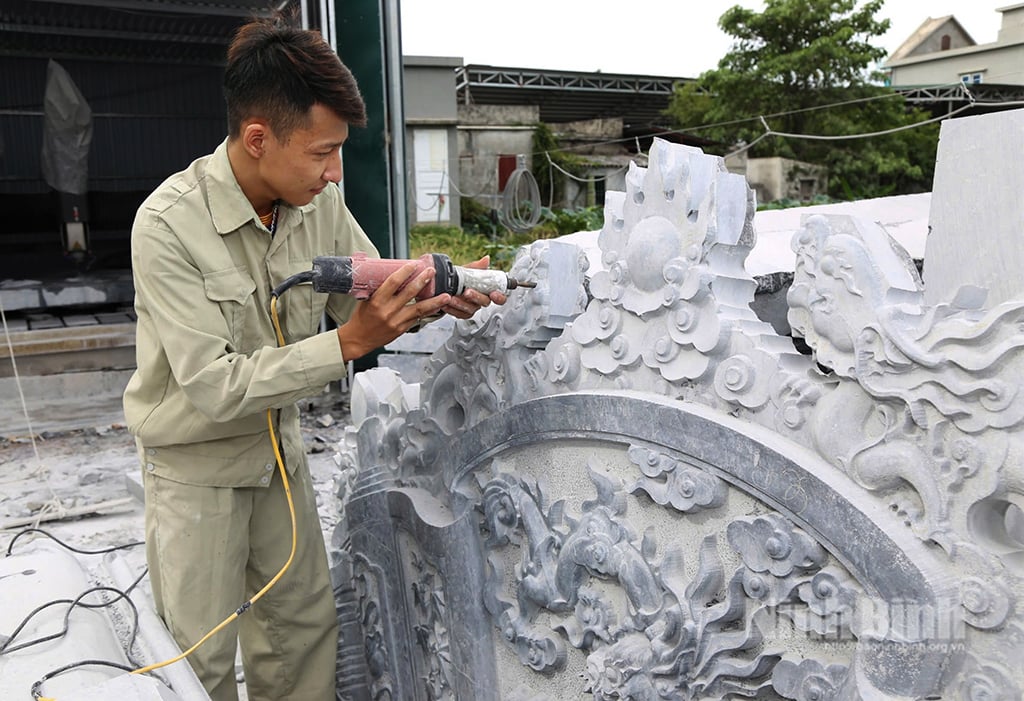
At nearly 30 years old, Duong Minh Trung has become the owner of a renowned stone carving business in Ninh Van commune (Hoa Lu city). Trung received the "Golden Hand" award for stone carving in Ninh Binh in 2020. Despite his skilled craftsmanship, Trung highly values the vocational training courses in stone carving organized by the local authorities in collaboration with vocational training institutions for stone carvers.
Trung shared that most stoneworkers in Ninh Van have known and practiced the craft since they were very young, following a "father-to-son" tradition, but not everyone understands the basic principles of painting, sculpture, etc.
Furthermore, many machines and equipment have now replaced manual labor. However, not all workers possess the in-depth knowledge to use these devices safely and effectively. If workers are not proficient in using equipment safely, it will not only affect the quality and aesthetics of the product but, worse, the worker may face risks during the course of their work.
“Furthermore, when participating in vocational training classes, learners are also guided on how to sit and hold tools correctly according to standards, instead of just sitting wherever they want as before. By sitting in the correct posture, the craftsman will be less tired and create balance in each carving detail. After training, workers have basic knowledge and high-level skills, ready to undertake orders requiring high precision with commensurate profits,” Mr. Trung said.
Mr. Do Khac The, a renowned stone craftsman in Ninh Van, shared: "In practice, the biggest weakness of Ninh Van stone craftsmen is their limited drawing skills. Therefore, when they start crafting, the products may be unbalanced, greatly affecting their aesthetics. There is still much knowledge to be learned if they want to bring the village's products to the larger market. Therefore, when the local authorities coordinated the organization of sculpting training courses, the households involved in the craft actively participated."
Essentially, the workers in Ninh Van stone carving village possess a good technical foundation, a passion for the craft, and a wealth of creativity. However, to create a beautiful product, skillful hands alone are not enough; it also requires fundamental and comprehensive knowledge and skills in each stage of the creation process.
However, similar to the situation of most other craft village workers, due to apprenticeship and training methods passed down from generation to generation, many workers have not yet acquired the basic skills and knowledge of sculpting. Many craft villages can only produce one main type of product, such as flowers, animal figures, or statues…
Having directly participated in vocational training for workers in Ninh Van stone carving village, teacher Tran Phu Thuan, Deputy Head of the Vocational Training Department, Nam Dinh Construction College, shared: When learning a trade, students will be equipped with the knowledge to create all kinds of products according to changing customer tastes. They will also be trained in selecting stone materials, using machinery safely, and especially in product orientation. With this subject, students can identify market trends to plan the production of suitable products.
Dong Huong commune (Kim Son district) is one of the localities with a relatively large area of agricultural land reclaimed for the construction of the Dong Huong Industrial Cluster. In addition to coordinating with businesses, providing vocational training, and creating jobs for approximately 700 local workers, Dong Huong commune also focuses on and strongly develops traditional craft villages, namely Dong Dac village and Huong Dao village.
In order to attract rural laborers to work in craft villages, local organizations and associations have actively and persistently encouraged workers, especially those over 40, to learn the craft. During the learning process, people not only receive guidance from artisans to improve their skills but also get updated on new designs that suit consumer tastes and, importantly, meet the requirements of export businesses.
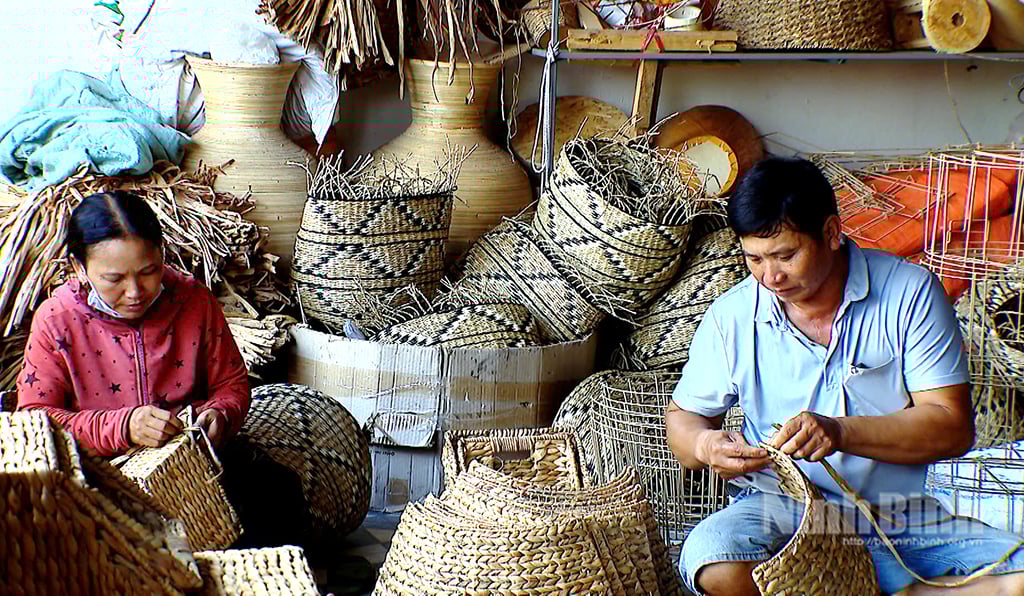
Thus, every year, Dong Huong commune coordinates the opening of vocational training classes for rural laborers, clearly differentiating between those who already have a trade for advanced training and those who do not. Therefore, the quality of the classes meets the set requirements.
In Dong Huong, the craft of weaving sedge and water hyacinth, although considered a secondary occupation, has become the main source of income for the people in the commune. Currently, the craft village employs nearly 400 people regularly, with a minimum income of 3 million VND per person per month. These are workers who are not within the age range for recruitment by businesses.
The Viet Xo Construction and Mechanical Engineering College is one of the province's vocational training institutions actively providing vocational training for workers in traditional craft villages. Mr. Nguyen Hong Phong, the school's Vice Principal, stated that the school regularly collaborates with local authorities to organize on-site vocational training classes for workers in these villages. Participants in these classes are all skilled craftsmen. Beyond developing vocational skills, the school also equips students with knowledge in material calculation, understanding the product market, accident and occupational disease prevention, and advanced skills training to produce highly sophisticated products.
Upon completing the vocational training course, workers receive a vocational certificate. With this certificate, they will have the opportunity to access bank loans and participate in a high-quality labor market. In particular, after completing the basic vocational training, if students so desire, the school will accept them for further training at the intermediate or advanced level to acquire higher-level skills, meeting the increasingly demanding requirements of the market.
According to statistics from relevant authorities, Ninh Binh province has 77 craft villages recognized by the Provincial People's Committee, the majority of which are villages producing handicrafts such as: stone carving, embroidery, sedge weaving, rattan and bamboo weaving, carpentry, ceramics, etc., requiring a high level of skill.
Over the years, along with promoting vocational training for rural workers, relevant agencies and localities have also paid great attention to vocational training for workers in traditional craft villages. With high-level skills that are in line with current trends, workers will achieve better incomes for the same unit of product.
Furthermore, a workforce that is both "professional" and "skilled" contributes to the preservation and development of traditional crafts, safeguarding the cultural essence of the homeland.
Source: https://baoninhbinh.org.vn/chat-luong-lao-dong-lang-nghe-can-chuyen-va-tinh-418358.htm
![[Image] Leaked images ahead of the 2025 Community Action Awards gala.](/_next/image?url=https%3A%2F%2Fvphoto.vietnam.vn%2Fthumb%2F1200x675%2Fvietnam%2Fresource%2FIMAGE%2F2025%2F12%2F16%2F1765882828720_ndo_br_thiet-ke-chua-co-ten-45-png.webp&w=3840&q=75)
![[Photo] Prime Minister Pham Minh Chinh receives Lao Minister of Education and Sports Thongsalith Mangnormek](/_next/image?url=https%3A%2F%2Fvphoto.vietnam.vn%2Fthumb%2F1200x675%2Fvietnam%2Fresource%2FIMAGE%2F2025%2F12%2F16%2F1765876834721_dsc-7519-jpg.webp&w=3840&q=75)
![[Photo] Prime Minister Pham Minh Chinh receives the Governor of Tochigi Province (Japan)](/_next/image?url=https%3A%2F%2Fvphoto.vietnam.vn%2Fthumb%2F1200x675%2Fvietnam%2Fresource%2FIMAGE%2F2025%2F12%2F16%2F1765892133176_dsc-8082-6425-jpg.webp&w=3840&q=75)
![[Live] 2025 Community Action Awards Gala](/_next/image?url=https%3A%2F%2Fvphoto.vietnam.vn%2Fthumb%2F1200x675%2Fvietnam%2Fresource%2FIMAGE%2F2025%2F12%2F16%2F1765899631650_ndo_tr_z7334013144784-9f9fe10a6d63584c85aff40f2957c250-jpg.webp&w=3840&q=75)

























































![[Live] Closing Ceremony and Award Presentation for the "Impressive Vietnam Tourism" Video/Clip Creation Contest 2025](https://vphoto.vietnam.vn/thumb/402x226/vietnam/resource/IMAGE/2025/12/17/1765974650260_z7273498850699-00d2fd6b0972cb39494cfa2559bf85ac-1765959338756946072104-627-0-1338-1138-crop-1765959347256801551121.jpeg)



















Comment (0)