

The Hanoi sky seemed higher and bluer, welcoming the first rays of summer sunshine, ablaze with the vibrant red blossoms of the kapok and bauhinia trees. The streets and corners of the capital, from the suburbs to the city center, were adorned with flags and flowers, celebrating the grand occasion, filled with shared joy across the three regions: Hanoi, Hue, and Saigon, and the sister city relationship between Hanoi and Dien Bien.
1. Hanoi and Dien Bien Phu are only a half-hour flight apart, but they differ greatly in weather patterns between the Northern Delta and the mountainous Northwest regions. For the past few days, or more precisely, almost a week, the skies over Dien Bien province and Dien Bien Phu city have been thick with clouds and fog, with light rain in the mornings and evenings, and cool, pleasant weather. It seems this is also the last cold spell of the season – the "Nang Ban" cold spell is approaching. Cold winds and the colors of spring have once again arrived in the land of the bauhinia flower – the "capital" of the high mountainous Northwest region.
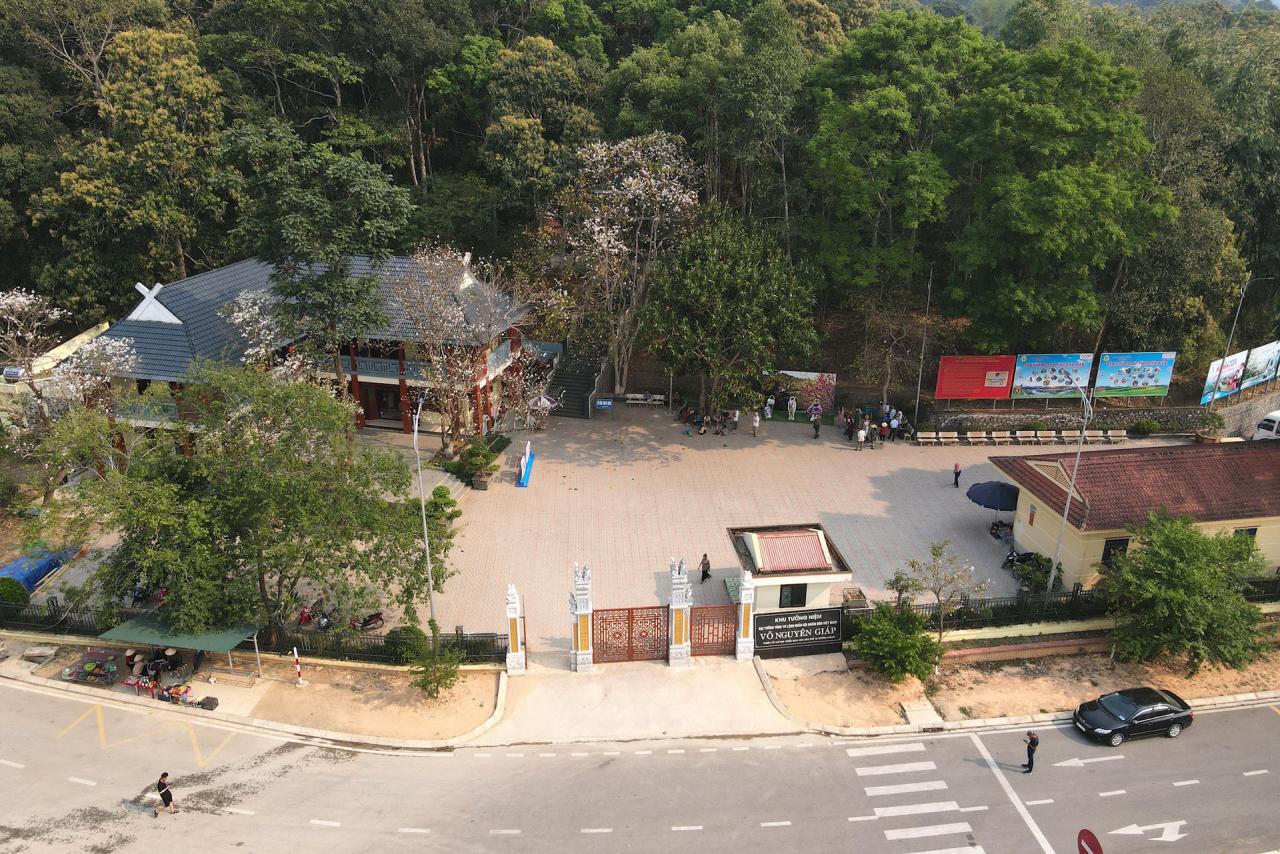
The General Vo Nguyen Giap Memorial Area is located at the Dien Bien Phu Campaign Command Headquarters in Muong Phang. Photo: Tuan Diep.
Dien Bien Airport has been upgraded, renovated, and expanded, doubling its capacity to accommodate A320 and A321 transport aircraft. It is scheduled to be operational before the Lunar New Year of 2024 and can handle half a million passengers annually. Modern air transport in Dien Bien paves the way for a thriving economy , trade, tourism, and culture, not only within the provinces of Dien Bien, Lai Chau, and Son La, but also connecting and integrating the entire Northwest region, creating new opportunities for comprehensive development.
2. The people of Dien Bien Phu city are living and working in a festive atmosphere. From Vo Nguyen Giap and Hoang Van Thai avenues to the streets and roads, everything is beautifully decorated, overflowing with the red of flags and flowers, resplendent with the vibrant colors of spring, welcoming the great festival of the country and the nation. On the faces of the children wearing red scarves carrying their books to school, or the young Tay, Thai, Mong, and Dao women, and the elderly women with blackened teeth and high buns, all radiate the confidence and pride of the masters of the country - the heroic citizens of Dien Bien.
The city of Dien Bien Phu has completed preparations to welcome millions of relatives and tourists to gather for the momentous occasion of the 70th anniversary of Victory Day. 70 years, equivalent to the average lifespan of a person – bringing people closer to the age of seventy! 70 years is not a long time compared to the history of a nation, but how many elderly men and women who once held guns, carried explosives, and pushed transport carts during the Dien Bien Phu Campaign are here today to revisit this battlefield with their comrades?!
We, the younger generation following the Dien Bien Phu Victory, were fortunate to be present in the heroic city of Dien Bien Phu on the day of the National Scientific Conference “The Dien Bien Phu Victory and the Cause of Building and Defending the Socialist Republic of Vietnam” (April 2024), chaired by the Ministry of National Defense, in coordination with Dien Bien province and central ministries and agencies. The conference reaffirmed the correct policies and wise leadership of our Party and President Ho Chi Minh; the unwavering will to fight and win, the fervent patriotism, the immense political and spiritual strength of the nation; the uniqueness and creativity of Vietnamese military art; and provided an opportunity for the entire Party, people, and army to recall the tradition of tenacious and indomitable struggle of our forefathers, and to remember the compatriots and comrades who bravely sacrificed themselves in the cause of national liberation.
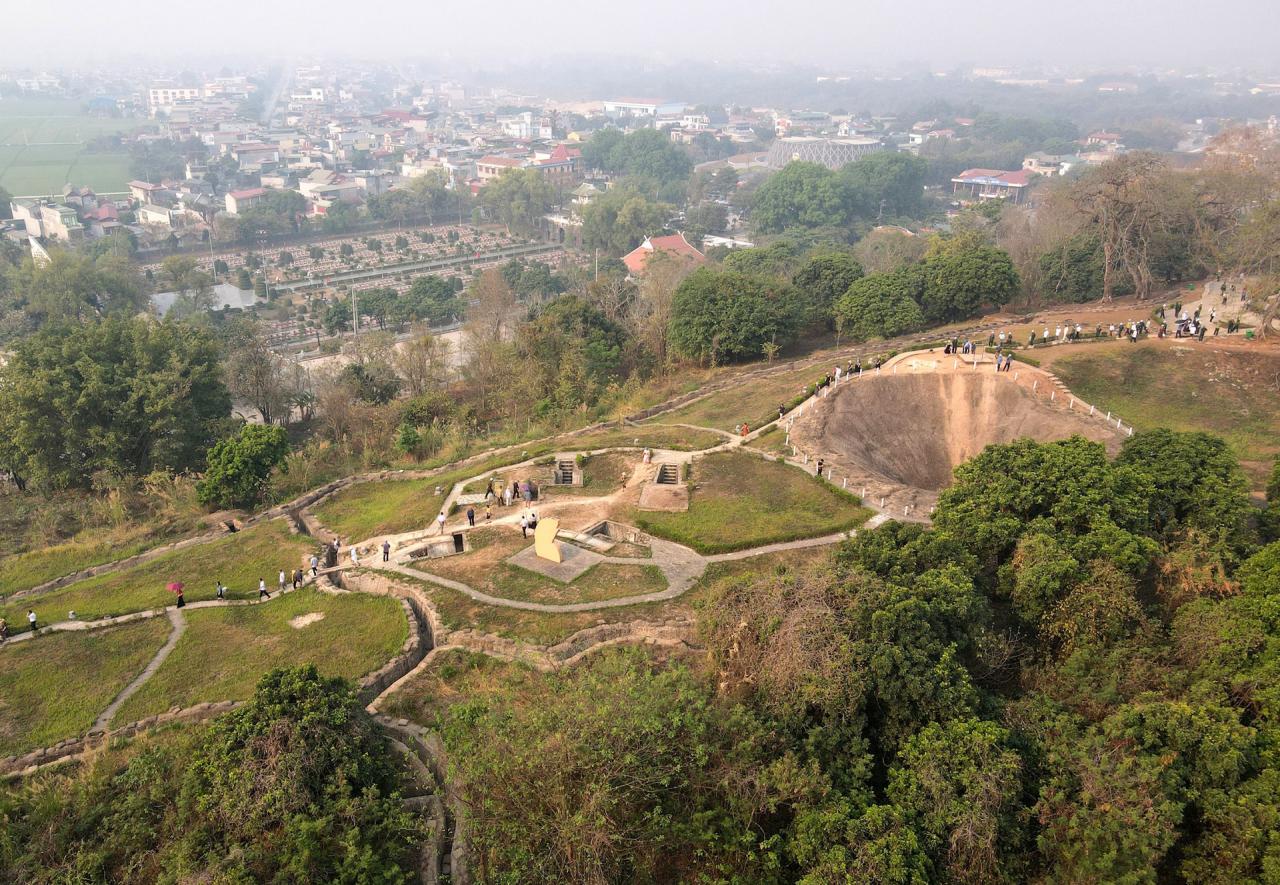
Explosion crater at the A1 Hill historical site. Photo: Tuan Diep
3. For more than half a century, Vietnam has left its mark on the world map with its honored landmarks and figures: "Vietnam - Dien Bien Phu - Ho Chi Minh - Vo Nguyen Giap". Following the August Revolution of 1945 came the Dien Bien Phu Victory of 1954, where our army and people inscribed a victory on par with the landmarks of Bach Dang, Chi Lang, Dong Da, Rach Gam, and Xoai Mut - brilliant milestones in the fight against foreign invaders, creating a golden chapter in history: "Resounding throughout the world, shaking the earth", "Nine years to create Dien Bien Phu / A red wreath of victory, a golden chapter in history".
The victory at Dien Bien Phu ended the nine-year protracted resistance war of our army and people, forcing the French colonialists to sit at the negotiating table, sign the Geneva Accords, recognize the independence, unity, and territorial integrity of the three countries: Vietnam, Laos, and Cambodia, and agree to withdraw their troops from Indochina.
The victory at Dien Bien Phu marked a crucial turning point in the history of the revolutionary struggle of Laos and Cambodia. The Dien Bien Phu victory was the pinnacle of the resistance war, with "56 days and nights of digging tunnels in the mountains, sleeping in bunkers, enduring torrential rain, and eating meager rations / Blood mixed with mud," we achieved a new miracle: a victory of national pride, a determination not to lose our country, not to be enslaved.
With the military art of "encirclement, encroachment, attack, destruction, annihilation, and annihilation," and the brilliant leadership of the Commander-in-Chief, General Vo Nguyen Giap, and the Campaign Staff, the operational strategy was changed from "quick attack, quick resolution" planned for 2 days and 3 nights to "steady attack, steady advance," and we achieved complete victory.
At 3:30 PM on May 7, 1954, our troops, advancing from all directions, bravely attacked and captured the Command Headquarters of the Dien Bien Phu fortified complex, taking General De Castries and the French Army's General Staff in Dien Bien Phu captive.

The operations center, where the Dien Bien Phu Campaign Command held its daily briefings. Photo: Tuan Diep
4. Today, Dien Bien Phu still bears the traces of the strongest fortified complex of the French colonialists at that time, located in the Dien Bien Phu basin, with 49 checkpoints on the high points. These have been preserved and restored, becoming immortal historical and cultural relics, echoing the glorious victory of "blood, mud, and flowers." These include the relics of the A1, D1, C2, Him Lam, Doc Lap, Ban Keo hills, Muong Thanh airfield, and De Castries' bunker. And there too, the Dien Bien Phu Victory Monument, the Dien Bien Phu Victory History Museum, and the Campaign Command Post in Muong Phang. Recently, the Vietnamese government completed the construction of the Dien Bien Phu Martyrs' Memorial, located on a high hill amidst the clouds and mountain winds next to A1 Hill.
In remembrance of the immense contributions of thousands upon thousands of heroic martyrs who fell to achieve the Dien Bien Phu Victory, the Party and State of Vietnam have gathered their remains to reunite with their comrades at three national martyrs' cemeteries: A1, Doc Lap, and Him Lam. Nearby is the Tong Khao Martyrs' Cemetery, which houses the remains of Vietnamese volunteer soldiers who fought and died in Laos.
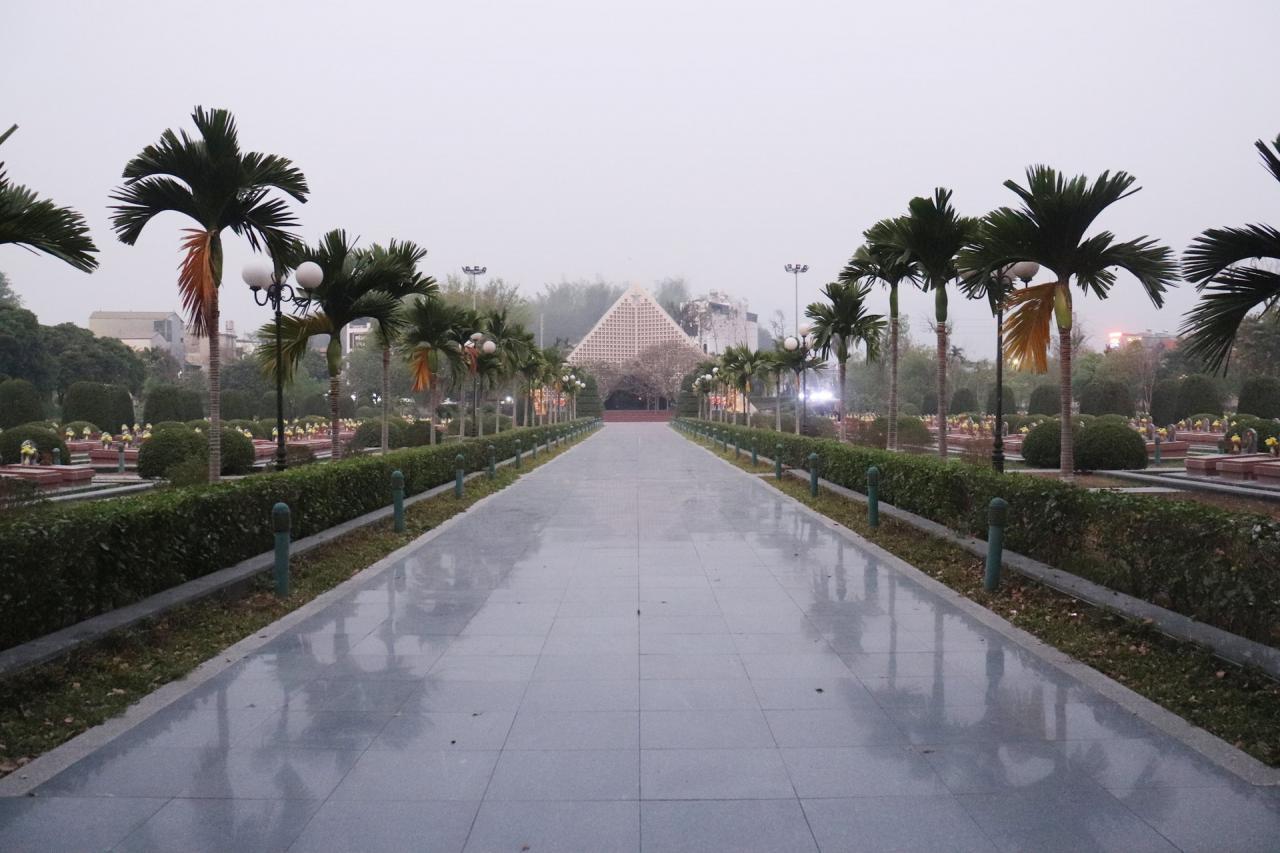
The cemetery covers an area of over 32,000 square meters , containing 644 graves of officers and soldiers who bravely sacrificed their lives in the Dien Bien Phu Campaign. Photo: Tuan Diep
The A1 Martyrs' Cemetery, the resting place of 644 heroic martyrs, only has four whose names are inscribed on tombstones: Tran Can, Phan Dinh Giot, To Vinh Dien, and Be Van Dan. The rest are "unknown" martyrs. This shows just how fierce the war was, for the bones and flesh of these heroes were "mixed with blood and mud"...
5. Over 160 years have passed since the French colonialists fired the first shots of their invasion of Vietnam (in 1858), and seven decades since the magnificent Dien Bien Phu epic was celebrated. We bid farewell to the last French soldier after the 1954 Geneva Accords. The Vietnam-France relationship has gone through many ups and downs, and is now developing deeply and effectively. Leveraging Vietnamese resilience and the flexible "Vietnamese bamboo diplomacy," we are ready to shake hands and befriend nations around the world, regardless of their political systems.
In 1973, Vietnam and France established diplomatic relations. In 2013, the Vietnam-France relationship was elevated to a Strategic Partnership. We have welcomed French Presidents on visits, including President F. Mitterand (1993), President J. Chirac (1997, 2004), and President F. Hollande (2016). The two countries have effective and comprehensive cooperation in various fields, from economic cooperation, defense and security, trade, investment, science and technology, education and training, innovation, digital transformation, green transformation, culture, and people-to-people exchanges. Economic, trade, and investment cooperation is one of the pillars of the Vietnam-France relationship, especially since the Free Trade Agreement between Vietnam and the European Union (EVFTA) came into effect (August 2020).
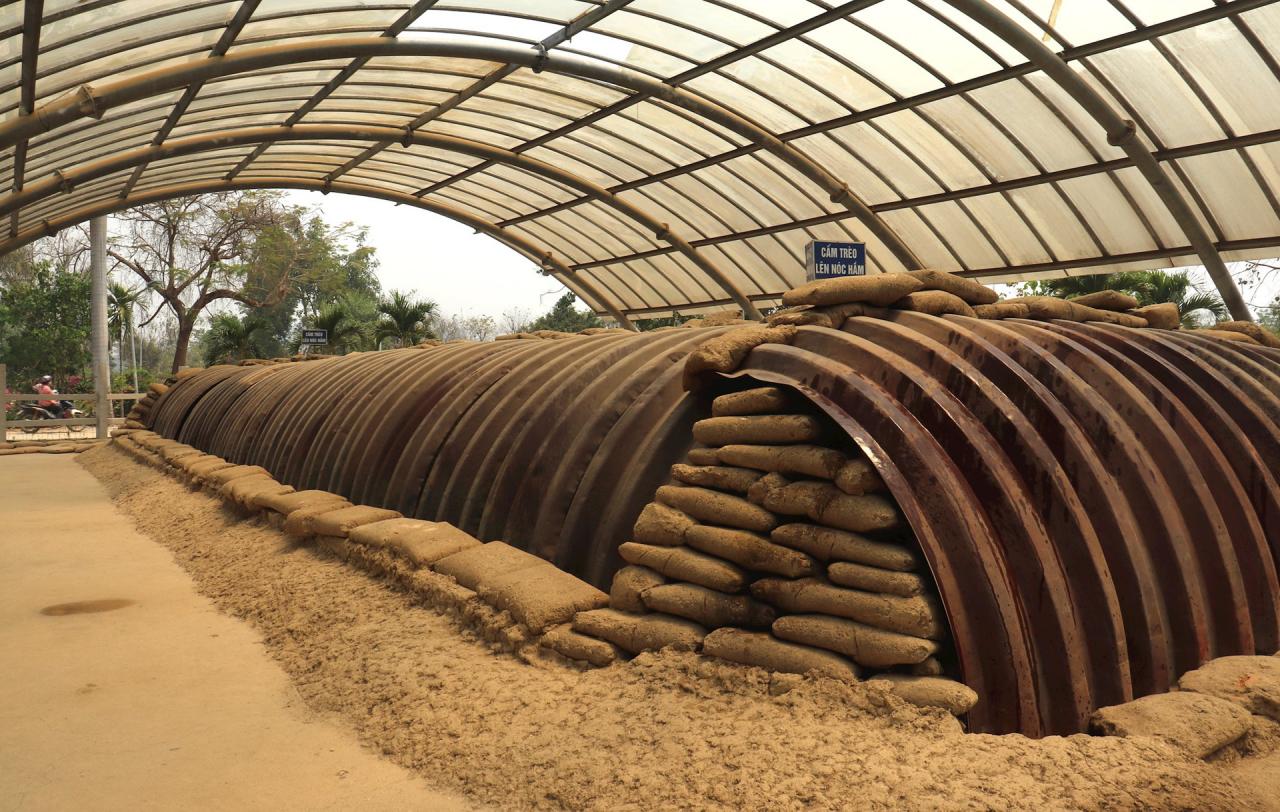
The command bunker of the Dien Bien Phu fortified complex is located in the center of the Dien Bien Phu basin. Photo: Tuan Diep
6. Visiting Dien Bien and Lai Chau is like returning to the common home of Northwest Vietnam, the homeland of the delicate and beautiful ban flower; the captivating Thai Xoe dance that enchants tourists. The Nam Rom River still flows with clear, cool water, irrigating the rice paddies of Muong Thanh, producing fragrant, sticky rice, and leading us to cultural villages and new rural areas. Dien Bien Province and Dien Bien Phu City are sister cities to Hanoi; they are the homeland of gratitude and reciprocation from provinces and cities in the spirit of the whole country joining hands and contributing for Dien Bien, Dien Bien for the whole country, so that "Muong Thanh, Hong Cum, Him Lam / The apricot blossoms are white again, the orange groves are yellow again."
The increasingly modern and well-equipped economic, commercial, tourism, and socio-cultural projects springing up in Dien Bien and Dien Bien Phu city are not only a fitting recognition and worthy compensation for the noble sacrifices of the people of various ethnic groups for independence and freedom, but also a testament to the heart, intellect, and efforts of the people of Hanoi and the entire country towards the people of the Northwest, enabling the mountainous regions to catch up with the lowlands.
In recent days, in response to the campaigns of the Central Committee of the Vietnam Fatherland Front, the Vietnam Veterans Association, various organizations, associations, agencies, units, and governments at all levels have been mobilizing and contributing to the fund to eliminate temporary and dilapidated houses and build solidarity houses for veterans, youth volunteers, and civilian workers who served in the Dien Bien Phu Campaign and their families, who are facing particular difficulties.
Suddenly, the stirring lyrics of a song came to mind: "Liberating Dien Bien Phu, our soldiers march back home / Amidst the blooming flowers, the Northwest region rejoices."
Dien Bien Phu, an immortal epic, a revolutionary torch that burns brightly forever, illuminating the hearts and minds of each and every one of us!
Source


![[Photo] General Secretary and President To Lam meets with National Assembly delegates from ethnic minorities.](https://vphoto.vietnam.vn/thumb/1200x675/vietnam/resource/IMAGE/2026/04/20/1776696701056_a1-bnd-8331-3342-jpg.webp)
![[Image] National Assembly discusses the implementation of the socio-economic development plan.](https://vphoto.vietnam.vn/thumb/1200x675/vietnam/resource/IMAGE/2026/04/20/1776696707422_ndo_br_img-20260420-185419-jpg.webp)
























































Comment (0)