

Harvesting rice at night under the lights.
In late September, floodwaters on the Cau River rose, threatening hundreds of hectares of rice paddies in the two communes of Hop Thinh and Xuan Cam. The villagers along the dike, accustomed to "living with floods," still scrambled to harvest their rice crops before the rising water level reached their peak.
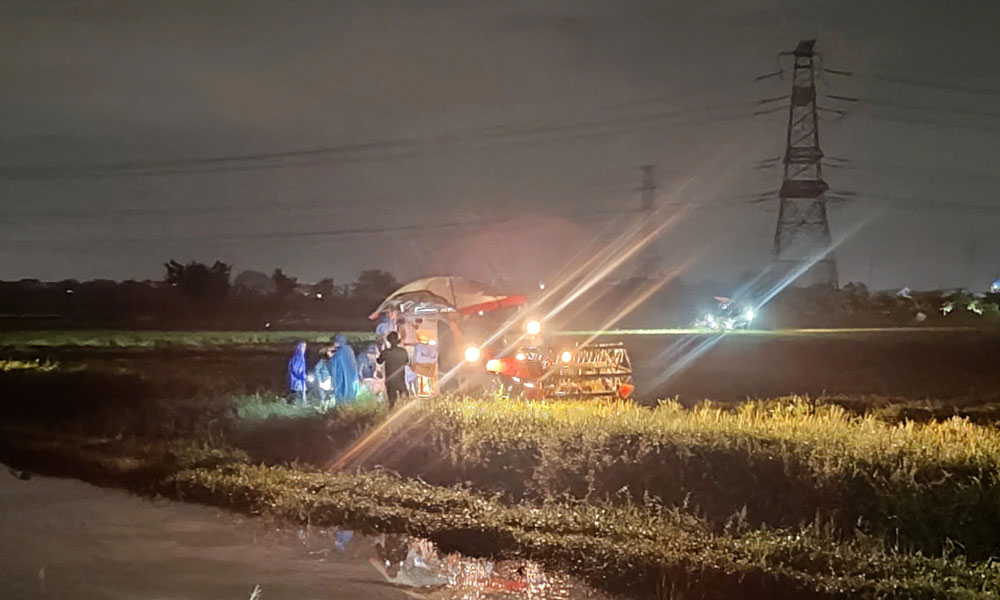 |
Farmers in Hop Thinh commune are rushing to harvest their rice before the floodwaters arrive. |
Under the direct guidance of the Party Committee and People's Committee of Hop Thinh commune, the army, militia, youth union members, and machinery went to the fields to assist farmers in harvesting rice. "The entire commune has more than 2,200 hectares of rice ready for harvest. If we don't urgently save the rice tonight, tens of tons of rice risk being completely lost," said Comrade Nguyen Van Thang, Chairman of the People's Committee of Hop Thinh commune.
The night on the Cau River was tranquil, with dozens of boats lined up, anchored close to the dike to avoid flooding. Inside the dike, the atmosphere was bustling with activity. Under the bright floodlights, combine harvesters moved around the waterlogged rice paddies, bringing sacks of rice to shore. Officers and soldiers in green uniforms waded through the fields, rhythmically transferring sacks of rice to each other.
Their clothes were soaked with rain and mud, but everyone worked tirelessly, striving to quickly harvest the rice for their fellow villagers. An Ngoc Kien, the squad leader of the Dong Dao village militia, arrived early to help the villagers harvest. He recounted: “Last year, Typhoon Yagi hit, and the fields here were completely submerged. This time, the floodwaters rose quickly, posing a great risk of flooding; the only difference is that the fields are brightly lit, the sound of the harvesting machines roaring through the quiet night, and the fear of flooding at any moment is palpable. Everyone is enthusiastic, and no one thinks about being tired.”
Mr. Nguyen Van Sang shared: “My family has 5 sao (approximately 0.5 hectares) of rice fields in this area, but we are short of manpower, and our children work far away. The rice grains aren't fully ripe yet, and it will be almost ten days before harvest, but if we delay, the flood will come and we'll lose everything. Luckily, the commune and village officials and other forces came to help, and I'm very happy.”
Thanks to timely assistance, by nearly midnight, dozens of tons of rice had been brought ashore and piled up on a dry concrete yard, waiting to dry. The night along the Cau River was tranquil, the water level still silently rising centimeter by centimeter, but in the bright lights, the farmers of Hop Thinh could rest assured that their rice had arrived ashore in time.
"Harvest site"
Not only in Hop Thinh, but from the afternoon of October 1st, many fields in Xuan Cam commune, Nen ward, and Da Mai ward also became "harvest sites" before the flood.
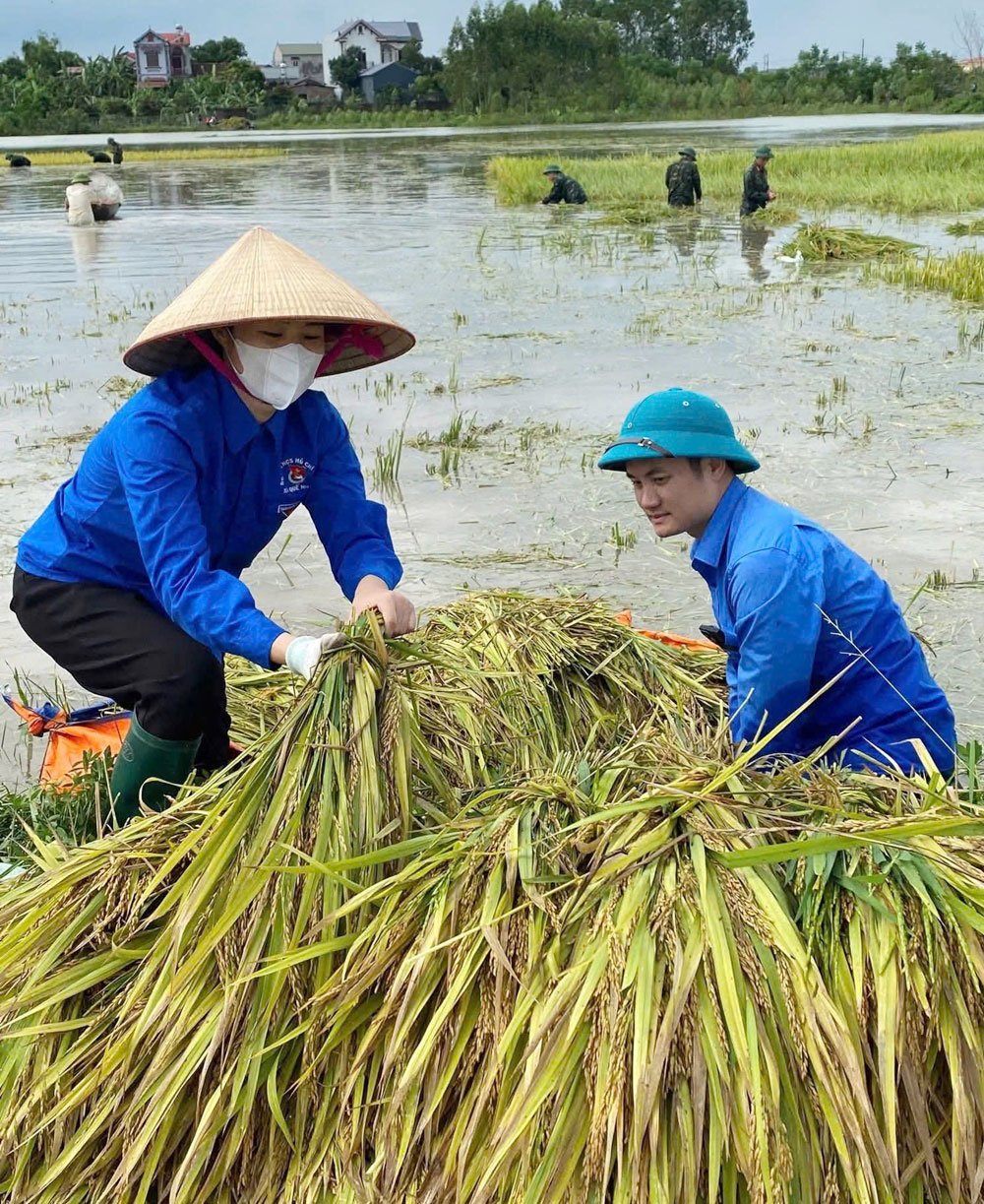 |
Youth union members from Da Mai ward help farmers harvest rice. |
Heavy rains for several consecutive days, combined with flooding from the Thuong River, have put the rice fields in Ngoc Tri residential area (Da Mai ward) at risk of severe inundation; if not harvested in time, the entire crop could be lost.
Faced with the urgent situation, nearly 200 police officers, soldiers, militia members, and members of various organizations in the area promptly and without hesitation came to help the people harvest their rice. Ms. Luong Thi Phuong, head of the Ngoc Tri residential group, said: “Our residential group has 127 households, mostly elderly and middle-aged people; the younger generation is either studying or working far away. When we heard that the flood was about to inundate the fields, the people were very worried. Fortunately, the ward mobilized forces to help, and within a few hours, the entire field was harvested.”
For the people of Ngoc Tri, this is perhaps the first time they have received support from such a large force. Comrade Do Van Quy, Chairman of the People's Committee of Da Mai Ward, who was present to directly supervise the operation, said: “We recognize that disaster prevention and control is an urgent task at this time, so we are focusing our efforts on directing and mobilizing forces to save rice crops and other assets in every way possible, striving to minimize damage to the people.”
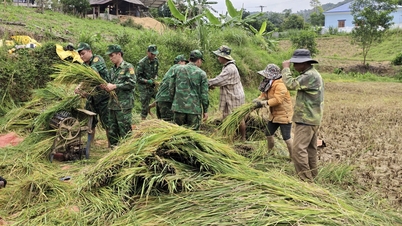
The rice harvest during the floods was fraught with difficulties. Many fields were submerged up to waist-deep, the rice stalks underwater, forcing farmers and officials to bend down to retrieve each bundle, cut, and neatly bundle them. Lacking sufficient supplies, volunteers had to use tarpaulins tied together at both ends to make makeshift "boats" to pull the rice to shore. Some officials and youth union members even suffered insect bites that left their hands swollen, yet they remained determined to stay in the fields and volunteer to help the farmers until the very end.
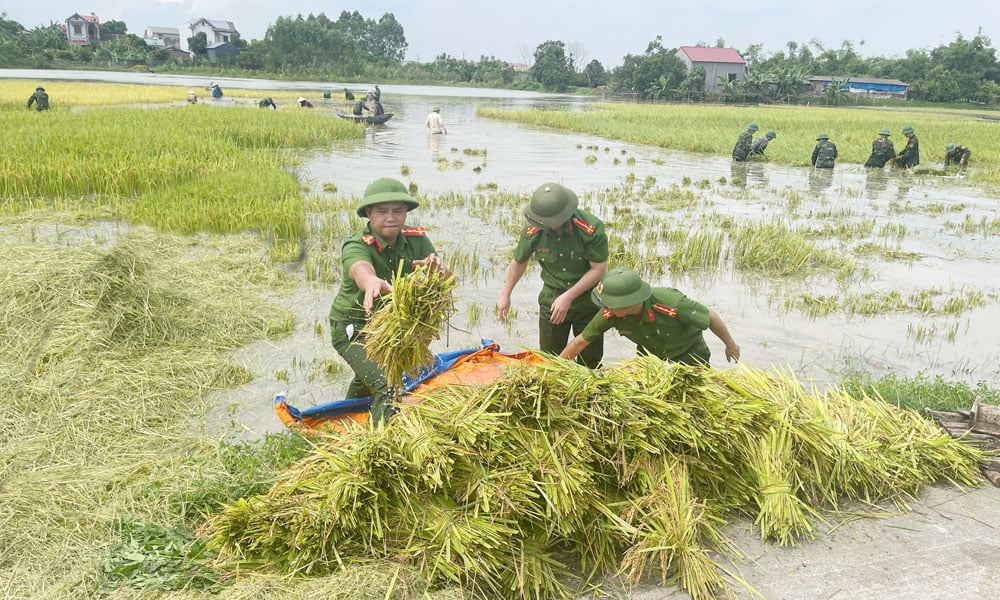 |
Forces are assisting residents of Da Mai ward in harvesting rice. |
During the harvest season, people rush to thresh their rice to escape the flood, and at night, they light lamps to carefully separate each grain. Under the light of electric bulbs powered by portable generators, the sound of threshing machines blends with the lively calls of people along the dike. The still-wet, golden grains of rice are put into sacks and safely transported home. "The harvested rice must be threshed immediately; if delayed, it will sprout and become moldy and spoiled. Families with more people help those with fewer, and officials and union members also stay to work alongside them, sometimes not resting until midnight," said Mrs. Luong Thi Phuong.
In Xuan Cam commune, the rising water level of the Cau River threatens the lives of nearly 600 households along the left bank of the Cau River, with the highest risk of flooding affecting 465 households in villages outside the dike, such as Mai Trung, Mai Thuong, and Vong Giang. On October 1st, the Xuan Cam commune police, in coordination with the commune's military forces, urgently assisted residents in harvesting crops and moving property and livestock to higher ground. Even when the floodwaters on the Cau River reached the alert level, many officers and soldiers remained on duty along the dike, disseminating information and guiding motorized vehicles away from dangerous areas. Some soldiers did not return home for days, putting aside personal matters to stay and work with their unit and the local authorities to ensure the safety of the people.
The remnants of Typhoon No. 10 affected more than 3,100 hectares of crops, including 2,500 hectares of rice that were flattened or flooded (802 hectares completely submerged), and about 600 hectares of corn, vegetables, peanuts, and fruit trees also suffered damage. Thanks to the assistance of various forces, by October 1st, farmers had harvested more than 4,000 hectares out of a total of 76,000 hectares of rice in the province.
During the floods, each sack of rice brought ashore represents not only the golden grain of the harvest but also the fruit of solidarity and sharing between the Party committee, the government, and the people. Every hectare of rice "saved" in time not only alleviates immediate worries but also preserves the fruits of months of hard work and toil by farmers in the riverside communes. With the spirit of military and civilian cooperation, these "harvesting sites" working through the night in the flooded fields are stories steeped in compassion, set against the harsh backdrop of the weather, all for the goal of protecting the rice grain – the golden grain of the fields.
Source: https://baobacninhtv.vn/chong-den-gat-lua-dem-postid427943.bbg
![[Photo] National Assembly Chairman Tran Thanh Man attends the groundbreaking ceremony for the National Highway 1A spatial axis project.](https://vphoto.vietnam.vn/thumb/1200x675/vietnam/resource/IMAGE/2026/05/19/1779161360398_ndo_br_bnd-1412-jpg.webp)
![[Photo] Capturing the moment the tide recedes at Yen Binh Son rapids - a million-year-old scenic spot in Quang Ngai.](https://vphoto.vietnam.vn/thumb/1200x675/vietnam/resource/IMAGE/2026/05/19/1779175463885_yen9-1199-jpg.webp)









































![[Photo] General Secretary and President To Lam receives Indian Defense Minister Rajnath Singh](https://vphoto.vietnam.vn/thumb/402x226/vietnam/resource/IMAGE/2026/05/19/1779184046302_anh-man-hinh-2026-05-19-luc-16-46-58.png)














Comment (0)