

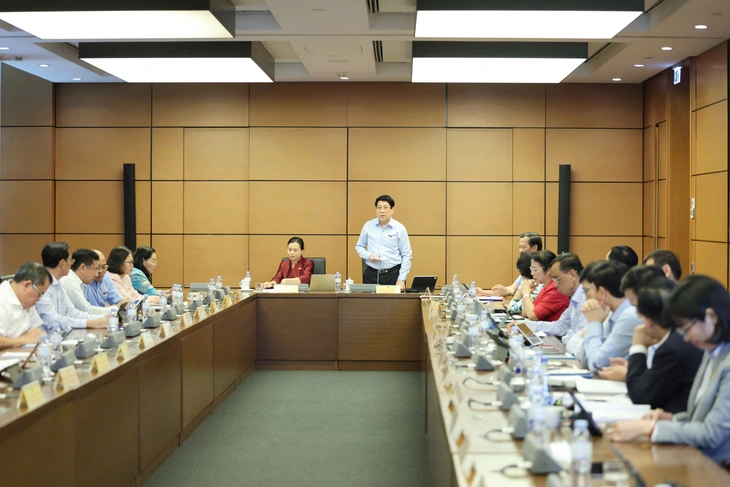
President Luong Cuong speaks at Group 2 - Ho Chi Minh City National Assembly Delegation - Photo: QP
On the morning of October 22, President Luong Cuong attended and delivered a speech at the group meeting of Group 2 - Ho Chi Minh City National Assembly Delegation.
Amendments to the law must meet the requirements of streamlining the administrative apparatus.
Commenting on the draft Law on Public Employees (amended), the President stated that the amendments must aim to meet the requirements of streamlining the administrative apparatus for greater efficiency and effectiveness, and to support the urban government model.
One of the core issues is improving the quality of civil servants and creating linkages between the public and private sectors, especially in healthcare, education , and journalism.
"The law must clearly stipulate: what the state must fully subsidize, what the state should partially support, and what can be left for units to manage independently," the President emphasized.
Drawing on his experience while serving in the military, the President shared insights into the process of restructuring public service units such as hospitals, convalescent centers, and military television stations.
He argued that a completely market-based autonomy mechanism could not be applied to units with political responsibilities.
"When I was working in the military, during the implementation of Central Committee Resolutions 18 and 19 on restructuring the apparatus and public service units, there was also a requirement for hospitals, convalescent centers, and military television stations to be self-sufficient. But I believe we must determine the purpose of these units' existence," he analyzed.
The President stated that military hospitals are established to serve national defense purposes. In case of an emergency, they can be immediately mobilized to form field medical stations.
In peacetime, they utilize their skills to provide medical care, maintain their expertise, ensure their livelihoods, and serve society. If they were completely self-sufficient under a market mechanism, they would not be able to fulfill their political mission.

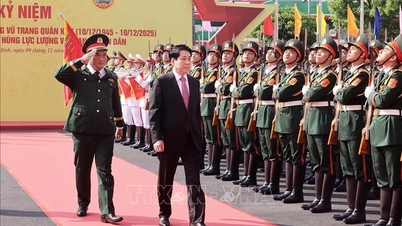
President Luong Cuong - Photo: Ministry of National Defense
According to him, the chosen solution is to maintain the existing model, only utilizing its functions to both fulfill political tasks and serve society, while ensuring the livelihoods of officials and employees. The Politburo has agreed on the use of national defense land for key national projects.
At the end of his remarks, the President stated that the standards and methods for training and developing cadres need to be reviewed.
"For leaders and managers, it's not necessary to be the best in their field, but they must be able to utilize and manage people who are more skilled than themselves. As for educators and scientists, they must be truly specialized. Vocational training must be linked to the needs of the labor market, training what society needs, not what we have," he emphasized.
Clearly state the minimum criteria.

Delegate Ha Sy Dong - Photo: GIA HAN
Speaking at the Quang Tri delegation meeting, National Assembly representative Ha Sy Dong commented that the revised Law on Public Employees demonstrates a spirit of encouraging innovation and creativity by providing mechanisms to exclude, exempt, or reduce responsibility for collectives and individuals who dare to think and act for the common good.
According to Mr. Dong, the new regulations on evaluating and ranking civil servants, which are quantitative, multidimensional, and link results to income and personnel; and require updating evaluation data to a centralized management system, will help improve transparency and encourage innovation.
The draft revised Law on Public Employees assigns the Government the responsibility to provide detailed regulations on the evaluation of public employees.
However, Mr. Dong argued that the bill should clearly state minimum mandatory criteria, such as: output results, level of task completion, citizen satisfaction index, level of digital transformation, and efficiency of financial and human resource management.
National Assembly representative Ha Sy Dong also requested the Government to soon issue a new salary framework; specifying the range, resources, and implementation roadmap.
According to him, the draft law also needs to specify a transitional provision until July 1, 2027, stating that "if an agency or unit has not completed the job placement and the establishment of a new salary scale, it must report to the competent authority and have a clear plan for rectification."
Another noteworthy new provision is that the draft law expands the rights of civil servants to allow them to sign contracts for professional activities, participate in capital contributions, and manage businesses if these are not prohibited by anti-corruption laws or if specialized laws do not provide otherwise.
While acknowledging that this new regulation is necessary, Mr. Dong also warned that it "clash of interests could easily arise."
He proposed clearly defining the reporting and approval mechanisms and the list of installation locations, as well as specifying the responsibilities of the head of the agency in controlling and handling violations.
"It is necessary to clearly define the criteria, procedures, and approval authority for after-hours professional activities of civil servants; and to have a list of positions that are absolutely prohibited to prevent conflicts of interest," Mr. Dong suggested.
In addition, Mr. Dong suggested reviewing the regulations on prohibited behaviors, especially those related to the right to participate in social and professional activities, to ensure consistency with current laws.
Source: https://tuoitre.vn/chu-tich-nuoc-can-bo-quan-ly-khong-nhat-thiet-phai-gioi-nhat-chuyen-mon-nhung-phai-biet-dung-nguoi-20251022132853348.htm
![[Photo] Prime Minister Pham Minh Chinh holds a phone call with the CEO of Russia's Rosatom Corporation.](/_next/image?url=https%3A%2F%2Fvphoto.vietnam.vn%2Fthumb%2F1200x675%2Fvietnam%2Fresource%2FIMAGE%2F2025%2F12%2F11%2F1765464552365_dsc-5295-jpg.webp&w=3840&q=75)






















































Comment (0)