

 |
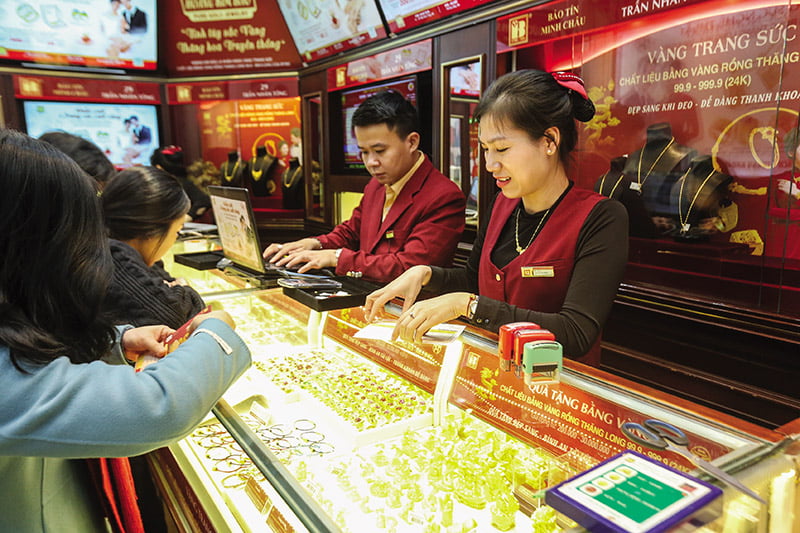
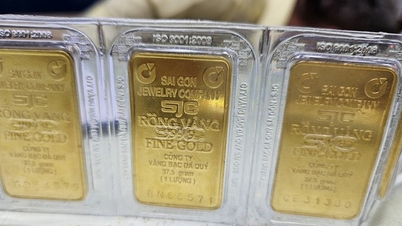
| The draft decree amending Decree 24/2012/ND-CP will eliminate the monopoly on gold bars, "unleashing" the gold market. Photo: Duc Thanh |
Does increased supply stimulate investment demand?
One of the key amendments proposed in the Draft Decree is the elimination of the monopoly on gold bars and the monopoly on the import of raw gold. Accordingly, businesses and credit institutions that meet the conditions will be allowed to import and produce gold bars.
According to the State Bank of Vietnam's explanation, the annual gold import limit will be balanced by the agency based on the macroeconomic situation, monetary policy objectives, national foreign exchange reserves, and the situation of gold bar and raw gold exports and imports.
Speaking to reporters, Dr. Nguyen Minh Phong, an economic expert, said that allowing the import of raw gold again is necessary. In fact, gold imports are not only for the production of gold bars, but also for the production of gold jewelry, with a view to export.
“Twenty years ago, Thailand’s jewelry exports exceeded $2 billion, and in 2023, they reached nearly $9 billion. The skills and capabilities of Vietnamese businesses and jewelers are not inferior. However, for a long time, Vietnam’s gold jewelry industry has been unable to import raw materials for production. Therefore, allowing the import of raw gold for production is extremely necessary,” Mr. Phong stated.
Sharing the same view, Dr. Nguyen Tri Hieu, Director of the Institute for Global Financial and Real Estate Market Development Research, affirmed that increasing the supply of gold will "unleash" businesses.
An increase in gold supply could lead people to invest more in gold, even creating a frenzy during periods of sharp increases in world gold prices. However, in the long run, according to Mr. Hieu, abolishing the monopoly and allowing the import of raw gold again will help the market become more competitive and stable. In addition, an increased gold supply will help cool down domestic gold prices, reducing the difference with world gold prices. At the same time, when gold is no longer scarce, the speculative and hoarding mentality of many people will decrease.
The draft decree also enhances transparency in gold transactions (identifying gold buyers; requiring bank transfers for transactions of 20 million VND or more; mandating the recording of gold bar serial numbers on documents, etc.). This will help verify the origin of gold transactions and limit money laundering and corruption through gold.
Be cautious with the gold market.
In its comments on the draft amendment to the Decree, the Gold Business Association recommended that the State Bank of Vietnam research and develop a legal framework and roadmap to allow the implementation of additional products to support market liquidity, such as gold futures, gold certificates, and a national gold exchange.
According to Mr. Huynh Trung Khanh, Senior Advisor to the World Gold Council (WGC) in Singapore, Indonesia, Thailand, and Vietnam, establishing a national gold exchange would rapidly reduce the difference between domestic and international gold prices. For a country with high gold consumption like Vietnam, this is essential.
However, Mr. Nguyen Minh Phong believes that establishing a gold exchange must be done with extreme caution, as Vietnam has learned a costly lesson. If not properly controlled, a gold exchange could lead to excessive speculation, causing macroeconomic instability, and making it particularly difficult to control the exchange rate.
For his part, Mr. Nguyen Tri Hieu commented that a gold exchange would make transactions more transparent, with prices updated in real time, reflecting fluctuations in world gold prices. However, if a gold exchange is established, it should only be for commodity gold, and trading in gold certificates should not be allowed due to the high risks involved.
Reportedly, the draft decree does not mention a gold exchange. The State Bank of Vietnam (SBV) stated that after the decree is issued, it will review and amend relevant regulations to create a basis for commercial banks to offer gold derivative products.
Businesses using derivative instruments will account for them in accordance with the regulations of the Ministry of Finance in Circular 210/2009/TT-BTC, which guides the application of International Accounting Standards on the presentation of financial statements and disclosure of information regarding financial instruments in Vietnam.
The State Bank of Vietnam will also coordinate with relevant agencies to consider adding gold to the list of commodities permitted for trading at the Commodity Exchange, as stipulated in Government Decree 158/2006/ND-CP dated December 28, 2006 (as amended and supplemented). Gold trading on accounts will also be studied and guided alongside the establishment of a centralized gold exchange.
The Vietnam Gold Business Association has proposed that the State Bank of Vietnam study the form of mobilizing/lending in gold. Some banks, such as Agribank and BIDV, have suggested allowing credit institutions to issue Gold Ownership Certificates to customers without requiring physical gold transactions. The delivery and receipt of gold could be carried out in the future according to an agreement between the credit institution and the customer, clearly stipulated on the certificate.
However, according to experts, the State Bank of Vietnam will not allow the mobilization and lending of gold because this would mean "goldification" of the economy.
Regarding gold safekeeping services, the State Bank of Vietnam stated that it has taken into account feedback and will study the issuance of guidelines, including amending and supplementing Circular 02/2016/TT-NHNN dated February 26, 2016, on asset safekeeping services and rental of safe deposit boxes by credit institutions.
While the USD Index continues to fall sharply globally, the VND continues to depreciate against the USD, making the calculation of gold import quotas even more cautious. However, monetary policy cannot satisfy all the demands of the economy; therefore, stabilizing both the exchange rate and the gold market is essential. "Unleashing" the gold market is reasonable, and the State Bank of Vietnam needs to maintain its highest regulatory role over the gold market, instead of directly participating in gold trading as it currently does.
- Dr. Nguyen Tri Hieu, economic expert
Source: https://baodautu.vn/coi-troi-cho-thi-truong-vang-d334025.html





![[Photo] General Secretary and President To Lam presides over a meeting on preparations for the review of one year of operation of the three-tiered government system.](https://vphoto.vietnam.vn/thumb/1200x675/vietnam/resource/IMAGE/2026/06/02/1780391821195_a1-bnd-4595-9717-jpg.webp)






















































































Comment (0)