

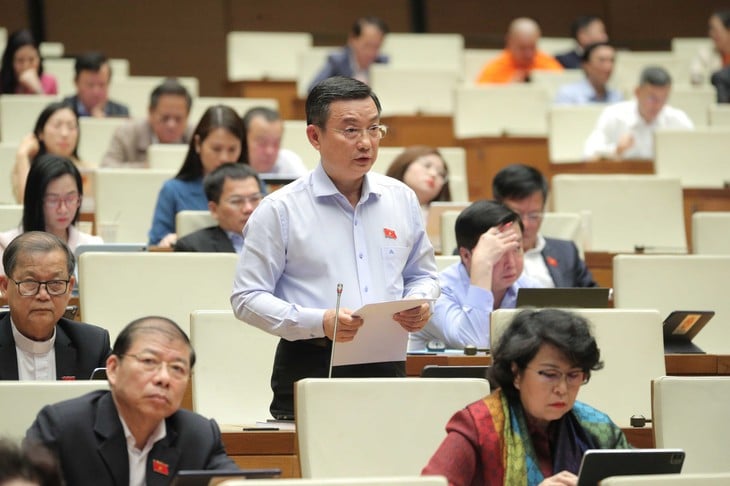
Delegate Pham Trong Nhan (HCMC) - Photo: GIA HAN
National Assembly Delegate Pham Trong Nhan (HCMC) raised this situation when discussing the Digital Transformation Law in the hall on the afternoon of December 1.
In the digital economic game, Vietnamese businesses are having to play on someone else's turf.
Agreeing with the necessity of the bill, however, according to Mr. Nhan, the draft still has some major gaps. In particular, the scope of the law is wide but unclear, easily overlapping with the Data Law and the AI Law.
According to the delegate, the public digital infrastructure has not been designed to national standards. Components such as identification - authentication, public digital payment, integration platform, data sharing, national digital signature, cloud, data center are the backbone of the digital government , but the draft has not affirmed the principle of "one standard - one platform - many services".
Along with that, it has not been determined which part is invested by the State and which part is socialized; there is no national API, so ministries, branches and localities build the system themselves, causing fragmentation and large hidden costs.
The Ho Chi Minh City delegation also pointed out that the digital economy and digital enterprises lack minimum mandatory mechanisms and maximum incentives. The digital economy is only strong when Vietnamese enterprises have data, a foundation, and the ability to innovate.
According to Mr. Nhan, currently, a very worrying reality is that 99% of Vietnamese people's digital behavioral data (travel, shopping, entertainment, consumption...) is on the ecosystem of large foreign platforms; while Vietnamese startups are "data hungry", do not have data to train AI, develop products, and compete.
"That means in the digital economic game, Vietnamese businesses are playing on someone else's turf. When data is not within one's legal borders, it is very difficult to protect digital sovereignty and develop domestic digital businesses. Without Vietnamese data, there can be no Vietnamese AI," Mr. Nhan said.
If the Law does not set out principles against data lock-in - open API - controlled data sharing, Vietnamese enterprises will be like bonsai, and the private sector will not be able to transform digitally without a mechanism for renting digital/cloud services; tax and credit incentives; and a Sandbox for new models.
From the above content, delegates proposed to supplement the principles of digital economic and digital society development in the direction of minimum mandatory combination in transactions with the State, maximum encouragement for businesses: renting digital services, cloud, sandbox.
At the same time, establish the principles of data economy: data is a new factor of production; non-personal data must be shared in aggregated and anonymous form; prevent data monopoly and data lock-in.
Be careful of inconsistent data, each place does it differently.
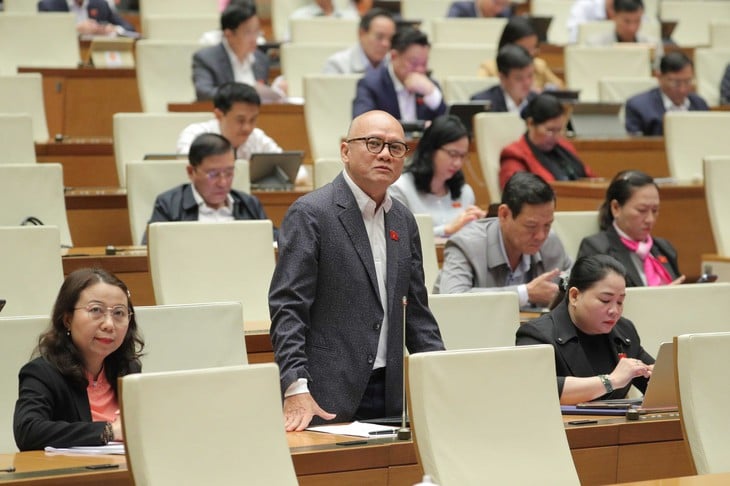
Delegate Be Trung Anh - Photo: GIA HAN
From the perspective of state management, delegate Be Trung Anh (Cao Bang) warned that when implementing strong decentralization, each locality does it differently, the data will not be unified, and if the data is not unified, it is impossible to successfully implement digital transformation.
Pointing out the conflict between laws on government organization and the draft Law on Digital Transformation, he recommended clearly stating that when there is a conflict, it is necessary to determine which law is the original law to regulate.
Regarding the development of public digital infrastructure, delegate Nguyen Tam Hung (HCMC) said that the draft stipulates that the State establishes and operates public digital infrastructure but has not clearly defined the mechanism for granting the right to exploit - use - monitor service prices for enterprises participating in the public-private partnership model.
Mr. Hung suggested considering adding the principle: service prices on public digital infrastructure must ensure transparency, non-discrimination, no monopoly advantage, and have an independent monitoring mechanism to prevent abuse of dominant infrastructure position.
"This is a key issue to avoid the risk of privatizing benefits and socializing costs in national infrastructure platforms," Mr. Hung said.
Explaining later, Minister of Science and Technology Nguyen Manh Hung said that the Law on Digital Transformation is a difficult law, and the world does not have a similar law. Therefore, the spirit of drafting the law is "short, framework law and giving flexibility to the Government".
Based on the delegates' comments, the Minister affirmed that he would remove detailed regulations and specialized technical descriptions; at the same time, he would add the missing pieces of a digital nation, which are the digital economy, digital society, and take the e-Government part of the Law on Information Technology.
"Thus, the Law on Digital Transformation is designed according to the model of a unified framework law for all national digital transformation activities, while integrating two core components: digital government, digital economy, and digital society, ensuring that there is no legal gap when the Law on Information Technology is abolished in this law," Minister Nguyen Manh Hung emphasized.
He added that current legal regulations on digital transformation are scattered across many laws, lacking a unified framework, lacking common principles, lacking minimum requirements, and especially lacking an overall coordination mechanism at the national level prescribed by law.
The Law on Digital Transformation was built, according to the Minister of Science and Technology, to create a unified legal framework for national digital transformation, ensuring digital transformation in the right direction, safely and effectively, and overcoming the situation of digital segregation and digital fragmentation on platforms.
"If we are slower in issuing digital transformation principles, if we are slower in connecting and unifying specialized laws, the blooming of a hundred flowers can ruin the overall picture of national digital transformation," said Minister Hung.
Source: https://tuoitre.vn/dai-bieu-lo-ngai-99-du-lieu-hanh-vi-nguoi-viet-o-nuoc-ngoai-doanh-nghiep-trong-nuoc-doi-du-lieu-20251201151716838.htm


![[Photo] Prime Minister Pham Minh Chinh receives President of Cuba's Latin American News Agency](/_next/image?url=https%3A%2F%2Fvphoto.vietnam.vn%2Fthumb%2F1200x675%2Fvietnam%2Fresource%2FIMAGE%2F2025%2F12%2F01%2F1764569497815_dsc-2890-jpg.webp&w=3840&q=75)


























































































Comment (0)