

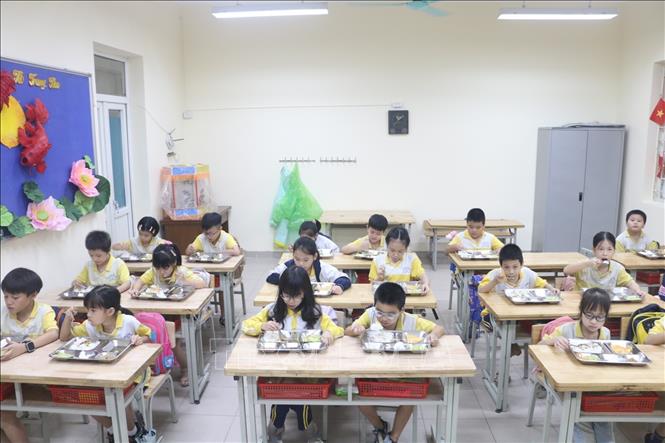
Large scale - high pressure
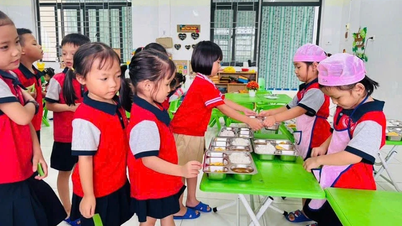
Hanoi has a large education system with nearly 2.3 million students and over 2,900 schools at all levels, of which more than 1 million students eat lunch at school across three levels: preschool, primary, and lower secondary. According to a report by the Hanoi Department of Education and Training, currently 1,455 schools organize their own meals, 647 schools partner with meal providers, and 283 schools order meals from external suppliers.
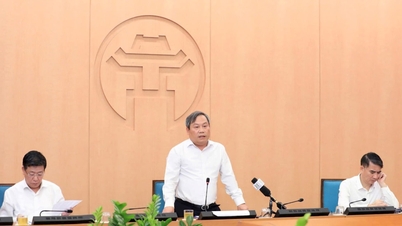
According to Ms. Vuong Huong Giang, Deputy Director of the Hanoi Department of Education and Training, the 2025-2026 school year will be the first year the city implements Resolution No. 18/2025/NQ-HĐND on the mechanism for supporting semi-boarding meals for primary school students. This is a humane policy that creates positive impacts in many aspects, helping to reduce financial pressure on parents.
“As the scale of boarding school programs increases significantly, the management requirements will certainly also need to be improved. The new policy is an impetus for schools that have already done well to now do even better in investing in facilities and equipment, standardizing one-way kitchen operations, and tightening supervision from the selection of food suppliers, preparation, processing, and distribution. The Department of Education and Training will coordinate with the Department of Health , relevant departments and agencies, and local authorities to strengthen inspections and checks to prevent the reduction of food portions or food safety issues,” Ms. Vuong Huong Giang shared.
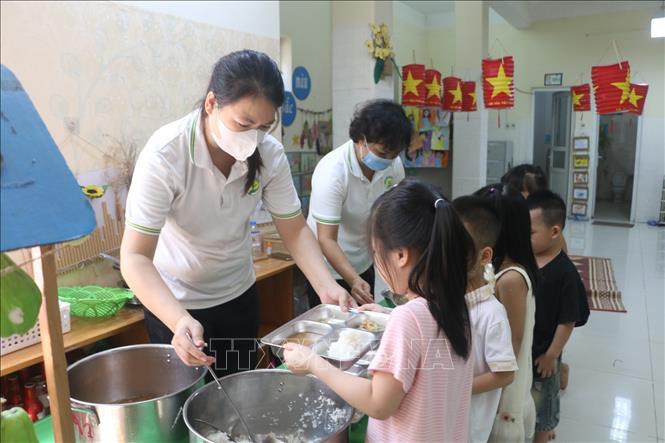
According to Vu Cao Cuong, Deputy Director of the Hanoi Department of Health, school lunch programs play a crucial role, not only in providing energy for students after school, but also directly impacting their physical, intellectual, and psychological development. Although the city has issued numerous guidelines and strengthened food safety measures in and around schools, implementation faces significant challenges, such as tracing the origin and source of food supplied to school kitchens, obtaining legal documentation for traceability of livestock farms, production and processing facilities, and the preparation and processing procedures within schools.
Most recently, when the incident of food of unknown origin being "magically" labeled as safe and then mixed in with safe food and supplied to the kitchens of some schools in Hanoi was discovered, the trust of many parents was eroded again. Although it was only a small supplier of food and the number of schools using its products was not large, many parents still felt apprehensive and worried when registering their children for school lunch programs.
“When sending our children to school, besides their academic performance, their safety is our top priority. This includes safety from injuries and food safety. We trust the school, but we still hope for stricter and more transparent supervision so that each meal for our children is not only delicious and high-quality, but above all, safe,” said Mr. Nguyen Van Viet, a parent with a child attending Dinh Cong Primary School (Dinh Cong Ward).
Sharing the same concerns about her child's meals at school, Ms. Vu Thi Le, a parent with a child attending Nghia Tan Primary School (Nghia Do Ward), believes that each meal, each afternoon snack at school, is not simply about satisfying hunger, but rather represents the parents' trust in the school – a place where their children are cared for both intellectually and physically.
"Every day when I pick up my child, I ask if they had fun at school and if they enjoyed their meal. That's something we parents care about just as much as our children's studies in class," shared Ms. Vu Thi Le.
Strict control over food inputs.
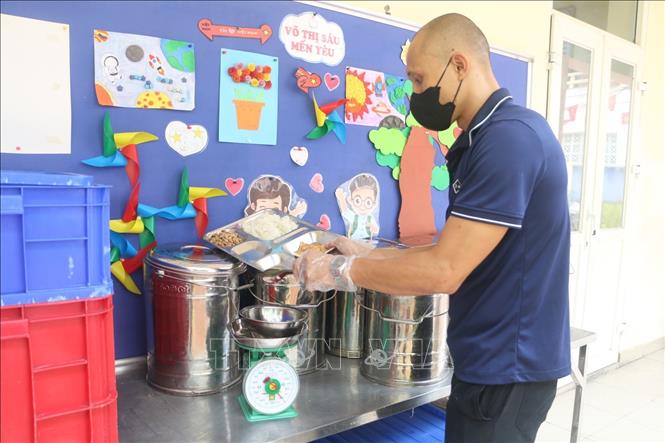
In response to parents' concerns, many schools in Hanoi have developed procedures and proactively implemented stricter food control measures right from the initial stages. Not only schools with their own kitchens, but also those that order pre-prepared meals are raising awareness in selecting suppliers and strengthening cooperation between schools, parents, and suppliers to prevent substandard food from reaching students' meals.
Teacher Nguyen Thanh Ha, Deputy Principal of Vo Thi Sau Primary School (Cua Nam Ward), said that due to limited facilities and insufficient resources to organize a canteen, the school collaborates with a provider of ready-made meals for students. For the 2025-2026 school year, the school has 373 students registered for boarding at two locations, so the organization of boarding meals is always carefully considered by the school in every aspect.
“Among the units that were assessed and selected by Cua Nam ward, we, along with parents and students, went to inspect them in person, examining the conditions and criteria, with transparency of origin and the reputation and capabilities of the businesses being prioritized. All information is publicly disclosed to parents. Only after receiving the consensus of the school staff and the parent committee did we sign the contract,” Ms. Nguyen Thanh Ha shared.
For preschool children, school lunches are even more important because the students are young children with weak immune systems. Therefore, the quality and hygiene of food in each school lunch is the "shield" protecting the children's health.
At Quan Hoa Kindergarten (Nghia Do Ward), nearly 300 preschool children eat lunch at the school every day. The entire process, from receiving ingredients to processing, takes about 2.5 to 3 hours. Food suppliers must have their documents reviewed and inspected by the Ward People's Committee. To ensure safety, the school absolutely does not accept pre-prepared food; all food must be in its original packaging and intact. If any problems are detected during processing, kitchen staff immediately report it to the school's management and health department to create a report, take photos, and request an exchange or return.
Ms. Vu Thi Kieu Nga, Principal of Quan Hoa Kindergarten, said that the school requires the kitchen staff to strictly adhere to regulations: During food preparation, kitchen staff comply with labor protection regulations and separate raw and cooked food. After cooking, samples of each meal are stored for 24 hours as per regulations, sealed, and documented for future reference. Thanks to the strict implementation of these regulations, the school has not experienced any food safety incidents to date.
In addition to internal inspections, the school annually collaborates with the district, ward, and parents to inspect food suppliers. Last September, the school inspected the milk supplier, and in October, it will inspect the food supplier. During these inspections, the school always invites parent representatives to accompany them for public monitoring. Furthermore, inspection teams from the ward People's Committee, health department, and veterinary department regularly visit the school's kitchen to conduct tests and check the procedures and records of the boarding program.
Shared responsibility
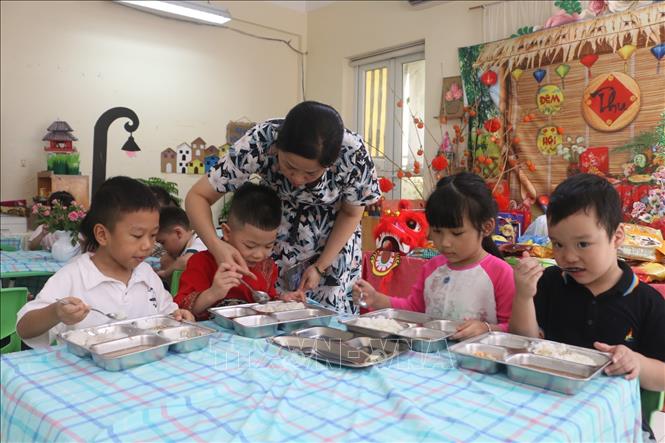
To ensure food safety in school meals, and to make every day at school a truly joyful, safe, and healthy day for students, a coordinated effort from the political system, managers, and local authorities is essential. This includes effective inspection and supervision to ensure safe food processing and food traceability.
After personally inspecting the school's lunch program, Mr. Vu Long, a parent of a 4th-grade student at Vo Thi Sau Primary School, immediately took photos and shared them on the class's parent group. Mr. Long believes that ensuring the quality of children's meals requires the joint efforts of both families and the school. This will give parents more peace of mind and confidence in the school's commitment to meal quality.
“For us, every meal for children is an important part of their education and care. Ensuring food safety is not just a regulation, but has become a responsibility and part of the school's culture,” shared teacher Vu Thi Kieu Nga, Principal of Quan Hoa Kindergarten.
Recently, the Chairman of the Hanoi People's Committee, Tran Sy Thanh, signed Decision No. 4981/QD-UBND dated October 3rd, establishing an inter-agency inspection team to oversee the organization of school lunch programs for students in schools throughout the city for the 2025-2026 school year. The team will conduct unannounced inspections from October 6th, 2025 to May 31st, 2026, across the entire city, focusing on wards and communes that provide school lunch programs for students.
The delegation will inspect the process of selecting, signing contracts, and monitoring the implementation of contracts between schools and food, milk, and bottled water suppliers; and the compliance with food safety laws and related conditions according to Guidance No. 02/BCĐ-HD of the City's Food Safety Steering Committee for the supply units.
Ensuring food safety and hygiene, as well as the quality of school lunches for students, is a mandatory requirement, closely linked to the health, physical and mental development of future generations. In the context of ongoing epidemics, food contamination, and the risk of food poisoning, tightening control over food sources, processing, storage, and sample retention becomes even more crucial.
A high-quality school lunch program is not only a measure of a school's organizational capacity, but also reflects the responsibility of the entire society in protecting children. When each meal is prepared with seriousness, transparency, and love, it is the most practical way to nurture generations of healthy, happy, and confident students.
Source: https://baotintuc.vn/giao-duc/dam-bao-chat-luong-bua-an-hoc-duong-20251009110535560.htm



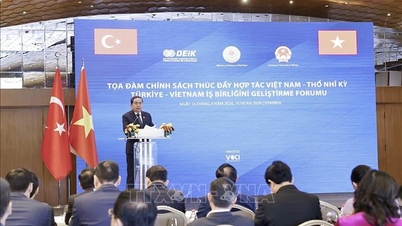
![[Photo] National Assembly Chairman Tran Thanh Man attends the policy seminar to promote Vietnam-Türkiye cooperation.](https://vphoto.vietnam.vn/thumb/1200x675/vietnam/resource/IMAGE/2026/04/16/1776351415367_vna-potal-chu-tich-quoc-hoi-tran-thanh-man-du-toa-dam-chinh-sach-thuc-day-hop-tac-viet-nam-tho-nhi-ky-8705791-jpg.webp)
![[Infographic] Details of the Hanoi-Quang Ninh High-Speed Railway Project](https://vphoto.vietnam.vn/thumb/402x226/vietnam/resource/IMAGE/2026/04/16/1776338188424_anh-man-hinh-2026-04-16-luc-18-16-10.png)











![[Image] Bridges and roads connecting the eastern part of Ho Chi Minh City](https://vphoto.vietnam.vn/thumb/1200x675/vietnam/resource/IMAGE/2026/04/16/1776328595108_ndo_br_bh-vt5-jpg.webp)























![[Photo] National Assembly Chairman Tran Thanh Man meets with the Speaker of the Georgian Parliament](https://vphoto.vietnam.vn/thumb/402x226/vietnam/resource/IMAGE/2026/04/16/1776338494029_anh-man-hinh-2026-04-16-luc-18-21-21.png)














Comment (0)