

Does your child have any of the following characteristics?
Have you ever noticed this phenomenon: When they reach middle and high school, many elementary school students who were considered top students suddenly become very average? Why can't these "model children" maintain their academic achievements?

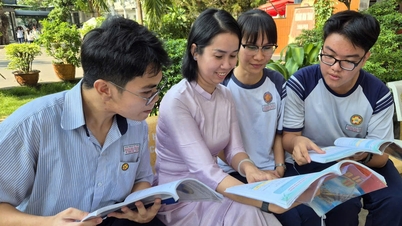
Illustrative image
1. Objective reasons: A sudden increase in the number of subjects and a significant increase in difficulty.
In primary school, the main subjects are just Math and Vietnamese, with relatively simple, visual, and easy-to-understand knowledge. As long as your child is diligent and dedicates time to studying, their academic performance will be quite stable.
However, when entering secondary school, in addition to the three main subjects, children have to study Biology, Geography, History, Physics, Chemistry, etc. If they maintain the same slow learning habits as in primary school, they will easily become overwhelmed and lead to unbalanced learning, resulting in less than expected academic results.
Furthermore, middle and high school knowledge is much deeper and broader, sometimes even abstract. If a child doesn't have good logical thinking skills, learning will become difficult, and their grades will not be high.
2. Subjective causes: Outdated learning methods and lack of proactiveness.
Some elementary school children are accustomed to being supervised and encouraged to study by teachers and parents. When they reach middle school, without close supervision, they may lack initiative in their learning. Furthermore, many children are only used to rote learning and mechanically completing assignments without understanding the essence of the knowledge. As the difficulty increases, this method of learning becomes ineffective.
Such children often struggle to keep up with the fast pace of teaching when they enter secondary school. Without good study methods, determination, and the ability to learn independently and think critically, it's very difficult for them to achieve high academic results.
What exactly constitutes a "truly excellent student"?
1. Good study habits
Many education experts have emphasized that elementary school achievements are not as important as study habits.
High level of concentration: High-achieving students are usually very focused during class, not distracted by external factors, not daydreaming or doing other things, and actively interacting with the teacher.
Effective learning: When doing homework or studying at home, children are very focused and can quickly get into the rhythm of learning without needing to be urged. In addition, habits such as preparing for class beforehand, reviewing after school, reading regularly, being diligent, and constantly improving themselves are also signs of a truly excellent student. If parents want their children to maintain their academic performance in secondary school, they need to focus on cultivating these habits from elementary school onwards.
2. Strong self-learning ability
Children who study independently versus those who are forced to study will yield completely different results.
Independent study planning: High-achieving students often have the ability to independently plan their studies, manage their progress, and proactively expand their knowledge beyond textbooks.
Set clear goals: Children are often guided from a young age to set big goals and break them down into smaller, short-term goals, such as those for each semester or month.
Self-management: High-achieving students often don't need constant supervision from parents or teachers. If their academic results aren't good, they will adjust their plans and are very disciplined. Furthermore, they proactively read reference books and seek knowledge beyond textbooks.
3. Deep thinking
Secondary and high school education requires deep, independent thinking skills, as well as the ability to analyze and synthesize information.
Problem-solving skills: When faced with a difficult problem, high-achieving students usually don't rush to ask the teacher but instead try to find a solution themselves.
Understanding the essence of knowledge: Children don't just memorize; they also delve deeper into the principles and rules behind the knowledge.
Synthesizing knowledge: High-achieving students often know how to systematize knowledge, find connections between different parts, and build their own knowledge system.
Advice for parents whose children are about to enter middle school.
Fostering proactive learning: Encourage your child to create their own study plan, independently complete assignments, and explore new knowledge.
Developing logical thinking: Expose your child to subjects that require critical thinking, such as Math and Physics, and engage them in intellectual activities like chess and puzzles.
Learn time management: Teach your child to organize their time effectively to balance studying and rest.
Encourage reading and in-depth exploration: Reading not only helps children expand their knowledge but also hones their thinking and analytical skills.
Monitoring and timely support: While it's important to encourage independence in children, parents should still closely monitor their learning process, promptly identifying and supporting them when they encounter difficulties.
Elementary school achievements are just the beginning. To help children maintain their performance in middle and high school, parents need to help them develop good study habits, strong self-learning abilities, and deep thinking skills. These factors will be key to their future success.
Source: https://giadinh.suckhoedoisong.vn/rat-nhieu-hoc-sinh-gioi-gia-o-tieu-hoc-con-ban-co-3-dac-diem-nay-thi-chuc-mung-day-la-hang-that-gia-that-172250311191333906.htm


























































![[Infographic] Vietnam's Economic Situation Report, Q1 2026: Strong Growth Momentum](https://vphoto.vietnam.vn/thumb/402x226/vietnam/resource/IMAGE/2026/04/04/1775298512042_tang-truong-kinh-te-viet-nam.jpeg)

![[Image] Close-up view of the 10-lane road connecting to Long Thanh Airport](https://vphoto.vietnam.vn/thumb/402x226/vietnam/resource/IMAGE/2026/04/04/1775291871988_ndo_br_1-resize-5690-jpg.webp)





























Comment (0)